

The Northern Adriatic Sea
383
showed a relatively great tolerance to eutrophication. In the lower sublittoral, Colpomenia sinuosa occupied considerable surfaces, particulaily in
the area around Rovinj.
It was obvious that the deterioration of fucoid stands was more severe
around Rovinj than in the Gulf of Trieste. An extinction of deep-water
fucoids was, however, observed in both areas. The main remnants at
these levels were crustose floristic elements (Lithophyllum incrustans,
Pseudolithophyllum expansum, Lithophyllum Jasciculatum, Peyssonnelia
species, Zanardinia prototypus), which had previously formed their
understorey.
In heavily polluted sites, changes in vegetation patterns were even
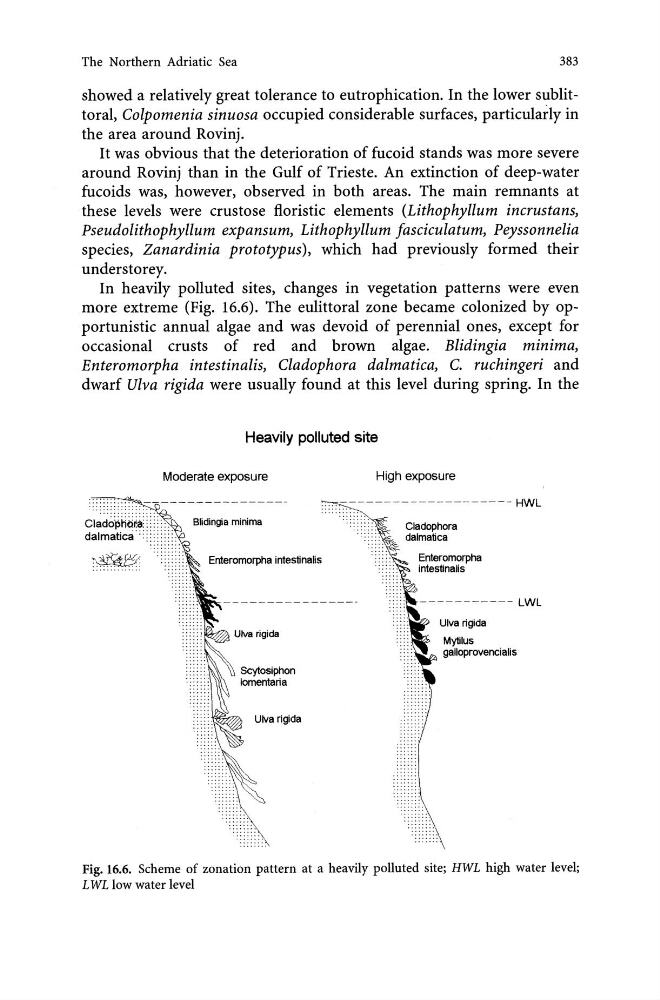
more extreme (Fig. 16.6). The eulittoral zone became colonized by opportunistic annual algae and was devoid of perennial ones, except for
occasional crusts of red and brown algae. Blidingia mlmma,
Enteromorpha intestinalis, Cladophora dalmatica, C. ruchingeri and
dwarf Ulva rigida were usually found at this level during spring. In the
Heavily polluted site
Moderate exposure
........
----------------....
Clado"pnor.a:
dalmatica';"
Blidingia minima
Enteromorpha intestinalis
Ulva rigida
High exposure
-----------lWL
Ulva rigida
Mytilus
galloprovencialis
Fig. 16.6. Scheme of zonation pattern at a heavily polluted site; HWL high water level;
L WL low water level
383
showed a relatively great tolerance to eutrophication. In the lower sublittoral, Colpomenia sinuosa occupied considerable surfaces, particulaily in
the area around Rovinj.
It was obvious that the deterioration of fucoid stands was more severe
around Rovinj than in the Gulf of Trieste. An extinction of deep-water
fucoids was, however, observed in both areas. The main remnants at
these levels were crustose floristic elements (Lithophyllum incrustans,
Pseudolithophyllum expansum, Lithophyllum Jasciculatum, Peyssonnelia
species, Zanardinia prototypus), which had previously formed their
understorey.
In heavily polluted sites, changes in vegetation patterns were even
more extreme (Fig. 16.6). The eulittoral zone became colonized by opportunistic annual algae and was devoid of perennial ones, except for
occasional crusts of red and brown algae. Blidingia mlmma,
Enteromorpha intestinalis, Cladophora dalmatica, C. ruchingeri and
dwarf Ulva rigida were usually found at this level during spring. In the
Heavily polluted site
Moderate exposure
........
----------------....
Clado"pnor.a:
dalmatica';"
Blidingia minima
Enteromorpha intestinalis
Ulva rigida
High exposure
-----------lWL
Ulva rigida
Mytilus
galloprovencialis
Fig. 16.6. Scheme of zonation pattern at a heavily polluted site; HWL high water level;
L WL low water level