

380
Relatively undisturbed site
Catenella caespitosa
Fucus virsoides
Ulva rigida
Cystoseira compressa
Ulva rigida
Cystoseira barbala
Dictyota dichotoma
HWL
lWL
Halopteris scoparia
C crinila
crustose
Peyssonnelia sPP. ...
Zanardinia protoptypus
Codiumspp.
I.M. Munda
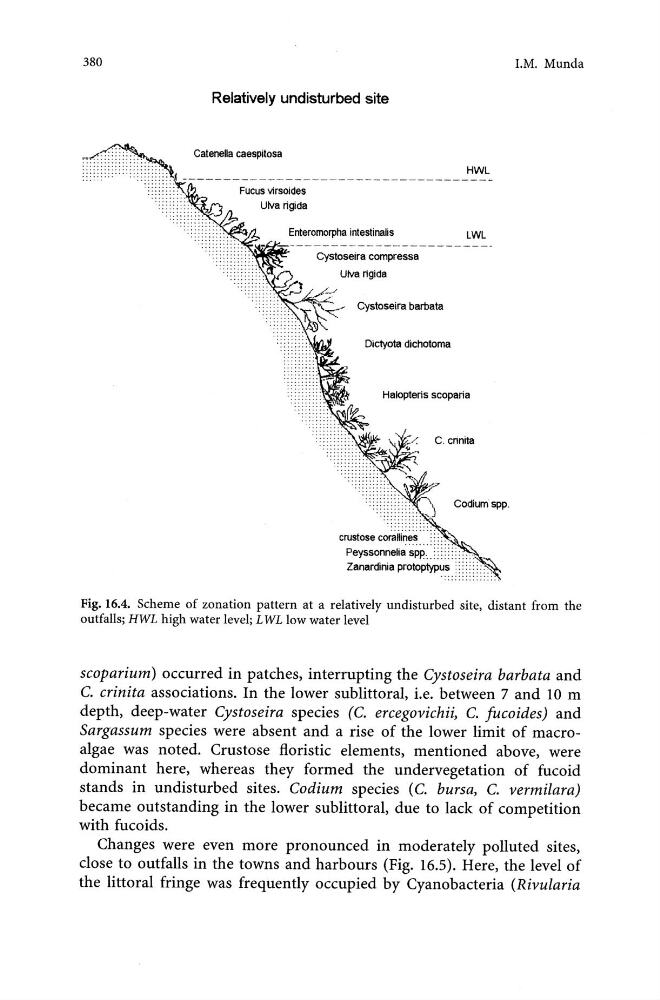
Fig. 16.4. Scheme of zonation pattern at a relatively undisturbed site, distant from the
outfalls; HWL high water level; L WI. low water level
scoparium) occurred in patches, interrupting the Cystoseira barbata and
C. crinita associations. In the lower sublittoral, i.e. between 7 and 10 m
depth, deep-water Cystoseira species (c. ercegovichii, C. fucoides) and
Sargassum species were absent and a rise of the lower limit of macroalgae was noted. Crustose floristic elements, mentioned above, were
dominant here, whereas they formed the undervegetation of fucoid
stands in undisturbed sites. Codium species (c. bursa, C. vermilara)
became outstanding in the lower sublittoral, due to lack of competition
with fucoids.
Changes were even more pronounced in moderately polluted sites,
close to outfalls in the towns and harbours (Fig. 16.5). Here, the level of
the littoral fringe was frequently occupied by Cyanobacteria (Rivularia
Relatively undisturbed site
Catenella caespitosa
Fucus virsoides
Ulva rigida
Cystoseira compressa
Ulva rigida
Cystoseira barbala
Dictyota dichotoma
HWL
lWL
Halopteris scoparia
C crinila
crustose
Peyssonnelia sPP. ...
Zanardinia protoptypus
Codiumspp.
I.M. Munda
Fig. 16.4. Scheme of zonation pattern at a relatively undisturbed site, distant from the
outfalls; HWL high water level; L WI. low water level
scoparium) occurred in patches, interrupting the Cystoseira barbata and
C. crinita associations. In the lower sublittoral, i.e. between 7 and 10 m
depth, deep-water Cystoseira species (c. ercegovichii, C. fucoides) and
Sargassum species were absent and a rise of the lower limit of macroalgae was noted. Crustose floristic elements, mentioned above, were
dominant here, whereas they formed the undervegetation of fucoid
stands in undisturbed sites. Codium species (c. bursa, C. vermilara)
became outstanding in the lower sublittoral, due to lack of competition
with fucoids.
Changes were even more pronounced in moderately polluted sites,
close to outfalls in the towns and harbours (Fig. 16.5). Here, the level of
the littoral fringe was frequently occupied by Cyanobacteria (Rivularia