

The Northern Adriatic Sea
375
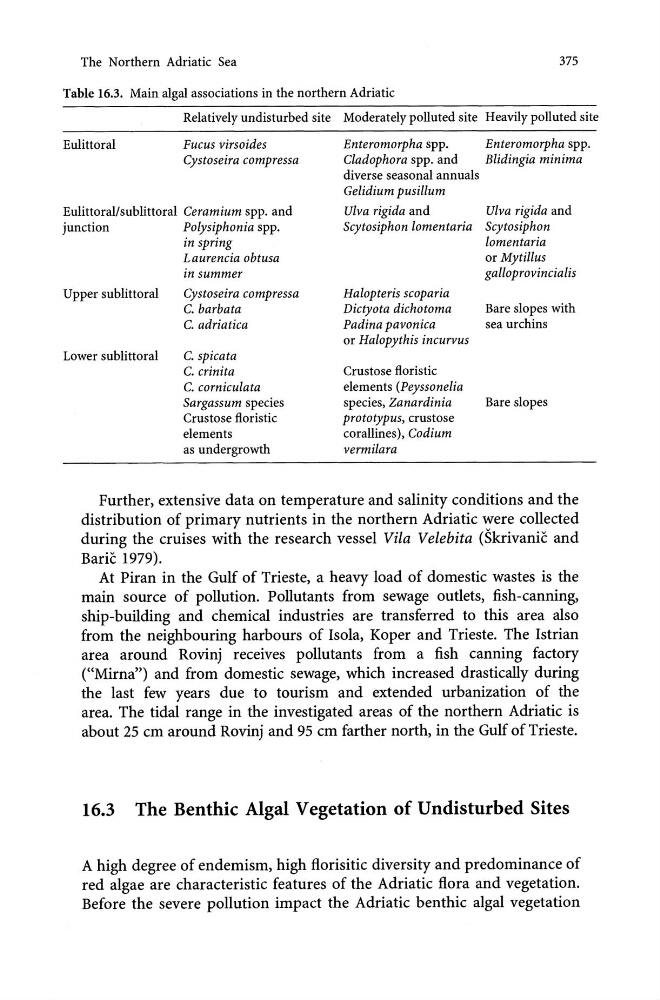
Table 16.3. Main algal associations in the northern Adriatic
Relatively undisturbed site Moderately polluted site Heavily polluted site
Eulittoral
Fucus virsoides
Cystoseira compressa
Eulittora1!sublittoral Ceramium spp. and
junction
Polysiphonia spp.
in spring
Laurencia obtusa
in summer
Upper sublittoral
Lower sublittoral
Cystoseira compressa
C. barbata
C. adriatica
C. spicata
C. crinita
C. corniculata
Sargassum species
Crustose floristic
elements
as undergrowth
Enteromorpha spp.
Enteromorpha spp.
Cladophora spp. and
Blidingia minima
diverse seasonal annuals
Gelidium pusillum
Ulva rigida and
Scytosiphon lomentaria
Halopteris scoparia
Dictyota dichotoma
Padina pavonica
or Halopythis incurvus
Crustose floristic
elements (Peyssonelia
species, Zanardinia
prototypus, crustose
corallines), Codium
vermilara
Ulva rigida and
Scytosiphon
lomentaria
or Mytillus
galloprovincialis
Bare slopes with
sea urchins
Bare slopes
Further, extensive data on temperature and salinity conditions and the
distribution of primary nutrients in the northern Adriatic were collected
during the cruises with the research vessel Vila Velebita (Skrivanic and
Baric 1979).
At Piran in the Gulf of Trieste, a heavy load of domestic wastes is the
main source of pollution. Pollutants from sewage outlets, fish-canning,
ship-building and chemical industries are transferred to this area also
from the neighbouring harbours of Isola, Koper and Trieste. The Istrian
area around Rovinj receives pollutants from a fish canning factory
("Mirna") and from domestic sewage, which increased drastically during
the last few years due to tourism and extended urbanization of the
area. The tidal range in the investigated areas of the northern Adriatic is
about 25 cm around Rovinj and 95 cm farther north, in the Gulf of Trieste.
16.3 The Benthic Algal Vegetation of Undisturbed Sites
A high degree of endemism, high florisitic diversity and predominance of
red algae are characteristic features of the Adriatic flora and vegetation.
Before the severe pollution impact the Adriatic benthic algal vegetation
375
Table 16.3. Main algal associations in the northern Adriatic
Relatively undisturbed site Moderately polluted site Heavily polluted site
Eulittoral
Fucus virsoides
Cystoseira compressa
Eulittora1!sublittoral Ceramium spp. and
junction
Polysiphonia spp.
in spring
Laurencia obtusa
in summer
Upper sublittoral
Lower sublittoral
Cystoseira compressa
C. barbata
C. adriatica
C. spicata
C. crinita
C. corniculata
Sargassum species
Crustose floristic
elements
as undergrowth
Enteromorpha spp.
Enteromorpha spp.
Cladophora spp. and
Blidingia minima
diverse seasonal annuals
Gelidium pusillum
Ulva rigida and
Scytosiphon lomentaria
Halopteris scoparia
Dictyota dichotoma
Padina pavonica
or Halopythis incurvus
Crustose floristic
elements (Peyssonelia
species, Zanardinia
prototypus, crustose
corallines), Codium
vermilara
Ulva rigida and
Scytosiphon
lomentaria
or Mytillus
galloprovincialis
Bare slopes with
sea urchins
Bare slopes
Further, extensive data on temperature and salinity conditions and the
distribution of primary nutrients in the northern Adriatic were collected
during the cruises with the research vessel Vila Velebita (Skrivanic and
Baric 1979).
At Piran in the Gulf of Trieste, a heavy load of domestic wastes is the
main source of pollution. Pollutants from sewage outlets, fish-canning,
ship-building and chemical industries are transferred to this area also
from the neighbouring harbours of Isola, Koper and Trieste. The Istrian
area around Rovinj receives pollutants from a fish canning factory
("Mirna") and from domestic sewage, which increased drastically during
the last few years due to tourism and extended urbanization of the
area. The tidal range in the investigated areas of the northern Adriatic is
about 25 cm around Rovinj and 95 cm farther north, in the Gulf of Trieste.
16.3 The Benthic Algal Vegetation of Undisturbed Sites
A high degree of endemism, high florisitic diversity and predominance of
red algae are characteristic features of the Adriatic flora and vegetation.
Before the severe pollution impact the Adriatic benthic algal vegetation