

350
A. Sfriso and A. Marcomini
Polysiphonia sanguinea. These species, except for Gracilaria, are small
and tube or ribbon-like in strucutre, and rarely reach biomasses higher
than 2-3 kg m -2 (wet weight). The areas inhibited by these species were
always flushed by tidal currents and never experienced anoxic conditions
typical of the areas covered by Ulva.
Spatial distribution of these main macroalgal associations are continuously changing over time: the Ulva association expanded from the 1970s
until 1990. During the last 5 years, however, this association regressed.
The main cause was meteorological conditions unfavourable for Ulva
growth during the April-May period that enhanced water turbidity by
sediment resuspension and phytoplankton blooms. Nowadays, the coverage
and growth of Ulva appear primarily governed by natural factors such as
the increased sedimentation rates due to the decreased biomass coverage
and the grazer pressure enhanced by the disappearance of anoxic crisis
(Sfriso and Marcomini 1995). Moreover, biomass harvesting may playa
key role in areas affected by quick biomass increases.
15.4 Macroalgal Production and Nutrient Cycling
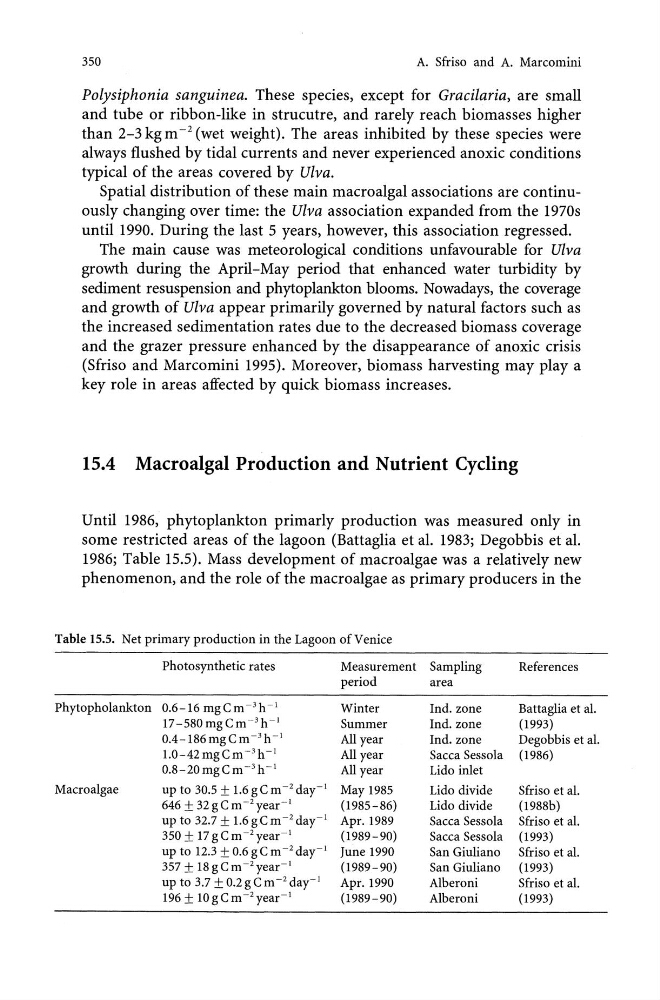
Until 1986, phytoplankton primarly production was measured only in
some restricted areas of the lagoon (Battaglia et al. 1983; Degobbis et al.
1986; Table 15.5). Mass development of macro algae was a relatively new
phenomenon, and the role of the macro algae as primary producers in the
Table 15.5. Net primary production in the Lagoon of Venice
Photosynthetic rates
Measurement Sampling
References
period
area
Phytopholankton 0.6-16 mgCm- 3 h- 1
Winter
Ind. zone
Battaglia et al.
17 -580 mg C m -3 h- 1
Summer
Ind. zone
(1993)
OA-186mgCm- 3 h- 1
All year
Ind. zone
Degobbis et al.
1.0-42mgCm- 3 h- 1
All year
Sacca Sessola (1986)
0.8-20mgCm- 3 h- 1
All year
Lido inlet
Macroalgae
up to 30.5 ± 1.6 gC m- 2 day-1 May 1985
Lido divide
Sfriso et al.
646 ± 32gCm- 2 year- 1
(1985-86)
Lido divide
(1988b)
up to 32.7 ± 1.6 gCm- 2 day-1 Apr. 1989
Sacca Sessola Sfriso et al.
350 ± 17 gCm- 2 year- 1
(1989-90)
Sacca Sessola (1993)
up to 12.3 ± 0.6gCm- 2 day-1 June 1990
San Giuliano Sfriso et aI.
357 ± 18gCm-2yeac 1
(1989-90)
San Giuliano (1993)
up to 3.7 ± 0.2 g C m -2 day-1
Apr. 1990
Alberoni
Sfriso et al.
196± lOgCm- 2 year- 1
(1989-90)
Alberoni
(1993)
A. Sfriso and A. Marcomini
Polysiphonia sanguinea. These species, except for Gracilaria, are small
and tube or ribbon-like in strucutre, and rarely reach biomasses higher
than 2-3 kg m -2 (wet weight). The areas inhibited by these species were
always flushed by tidal currents and never experienced anoxic conditions
typical of the areas covered by Ulva.
Spatial distribution of these main macroalgal associations are continuously changing over time: the Ulva association expanded from the 1970s
until 1990. During the last 5 years, however, this association regressed.
The main cause was meteorological conditions unfavourable for Ulva
growth during the April-May period that enhanced water turbidity by
sediment resuspension and phytoplankton blooms. Nowadays, the coverage
and growth of Ulva appear primarily governed by natural factors such as
the increased sedimentation rates due to the decreased biomass coverage
and the grazer pressure enhanced by the disappearance of anoxic crisis
(Sfriso and Marcomini 1995). Moreover, biomass harvesting may playa
key role in areas affected by quick biomass increases.
15.4 Macroalgal Production and Nutrient Cycling
Until 1986, phytoplankton primarly production was measured only in
some restricted areas of the lagoon (Battaglia et al. 1983; Degobbis et al.
1986; Table 15.5). Mass development of macro algae was a relatively new
phenomenon, and the role of the macro algae as primary producers in the
Table 15.5. Net primary production in the Lagoon of Venice
Photosynthetic rates
Measurement Sampling
References
period
area
Phytopholankton 0.6-16 mgCm- 3 h- 1
Winter
Ind. zone
Battaglia et al.
17 -580 mg C m -3 h- 1
Summer
Ind. zone
(1993)
OA-186mgCm- 3 h- 1
All year
Ind. zone
Degobbis et al.
1.0-42mgCm- 3 h- 1
All year
Sacca Sessola (1986)
0.8-20mgCm- 3 h- 1
All year
Lido inlet
Macroalgae
up to 30.5 ± 1.6 gC m- 2 day-1 May 1985
Lido divide
Sfriso et al.
646 ± 32gCm- 2 year- 1
(1985-86)
Lido divide
(1988b)
up to 32.7 ± 1.6 gCm- 2 day-1 Apr. 1989
Sacca Sessola Sfriso et al.
350 ± 17 gCm- 2 year- 1
(1989-90)
Sacca Sessola (1993)
up to 12.3 ± 0.6gCm- 2 day-1 June 1990
San Giuliano Sfriso et aI.
357 ± 18gCm-2yeac 1
(1989-90)
San Giuliano (1993)
up to 3.7 ± 0.2 g C m -2 day-1
Apr. 1990
Alberoni
Sfriso et al.
196± lOgCm- 2 year- 1
(1989-90)
Alberoni
(1993)