

Italy - The Lagoon of Venice
15.3 Temporal Changes of Algal Typology
and Associations
343
Wastewater discharges and the severe hydrodynamic alteration induced
by dredging new canals in the central lagoon caused strong selection
among the animal and plant species. In particular, a vertical compression
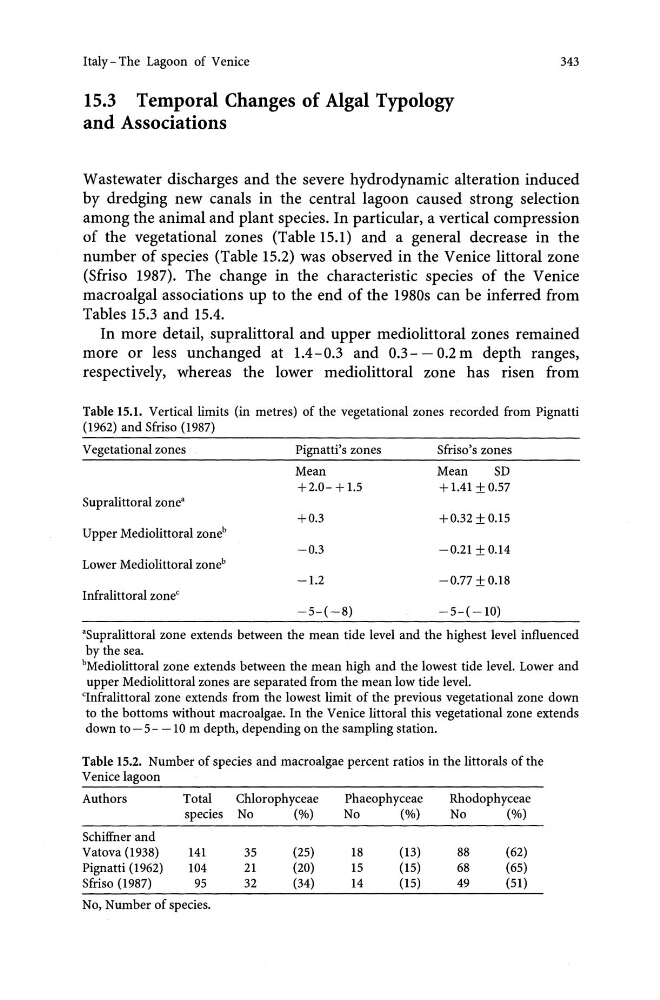
of the vegetational zones (Table 15.1) and a general decrease in the
number of species (Table 15.2) was observed in the Venice littoral zone
(Sfriso 1987). The change in the characteristic species of the Venice
macro algal associations up to the end of the 1980s can be inferred from
Tables 15.3 and 15.4.
In more detail, supralittoral and upper mediolittoral zones remained
more or less unchanged at 1.4 - 0.3 and 0.3 - - 0.2 m depth ranges,
respectively, whereas the lower mediolittoral zone has risen from
Table 15.1. Vertical limits (in metres) of the vegetational zones recorded from Pignatti
(1962) and Sfriso (1987)
Vegetational zones
Pignatti's zones
Sfriso's zones
Mean
Mean
SD
+2.0- +1.5
+1.41 ± 0.57
Supralittoral zone"
+0.3
+0.32 ± 0.15
Upper Mediolittoral zone b
-0.3
-0.21 ±0.14
Lower Mediolittoral zone b
-1.2
-0.77±0.18
Infralittoral zone c
-5-(-8)
-5-(-10)
"Supralittoral zone extends between the mean tide level and the highest level influenced
by the sea.
bMediolittoral zone extends between the mean high and the lowest tide level. Lower and
upper Mediolittoral zones are separated from the mean low tide level.
cInfralittoral zone extends from the lowest limit of the previous vegetational zone down
to the bottoms without macroalgae. In the Venice littoral this vegetational zone extends
down to - 5 - - 10 m depth, depending on the sampling station.
Table 15.2. Number of species and macroalgae percent ratios in the littorals of the
Venice lagoon
Authors
Schiffner and
Vatova (1938)
Pignatti (1962)
Sfriso (1987)
Total
species
141
104
95
No, Number of species.
Chlorophyceae
No
(%)
35
21
32
(25)
(20)
(34)
Phaeophyceae
No
(%)
18
15
14
(13)
(15)
(15)
Rhodophyceae
No
(%)
88
68
49
(62)
(65)
(51)
15.3 Temporal Changes of Algal Typology
and Associations
343
Wastewater discharges and the severe hydrodynamic alteration induced
by dredging new canals in the central lagoon caused strong selection
among the animal and plant species. In particular, a vertical compression
of the vegetational zones (Table 15.1) and a general decrease in the
number of species (Table 15.2) was observed in the Venice littoral zone
(Sfriso 1987). The change in the characteristic species of the Venice
macro algal associations up to the end of the 1980s can be inferred from
Tables 15.3 and 15.4.
In more detail, supralittoral and upper mediolittoral zones remained
more or less unchanged at 1.4 - 0.3 and 0.3 - - 0.2 m depth ranges,
respectively, whereas the lower mediolittoral zone has risen from
Table 15.1. Vertical limits (in metres) of the vegetational zones recorded from Pignatti
(1962) and Sfriso (1987)
Vegetational zones
Pignatti's zones
Sfriso's zones
Mean
Mean
SD
+2.0- +1.5
+1.41 ± 0.57
Supralittoral zone"
+0.3
+0.32 ± 0.15
Upper Mediolittoral zone b
-0.3
-0.21 ±0.14
Lower Mediolittoral zone b
-1.2
-0.77±0.18
Infralittoral zone c
-5-(-8)
-5-(-10)
"Supralittoral zone extends between the mean tide level and the highest level influenced
by the sea.
bMediolittoral zone extends between the mean high and the lowest tide level. Lower and
upper Mediolittoral zones are separated from the mean low tide level.
cInfralittoral zone extends from the lowest limit of the previous vegetational zone down
to the bottoms without macroalgae. In the Venice littoral this vegetational zone extends
down to - 5 - - 10 m depth, depending on the sampling station.
Table 15.2. Number of species and macroalgae percent ratios in the littorals of the
Venice lagoon
Authors
Schiffner and
Vatova (1938)
Pignatti (1962)
Sfriso (1987)
Total
species
141
104
95
No, Number of species.
Chlorophyceae
No
(%)
35
21
32
(25)
(20)
(34)
Phaeophyceae
No
(%)
18
15
14
(13)
(15)
(15)
Rhodophyceae
No
(%)
88
68
49
(62)
(65)
(51)