

France - The Mediterranean Lagoons
50~~-----------------,
Salinity
40
30
iil
0.. 20
10
Diana Urbino 1 Urbino2 Palo S BIlJJ.UIa N
20~--~---------------,
P.rtlculate C
Iliana Urbina 1 Urbino2 Palo S BIi!NIIa N
0,6 P04-P
"" 'E 0,4
-c
C)
E 0,2
Diana Urbino 1 Urbino2 Palo S BII!JJgia N
313
15r.7~~~~~--------~
N02-N +N03-N
"" 10
'E
-c
C)
E 5
Diana Urblno 1 Urbino2 Palo S I!II!NlIa N
4 ....,P=-.-rt"""'c-u..,...'.-te---:N,.,..-----------...,
Diana Urbino 1 Urbino2 Palo S BIi!NIIa N
15r=~~~------------~
"" 10
'E
-c
C)
E 5
Diana Urbina 1 Urbino2 Palo S BIi!NIIa N
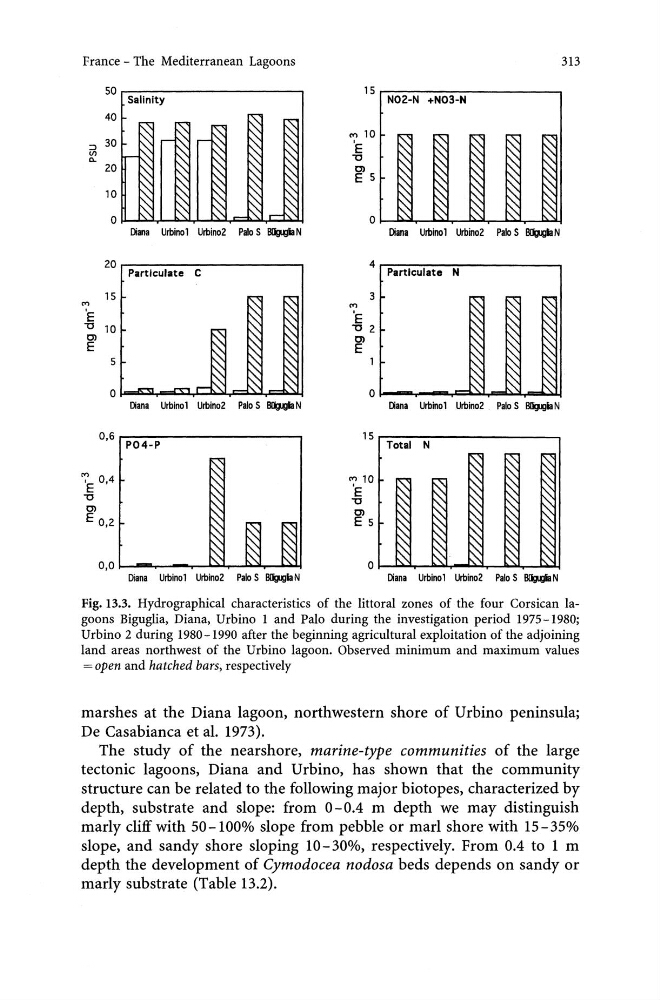
Fig. 13.3. Hydrographical characteristics of the littoral zones of the four Corsican lagoons Biguglia, Diana, Urbino 1 and Palo during the investigation period 1975-1980;
Urbino 2 during 1980-1990 after the beginning agricultural exploitation of the adjoining
land areas northwest of the Urbino lagoon. Observed minimum and maximum values
= open and hatched bars, respectively
marshes at the Diana lagoon, northwestern shore of Urbino peninsula;
De Casabianca et al. 1973).
The study of the nearshore, marine-type communities of the large
tectonic lagoons, Diana and Urbino, has shown that the community
structure can be related to the following major biotopes, characterized by
depth, substrate and slope: from 0-0.4 m depth we may distinguish
marly cliff with 50 -100% slope from pebble or marl shore with 15 - 35%
slope, and sandy shore sloping 10 - 30%, respectively. From 0.4 to 1 m
depth the development of Cymodocea nodosa beds depends on sandy or
marly substrate (Table 13.2).
50~~-----------------,
Salinity
40
30
iil
0.. 20
10
Diana Urbino 1 Urbino2 Palo S BIlJJ.UIa N
20~--~---------------,
P.rtlculate C
Iliana Urbina 1 Urbino2 Palo S BIi!NIIa N
0,6 P04-P
"" 'E 0,4
-c
C)
E 0,2
Diana Urbino 1 Urbino2 Palo S BII!JJgia N
313
15r.7~~~~~--------~
N02-N +N03-N
"" 10
'E
-c
C)
E 5
Diana Urblno 1 Urbino2 Palo S I!II!NlIa N
4 ....,P=-.-rt"""'c-u..,...'.-te---:N,.,..-----------...,
Diana Urbino 1 Urbino2 Palo S BIi!NIIa N
15r=~~~------------~
"" 10
'E
-c
C)
E 5
Diana Urbina 1 Urbino2 Palo S BIi!NIIa N
Fig. 13.3. Hydrographical characteristics of the littoral zones of the four Corsican lagoons Biguglia, Diana, Urbino 1 and Palo during the investigation period 1975-1980;
Urbino 2 during 1980-1990 after the beginning agricultural exploitation of the adjoining
land areas northwest of the Urbino lagoon. Observed minimum and maximum values
= open and hatched bars, respectively
marshes at the Diana lagoon, northwestern shore of Urbino peninsula;
De Casabianca et al. 1973).
The study of the nearshore, marine-type communities of the large
tectonic lagoons, Diana and Urbino, has shown that the community
structure can be related to the following major biotopes, characterized by
depth, substrate and slope: from 0-0.4 m depth we may distinguish
marly cliff with 50 -100% slope from pebble or marl shore with 15 - 35%
slope, and sandy shore sloping 10 - 30%, respectively. From 0.4 to 1 m
depth the development of Cymodocea nodosa beds depends on sandy or
marly substrate (Table 13.2).