

The Spanish Mediterranean Coasts
299
~',
\
"
\
,
\
,
\
'Ebro river \
:
'c::::::~s:.'.
,
N
i
5Km
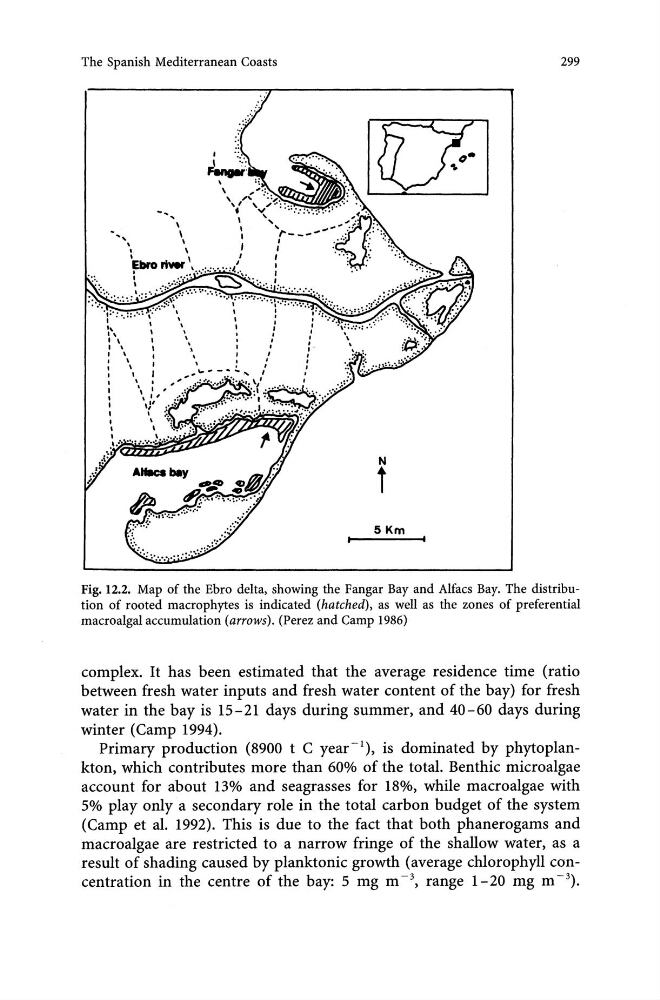
Fig. 12.2. Map of the Ebro delta, showing the Fangar Bay and Alfacs Bay. The distribution of rooted macrophytes is indicated (hatched), as well as the zones of preferential
macro algal accumulation (arrows). (Perez and Camp 1986)
complex. It has been estimated that the average residence time (ratio
between fresh water inputs and fresh water content of the bay) for fresh
water in the bay is 15-21 days during summer, and 40-60 days during
winter (Camp 1994).
Primary production (8900 t C year-I), is dominated by phytoplankton, which contributes more than 60% of the total. Benthic microalgae
account for about 13% and seagrasses for 18%, while macroalgae with
5% play only a secondary role in the total carbon budget of the system
(Camp et al. 1992). This is due to the fact that both phanerogams and
macroalgae are restricted to a narrow fringe of the shallow water, as a
result of shading caused by planktonic growth (average chlorophyll concentration in the centre of the bay: 5 mg m - 3, range 1- 20 mg m - 3).
299
~',
\
"
\
,
\
,
\
'Ebro river \
:
'c::::::~s:.'.
,
N
i
5Km
Fig. 12.2. Map of the Ebro delta, showing the Fangar Bay and Alfacs Bay. The distribution of rooted macrophytes is indicated (hatched), as well as the zones of preferential
macro algal accumulation (arrows). (Perez and Camp 1986)
complex. It has been estimated that the average residence time (ratio
between fresh water inputs and fresh water content of the bay) for fresh
water in the bay is 15-21 days during summer, and 40-60 days during
winter (Camp 1994).
Primary production (8900 t C year-I), is dominated by phytoplankton, which contributes more than 60% of the total. Benthic microalgae
account for about 13% and seagrasses for 18%, while macroalgae with
5% play only a secondary role in the total carbon budget of the system
(Camp et al. 1992). This is due to the fact that both phanerogams and
macroalgae are restricted to a narrow fringe of the shallow water, as a
result of shading caused by planktonic growth (average chlorophyll concentration in the centre of the bay: 5 mg m - 3, range 1- 20 mg m - 3).