

Spanish Atlantic Coasts
A
B
1974
C
D
D'
HIGH LEVEL
CJ <100
C:J 100-500
-
500-1000
-
>1000
LOW LEVEL
277
1984
A
B
c
D
D'
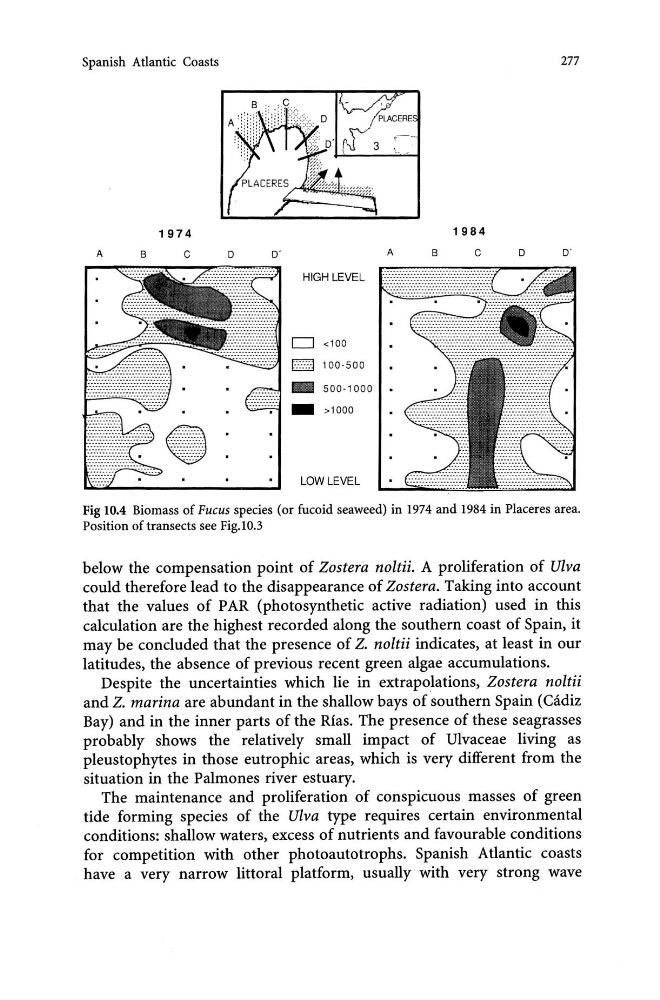
Fig 10.4 Biomass of Fucus species (or fucoid seaweed) in 1974 and 1984 in Placeres area.
Position of transects see Fig. 10.3
below the compensation point of Zostera noltii. A proliferation of Ulva
could therefore lead to the disappearance of Zostera. Taking into account
that the values of PAR (photosynthetic active radiation) used in this
calculation are the highest recorded along the southern coast of Spain, it
may be concluded that the presence of Z. noltii indicates, at least in our
latitudes, the absence of previous recent green algae accumulations.
Despite the uncertainties which lie in extrapolations, Zostera noltii
and Z. marina are abundant in the shallow bays of southern Spain (Cadiz
Bay) and in the inner parts of the Rias. The presence of these seagrasses
probably shows the relatively small impact of Ulvaceae living as
pleustophytes in those eutrophic areas, which is very different from the
situation in the Palmones river estuary.
The maintenance and proliferation of conspicuous masses of green
tide forming species of the Ulva type requires certain environmental
conditions: shallow waters, excess of nutrients and favourable conditions
for competition with other photoautotrophs. Spanish Atlantic coasts
have a very narrow littoral platform, usually with very strong wave
A
B
1974
C
D
D'
HIGH LEVEL
CJ <100
C:J 100-500
-
500-1000
-
>1000
LOW LEVEL
277
1984
A
B
c
D
D'
Fig 10.4 Biomass of Fucus species (or fucoid seaweed) in 1974 and 1984 in Placeres area.
Position of transects see Fig. 10.3
below the compensation point of Zostera noltii. A proliferation of Ulva
could therefore lead to the disappearance of Zostera. Taking into account
that the values of PAR (photosynthetic active radiation) used in this
calculation are the highest recorded along the southern coast of Spain, it
may be concluded that the presence of Z. noltii indicates, at least in our
latitudes, the absence of previous recent green algae accumulations.
Despite the uncertainties which lie in extrapolations, Zostera noltii
and Z. marina are abundant in the shallow bays of southern Spain (Cadiz
Bay) and in the inner parts of the Rias. The presence of these seagrasses
probably shows the relatively small impact of Ulvaceae living as
pleustophytes in those eutrophic areas, which is very different from the
situation in the Palmones river estuary.
The maintenance and proliferation of conspicuous masses of green
tide forming species of the Ulva type requires certain environmental
conditions: shallow waters, excess of nutrients and favourable conditions
for competition with other photoautotrophs. Spanish Atlantic coasts
have a very narrow littoral platform, usually with very strong wave