

Spanish Atlantic Coasts
275
completely mixed daily. It is very difficult to describe the dynamics of its
high nutrient levels, because the time course of phosphate and nitrate
variations is absolutely chaotic and unpredictable Clavero et al. (1991,
1992) observed a significant trend of organic phosphorus accumulation
in the sediment. Very recently, an increase in biomass of Ulva was
detected, and the sites of accumulation change over time. The cover is
sometimes higher than 75% and the blade area index is more than 2 m 2
m -2, sometimes reaching values of 4 m 2 m -2 or even higher in the
floating pleustophytic algal masses.
No seasonal quantitative direct evaluation of standing crop has ever
been carried out but using laboratory data, some calculations could be
made in order to estimate the potential increase in biomass of Ulvaceae.
Garcia-Jimenez (1990) gives data of fresh weight of 2.7 mg em -2 for
thalli of Ulva. Assuming a cover of 60-100%, a blade area index of 2 to
8 m 2 m -2, and a conversion index of wet to dry weight of 25%, the
expected biomass would range from 11.8 g m -2 in clean areas, to 189.6 g
m -2 in areas with a large accumulation of algae. Direct measurements
made in November 1993 in order to check these estimates gave a
biomass of Ulva of 97.6 ± 63.5 g dry weight m -2. These values differ
considerably from those obtained for the Venice lagoon, in Denmark or
Veersemeer in the Netherlands, areas strongly affected by proliferation of
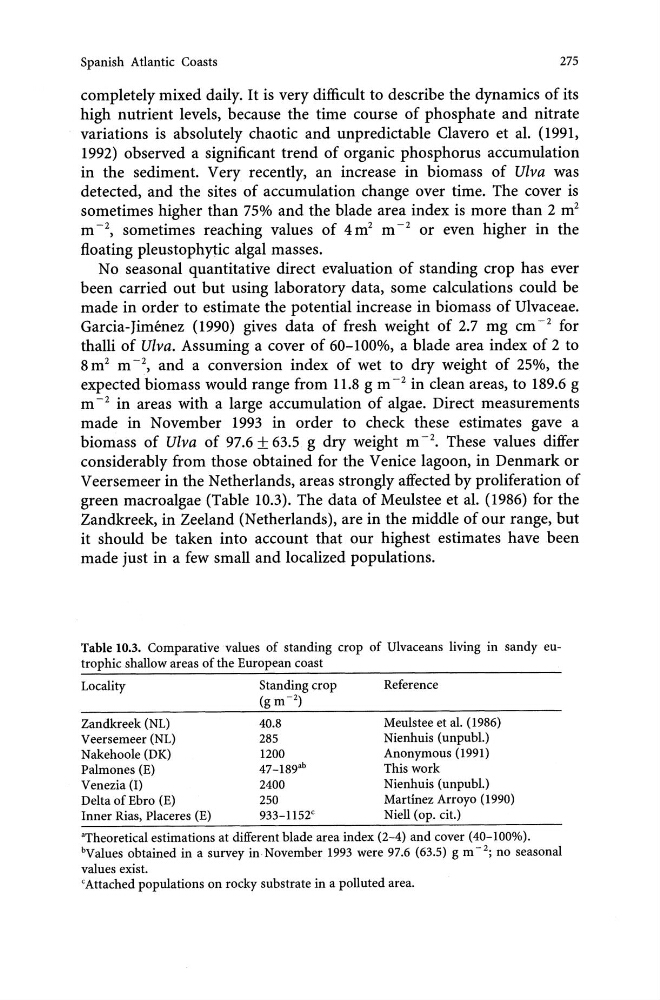
green macro algae (Table 10.3). The data of Meulstee et al. (1986) for the
Zandkreek, in Zeeland (Netherlands), are in the middle of our range, but
it should be taken into account that our highest estimates have been
made just in a few small and localized populations.
Table 10.3. Comparative values of standing crop of Ulvaceans living in sandy eutrophic shallow areas of the European coast
Locality
Standing crop
Reference
(g m -2)
Zandkreek (NL)
Veersemeer (NL)
Nakehoole (DK)
Palmones (E)
Venezia (I)
Delta of Ebro (E)
Inner Rias, Placeres (E)
40.8
285
1200
47-189,b
2400
250
933-1152 c
Meulstee et al. (1986)
Nienhuis (unpubl.)
Anonymous (1991)
This work
Nienhuis (unpubl.)
Martinez Arroyo (1990)
Niell (op. cit.)
'Theoretical estimations at different blade area index (2-4) and cover (40-100%).
bValues obtained in a survey in November 1993 were 97.6 (63.5) g m- 2 ; no seasonal
values exist.
'Attached populations on rocky substrate in a polluted area.
275
completely mixed daily. It is very difficult to describe the dynamics of its
high nutrient levels, because the time course of phosphate and nitrate
variations is absolutely chaotic and unpredictable Clavero et al. (1991,
1992) observed a significant trend of organic phosphorus accumulation
in the sediment. Very recently, an increase in biomass of Ulva was
detected, and the sites of accumulation change over time. The cover is
sometimes higher than 75% and the blade area index is more than 2 m 2
m -2, sometimes reaching values of 4 m 2 m -2 or even higher in the
floating pleustophytic algal masses.
No seasonal quantitative direct evaluation of standing crop has ever
been carried out but using laboratory data, some calculations could be
made in order to estimate the potential increase in biomass of Ulvaceae.
Garcia-Jimenez (1990) gives data of fresh weight of 2.7 mg em -2 for
thalli of Ulva. Assuming a cover of 60-100%, a blade area index of 2 to
8 m 2 m -2, and a conversion index of wet to dry weight of 25%, the
expected biomass would range from 11.8 g m -2 in clean areas, to 189.6 g
m -2 in areas with a large accumulation of algae. Direct measurements
made in November 1993 in order to check these estimates gave a
biomass of Ulva of 97.6 ± 63.5 g dry weight m -2. These values differ
considerably from those obtained for the Venice lagoon, in Denmark or
Veersemeer in the Netherlands, areas strongly affected by proliferation of
green macro algae (Table 10.3). The data of Meulstee et al. (1986) for the
Zandkreek, in Zeeland (Netherlands), are in the middle of our range, but
it should be taken into account that our highest estimates have been
made just in a few small and localized populations.
Table 10.3. Comparative values of standing crop of Ulvaceans living in sandy eutrophic shallow areas of the European coast
Locality
Standing crop
Reference
(g m -2)
Zandkreek (NL)
Veersemeer (NL)
Nakehoole (DK)
Palmones (E)
Venezia (I)
Delta of Ebro (E)
Inner Rias, Placeres (E)
40.8
285
1200
47-189,b
2400
250
933-1152 c
Meulstee et al. (1986)
Nienhuis (unpubl.)
Anonymous (1991)
This work
Nienhuis (unpubl.)
Martinez Arroyo (1990)
Niell (op. cit.)
'Theoretical estimations at different blade area index (2-4) and cover (40-100%).
bValues obtained in a survey in November 1993 were 97.6 (63.5) g m- 2 ; no seasonal
values exist.
'Attached populations on rocky substrate in a polluted area.