

Spanish Atlantic Coasts
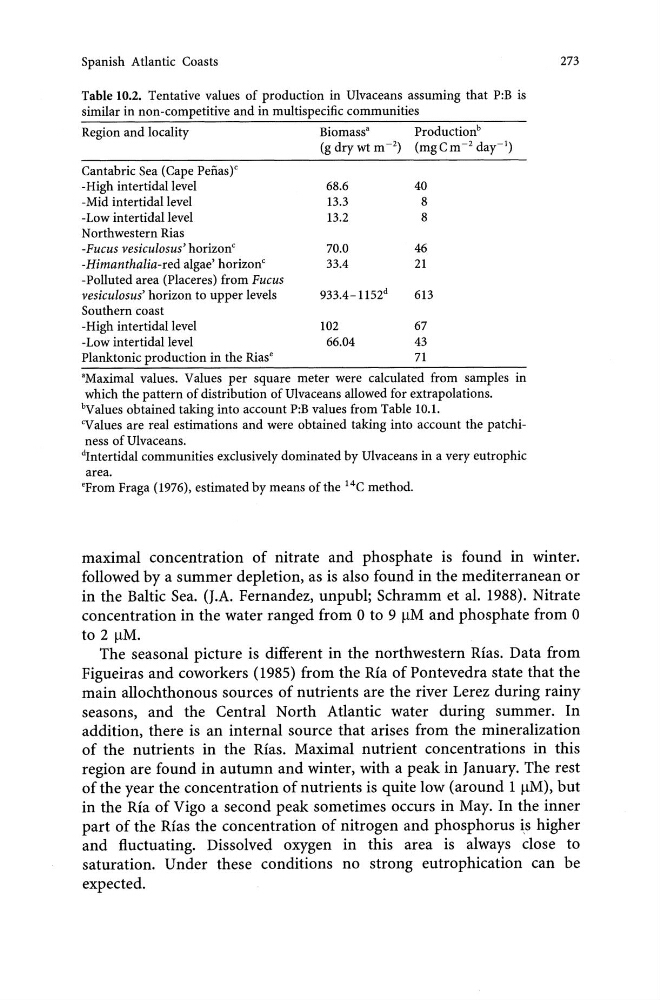
Table 10.2. Tentative values of production in Ulvaceans assuming that P:B is
similar in non-competitive and in muitispecific communities
Region and locality
Biomass'
Production b
(gdrywtm- 2 ) (mgCm- 2 day-l)
Cantabric Sea (Cape Pefiast
-High intertidal level
68.6
40
-Mid intertidal level
13.3
8
-Low intertidal level
13.2
8
Northwestern Rias
-Fucus vesiculosus' horizon c
70.0
46
-Himanthalia-red algae' horizon c
33.4
21
-Polluted area (Placeres) from Fucus
vesiculosus' horizon to upper levels
933.4-1152 d
613
Southern coast
-High intertidal level
102
67
-Low intertidal level
66.04
43
Planktonic production in the Rias e
71
"Maximal values. Values per square meter were calculated from samples in
which the pattern of distribution of Ulvaceans allowed for extrapolations.
bValues obtained taking into account P:B values from Table 10.1.
"Values are real estimations and were obtained taking into account the patchiness of Ulvaceans.
dlntertidal communities exclusively dominated by Ulvaceans in a very eutrophic
area.
eFrom Fraga (1976), estimated by means of the 14C method.
273
maximal concentration of nitrate and phosphate is found in winter.
followed by a summer depletion, as is also found in the mediterranean or
in the Baltic Sea. (J.A. Fernandez, unpubl; Schramm et al. 1988). Nitrate
concentration in the water ranged from 0 to 9 IlM and phosphate from 0
to 2 IlM.
The seasonal picture is different in the northwestern Rias. Data from
Figueiras and coworkers (1985) from the Ria of Pontevedra state that the
main allochthonous sources of nutrients are the river Lerez during rainy
seasons, and the Central North Atlantic water during summer. In
addition, there is an internal source that arises from the mineralization
of the nutrients in the Rias. Maximal nutrient concentrations in this
region are found in autumn and winter, with a peak in January. The rest
of the year the concentration of nutrients is quite low (around 1 IlM), but
in the Ria of Vigo a second peak sometimes occurs in May. In the inner
part of the Rias the concentration of nitrogen and phosphorus is higher
and fluctuating. Dissolved oxygen in this area is always close to
saturation. Under these conditions no strong eutrophication can be
expected.
Table 10.2. Tentative values of production in Ulvaceans assuming that P:B is
similar in non-competitive and in muitispecific communities
Region and locality
Biomass'
Production b
(gdrywtm- 2 ) (mgCm- 2 day-l)
Cantabric Sea (Cape Pefiast
-High intertidal level
68.6
40
-Mid intertidal level
13.3
8
-Low intertidal level
13.2
8
Northwestern Rias
-Fucus vesiculosus' horizon c
70.0
46
-Himanthalia-red algae' horizon c
33.4
21
-Polluted area (Placeres) from Fucus
vesiculosus' horizon to upper levels
933.4-1152 d
613
Southern coast
-High intertidal level
102
67
-Low intertidal level
66.04
43
Planktonic production in the Rias e
71
"Maximal values. Values per square meter were calculated from samples in
which the pattern of distribution of Ulvaceans allowed for extrapolations.
bValues obtained taking into account P:B values from Table 10.1.
"Values are real estimations and were obtained taking into account the patchiness of Ulvaceans.
dlntertidal communities exclusively dominated by Ulvaceans in a very eutrophic
area.
eFrom Fraga (1976), estimated by means of the 14C method.
273
maximal concentration of nitrate and phosphate is found in winter.
followed by a summer depletion, as is also found in the mediterranean or
in the Baltic Sea. (J.A. Fernandez, unpubl; Schramm et al. 1988). Nitrate
concentration in the water ranged from 0 to 9 IlM and phosphate from 0
to 2 IlM.
The seasonal picture is different in the northwestern Rias. Data from
Figueiras and coworkers (1985) from the Ria of Pontevedra state that the
main allochthonous sources of nutrients are the river Lerez during rainy
seasons, and the Central North Atlantic water during summer. In
addition, there is an internal source that arises from the mineralization
of the nutrients in the Rias. Maximal nutrient concentrations in this
region are found in autumn and winter, with a peak in January. The rest
of the year the concentration of nutrients is quite low (around 1 IlM), but
in the Ria of Vigo a second peak sometimes occurs in May. In the inner
part of the Rias the concentration of nitrogen and phosphorus is higher
and fluctuating. Dissolved oxygen in this area is always close to
saturation. Under these conditions no strong eutrophication can be
expected.