

The French Atlantic Coasts
259
authorities. A smaller and more experimental project was started recently in the Bay of Douarnenez (Piriou 1993). The introduction of
seaweed cultures as nutrient competitors for the green tides (see
ChapA, this vol.) was considered in some favourable situations but was
not followed up because there was no demand by the local seaweed
industry for such quantities of seaweeds which would be necessary to
substitute or outcompete the green algae.
3. Preventive Means of the "Chemical" Type. These concern decreasing
the input of nutrients already upstream in the drainage basin by
efficient effluent treatment and a preventive policy.
In this context, research programs have been undertaken at CEV A and
IFREMER to study the physiological ecology of Ulva nutritient requirements and to develop ecological models.
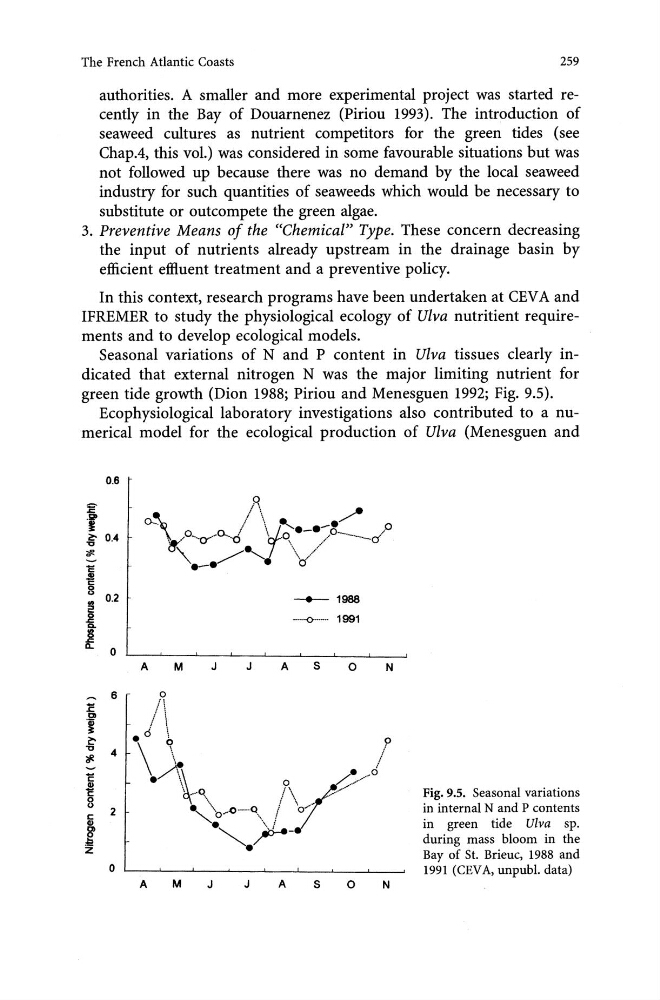
Seasonal variations of Nand P content in Ulva tissues clearly indicated that external nitrogen N was the major limiting nutrient for
green tide growth (Dion 1988; Piriou and Menesguen 1992; Fig. 9.5).
Ecophysiological laboratory investigations also contributed to a numerical model for the ecological production of Ulva (Menesguen and
0.6
.;.<:
.51>
l
~ 0.4
'"
1JiI.
~
i 8 0.2
'" 2 0
.<:
c.
S
if 0
~
6
E
·r
~
'" 4
8
c
2
GI
Cl
~
Z
0
A
M
J
J
A
M
J
J
_1988
..... -0 ... _ .. 1991
A
S
o
A
S
o
N
N
Fig. 9.5. Seasonal variations
in internal Nand P contents
in green tide Ulva sp.
during mass bloom in the
Bay of St. Brieuc, 1988 and
1991 (CEVA, unpubl. data)
259
authorities. A smaller and more experimental project was started recently in the Bay of Douarnenez (Piriou 1993). The introduction of
seaweed cultures as nutrient competitors for the green tides (see
ChapA, this vol.) was considered in some favourable situations but was
not followed up because there was no demand by the local seaweed
industry for such quantities of seaweeds which would be necessary to
substitute or outcompete the green algae.
3. Preventive Means of the "Chemical" Type. These concern decreasing
the input of nutrients already upstream in the drainage basin by
efficient effluent treatment and a preventive policy.
In this context, research programs have been undertaken at CEV A and
IFREMER to study the physiological ecology of Ulva nutritient requirements and to develop ecological models.
Seasonal variations of Nand P content in Ulva tissues clearly indicated that external nitrogen N was the major limiting nutrient for
green tide growth (Dion 1988; Piriou and Menesguen 1992; Fig. 9.5).
Ecophysiological laboratory investigations also contributed to a numerical model for the ecological production of Ulva (Menesguen and
0.6
.;.<:
.51>
l
~ 0.4
'"
1JiI.
~
i 8 0.2
'" 2 0
.<:
c.
S
if 0
~
6
E
·r
~
'" 4
8
c
2
GI
Cl
~
Z
0
A
M
J
J
A
M
J
J
_1988
..... -0 ... _ .. 1991
A
S
o
A
S
o
N
N
Fig. 9.5. Seasonal variations
in internal Nand P contents
in green tide Ulva sp.
during mass bloom in the
Bay of St. Brieuc, 1988 and
1991 (CEVA, unpubl. data)