

256
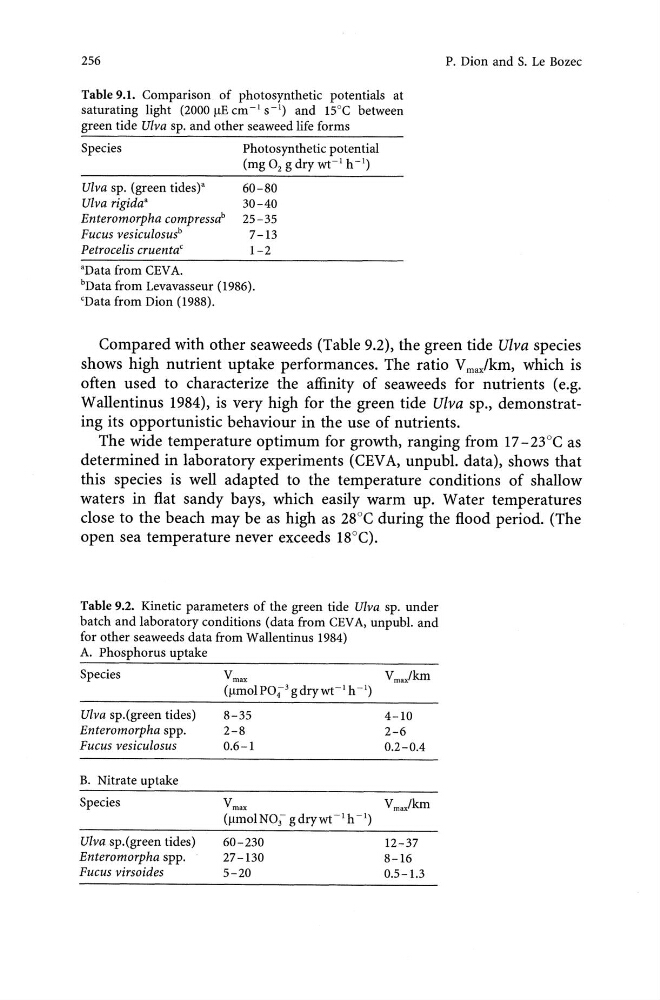
Table 9.1. Comparison of photosynthetic potentials at
saturating light (2000 IlE cm-' s-') and 15°C between
green tide Ulva sp. and other seaweed life forms
Species
Photosynthetic potential
(mg O 2 g dry we' h-')
Ulva sp. (green tides)a
Ulva rigida a
Enteromorpha compressa b
Fucus vesiculosus b
Petro celis cruenta C
aData from CEV A.
60-80
30-40
25-35
7-13
1-2
bData from Levavasseur (1986).
CData from Dian (1988).
P. Dion and S. Le Bozec
Compared with other seaweeds (Table 9.2), the green tide Ulva species
shows high nutrient uptake performances. The ratio V mjkm, which is
often used to characterize the affinity of seaweeds for nutrients (e.g.
Wallentinus 1984), is very high for the green tide Ulva sp., demonstrating its opportunistic behaviour in the use of nutrients.
The wide temperature optimum for growth, ranging from 17-23°C as
determined in laboratory experiments (CEVA, unpubl. data), shows that
this species is well adapted to the temperature conditions of shallow
waters in flat sandy bays, which easily warm up. Water temperatures
close to the beach may be as high as 28°C during the flood period. (The
open sea temperature never exceeds 18°C).
Table 9.2. Kinetic parameters of the green tide Ulva sp. under
batch and laboratory conditions (data from CEVA, unpubl. and
for other seaweeds data from Wallentinus 1984)
A. Phosphorus uptake
Species
Ulva sp.(green tides)
Enteromorpha spp.
Fucus vesiculosus
B. Nitrate uptake
Species
Ulva sp.(green tides)
Enteromorpha spp.
Fucus virsoides
Vrnax
VmaJkm
(Ilmo1POi3 gdrywc' h-')
8-35
4-10
2-8
2-6
Q6-1
Q2-Q4
60-230
27-130
5-20
12-37
8-16
0.5-1.3
Table 9.1. Comparison of photosynthetic potentials at
saturating light (2000 IlE cm-' s-') and 15°C between
green tide Ulva sp. and other seaweed life forms
Species
Photosynthetic potential
(mg O 2 g dry we' h-')
Ulva sp. (green tides)a
Ulva rigida a
Enteromorpha compressa b
Fucus vesiculosus b
Petro celis cruenta C
aData from CEV A.
60-80
30-40
25-35
7-13
1-2
bData from Levavasseur (1986).
CData from Dian (1988).
P. Dion and S. Le Bozec
Compared with other seaweeds (Table 9.2), the green tide Ulva species
shows high nutrient uptake performances. The ratio V mjkm, which is
often used to characterize the affinity of seaweeds for nutrients (e.g.
Wallentinus 1984), is very high for the green tide Ulva sp., demonstrating its opportunistic behaviour in the use of nutrients.
The wide temperature optimum for growth, ranging from 17-23°C as
determined in laboratory experiments (CEVA, unpubl. data), shows that
this species is well adapted to the temperature conditions of shallow
waters in flat sandy bays, which easily warm up. Water temperatures
close to the beach may be as high as 28°C during the flood period. (The
open sea temperature never exceeds 18°C).
Table 9.2. Kinetic parameters of the green tide Ulva sp. under
batch and laboratory conditions (data from CEVA, unpubl. and
for other seaweeds data from Wallentinus 1984)
A. Phosphorus uptake
Species
Ulva sp.(green tides)
Enteromorpha spp.
Fucus vesiculosus
B. Nitrate uptake
Species
Ulva sp.(green tides)
Enteromorpha spp.
Fucus virsoides
Vrnax
VmaJkm
(Ilmo1POi3 gdrywc' h-')
8-35
4-10
2-8
2-6
Q6-1
Q2-Q4
60-230
27-130
5-20
12-37
8-16
0.5-1.3