

254
P. Dion and S. Le Bozec
type", as is the case for the coasts of Brittany, seaweed degradation only
takes place after beaching.
.
The existence of green tides along the Brittany coastlines can already
be detected in the Bay of St. Brieuc, Lannion and Douarnenez from IGN
aerial photographs taken in the 1950s (cf. Piriou et ai. 1991). In the late
1970s, the phenomenon of green tides became evident, and reached an
intolerable point only in its recent evolution, during the 1980s. The extent
of these green tides now seems to be stabilized in these main sites, but it
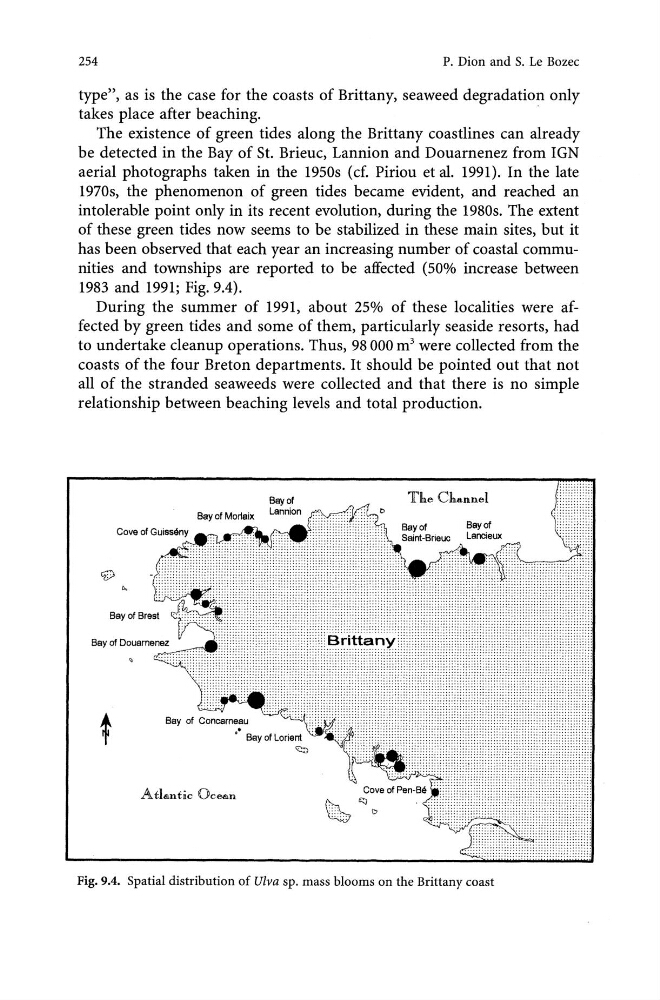
has been observed that each year an increasing number of coastal communities and townships are reported to be affected (50% increase between
1983 and 1991; Fig. 9.4).
During the summer of 1991, about 25% of these localities were affected by green tides and some of them, particularly seaside resorts, had
to undertake cleanup operations. Thus, 98000 m 3 were collected from the
coasts of the four Breton departments. It should be pointed out that not
all of the stranded seaweeds were collected and that there is no simple
relationship between beaching levels and total production.
TJl.e CJl. .. nnel
Fig. 9.4. Spatial distribution of Ulva sp. mass blooms on the Brittany coast
P. Dion and S. Le Bozec
type", as is the case for the coasts of Brittany, seaweed degradation only
takes place after beaching.
.
The existence of green tides along the Brittany coastlines can already
be detected in the Bay of St. Brieuc, Lannion and Douarnenez from IGN
aerial photographs taken in the 1950s (cf. Piriou et ai. 1991). In the late
1970s, the phenomenon of green tides became evident, and reached an
intolerable point only in its recent evolution, during the 1980s. The extent
of these green tides now seems to be stabilized in these main sites, but it
has been observed that each year an increasing number of coastal communities and townships are reported to be affected (50% increase between
1983 and 1991; Fig. 9.4).
During the summer of 1991, about 25% of these localities were affected by green tides and some of them, particularly seaside resorts, had
to undertake cleanup operations. Thus, 98000 m 3 were collected from the
coasts of the four Breton departments. It should be pointed out that not
all of the stranded seaweeds were collected and that there is no simple
relationship between beaching levels and total production.
TJl.e CJl. .. nnel
Fig. 9.4. Spatial distribution of Ulva sp. mass blooms on the Brittany coast