

244
R.L. Fletcher
Of particular ecological importance, however, is the role of the algal
mats as a nutrient sink. Soulsby et al. (1985) revealed Enteromorpha, in
both Langstone and Portsmouth Harbours, to contain very high, luxury
levels of nitrogen and phosphorus with the tissue content higher in
plants collected from the upper more polluted regions of each harbour. A
similar relationship was shown for Ulva plants collected from polluted
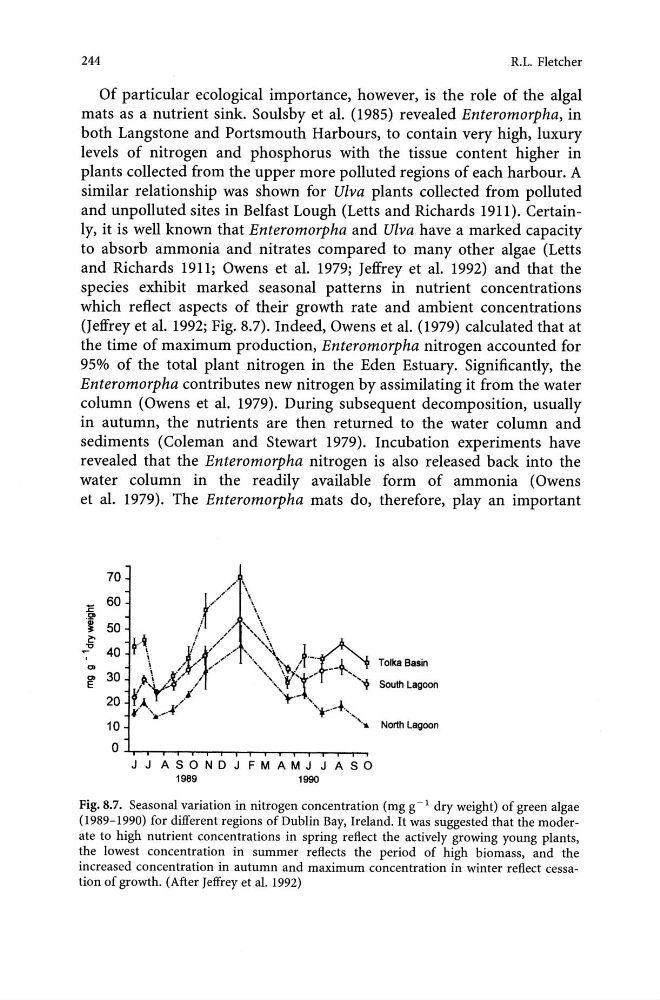
and unpolluted sites in Belfast Lough (Letts and Richards 1911). Certainly, it is well known that Enteromorpha and Ulva have a marked capacity
to absorb ammonia and nitrates compared to many other algae (Letts
and Richards 1911; Owens et al. 1979; Jeffrey et al. 1992) and that the
species exhibit marked seasonal patterns in nutrient concentrations
which reflect aspects of their growth rate and ambient concentrations
(Jeffrey et al. 1992; Fig. 8.7). Indeed, Owens et al. (1979) calculated that at
the time of maximum production, Enteromorpha nitrogen accounted for
95% of the total plant nitrogen in the Eden Estuary. Significantly, the
Enteromorpha contributes new nitrogen by assimilating it from the water
column (Owens et al. 1979). During subsequent decomposition, usually
in autumn, the nutrients are then returned to the water column and
sediments (Coleman and Stewart 1979). Incubation experiments have
revealed that the Enteromorpha nitrogen is also released back into the
water column in the readily available form of ammonia (Owens
et al. 1979). The Enteromorpha mats do, therefore, play an important
70
E
60
CI
.~
50
i!'
'0
40
'"
Tolka Basin
C>
30
E
South Lagoon
20
10
North Lagoon
0
JJASONDJFMAMJJASO
1989
1990
Fig.8.7. Seasonal variation in nitrogen concentration (mg g -1 dry weight) of green algae
(1989-1990) for different regions of Dublin Bay, Ireland. It was suggested that the moderate to high nutrient concentrations in spring reflect the actively growing young plants,
the lowest concentration in summer reflects the period of high biomass, and the
increased concentration in autumn and maximum concentration in winter reflect cessation of growth. (After Jeffrey et al. 1992)
R.L. Fletcher
Of particular ecological importance, however, is the role of the algal
mats as a nutrient sink. Soulsby et al. (1985) revealed Enteromorpha, in
both Langstone and Portsmouth Harbours, to contain very high, luxury
levels of nitrogen and phosphorus with the tissue content higher in
plants collected from the upper more polluted regions of each harbour. A
similar relationship was shown for Ulva plants collected from polluted
and unpolluted sites in Belfast Lough (Letts and Richards 1911). Certainly, it is well known that Enteromorpha and Ulva have a marked capacity
to absorb ammonia and nitrates compared to many other algae (Letts
and Richards 1911; Owens et al. 1979; Jeffrey et al. 1992) and that the
species exhibit marked seasonal patterns in nutrient concentrations
which reflect aspects of their growth rate and ambient concentrations
(Jeffrey et al. 1992; Fig. 8.7). Indeed, Owens et al. (1979) calculated that at
the time of maximum production, Enteromorpha nitrogen accounted for
95% of the total plant nitrogen in the Eden Estuary. Significantly, the
Enteromorpha contributes new nitrogen by assimilating it from the water
column (Owens et al. 1979). During subsequent decomposition, usually
in autumn, the nutrients are then returned to the water column and
sediments (Coleman and Stewart 1979). Incubation experiments have
revealed that the Enteromorpha nitrogen is also released back into the
water column in the readily available form of ammonia (Owens
et al. 1979). The Enteromorpha mats do, therefore, play an important
70
E
60
CI
.~
50
i!'
'0
40
'"
Tolka Basin
C>
30
E
South Lagoon
20
10
North Lagoon
0
JJASONDJFMAMJJASO
1989
1990
Fig.8.7. Seasonal variation in nitrogen concentration (mg g -1 dry weight) of green algae
(1989-1990) for different regions of Dublin Bay, Ireland. It was suggested that the moderate to high nutrient concentrations in spring reflect the actively growing young plants,
the lowest concentration in summer reflects the period of high biomass, and the
increased concentration in autumn and maximum concentration in winter reflect cessation of growth. (After Jeffrey et al. 1992)