

The British Isles
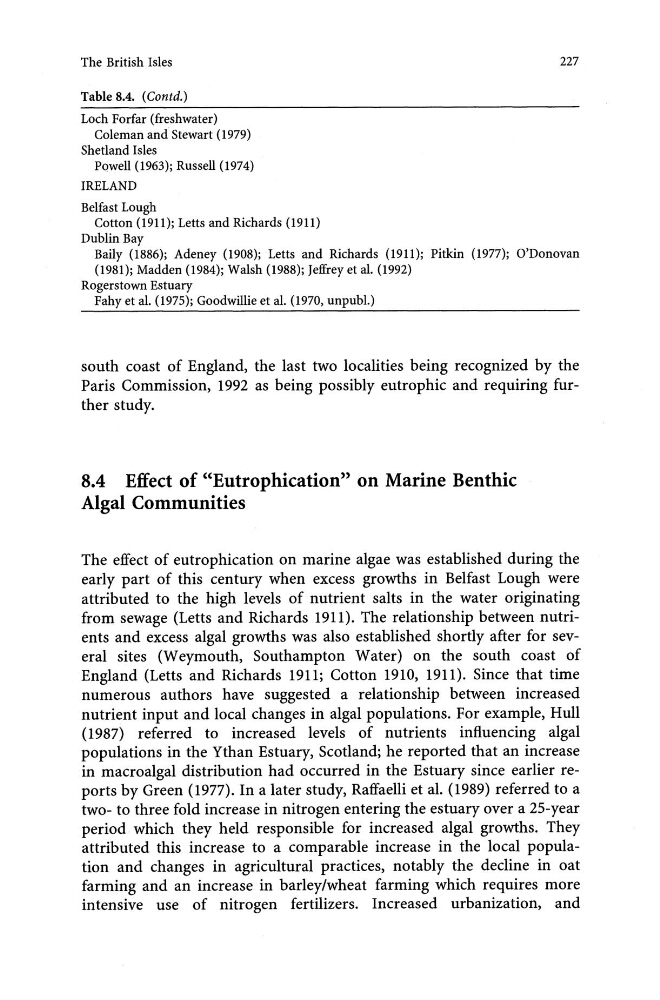
Table 8.4. (Contd.)
Loch Forfar (freshwater)
Coleman and Stewart (1979)
Shetland Isles
Powell (1963); Russell (1974)
IRELAND
Belfast Lough
Cotton (1911); Letts and Richards (1911)
Dublin Bay
227
Baily (1886); Adeney (1908); Letts and Richards (1911); Pitkin (1977); O'Donovan
(1981); Madden (1984); Walsh (1988); Jeffreyet aI. (1992)
Rogerstown Estuary
Fahyet aI. (1975); Goodwillie et aI. (1970, unpub!.)
south coast of England, the last two localities being recognized by the
Paris Commission, 1992 as being possibly eutrophic and requiring further study.
8.4 Effect of "Eutrophication" on Marine Benthic
Algal Communities
The effect of eutrophication on marine algae was established during the
early part of this century when excess growths in Belfast Lough were
attributed to the high levels of nutrient salts in the water originating
from sewage (Letts and Richards 1911). The relationship between nutrients and excess algal growths was also established shortly after for several sites (Weymouth, Southampton Water) on the south coast of
England (Letts and Richards 1911; Cotton 1910, 1911). Since that time
numerous authors have suggested a relationship between increased
nutrient input and local changes in algal populations. For example, Hull
(1987) referred to increased levels of nutrients influencing algal
populations in the Ythan Estuary, Scotland; he reported that an increase
in macro algal distribution had occurred in the Estuary since earlier reports by Green (1977). In a later study, Raffaelli et al. (1989) referred to a
two- to three fold increase in nitrogen entering the estuary over a 25-year
period which they held responsible for increased algal growths. They
attributed this increase to a comparable increase in the local population and changes in agricultural practices, notably the decline in oat
farming and an increase in barley/wheat farming which requires more
intensive use of nitrogen fertilizers. Increased urbanization, and
Table 8.4. (Contd.)
Loch Forfar (freshwater)
Coleman and Stewart (1979)
Shetland Isles
Powell (1963); Russell (1974)
IRELAND
Belfast Lough
Cotton (1911); Letts and Richards (1911)
Dublin Bay
227
Baily (1886); Adeney (1908); Letts and Richards (1911); Pitkin (1977); O'Donovan
(1981); Madden (1984); Walsh (1988); Jeffreyet aI. (1992)
Rogerstown Estuary
Fahyet aI. (1975); Goodwillie et aI. (1970, unpub!.)
south coast of England, the last two localities being recognized by the
Paris Commission, 1992 as being possibly eutrophic and requiring further study.
8.4 Effect of "Eutrophication" on Marine Benthic
Algal Communities
The effect of eutrophication on marine algae was established during the
early part of this century when excess growths in Belfast Lough were
attributed to the high levels of nutrient salts in the water originating
from sewage (Letts and Richards 1911). The relationship between nutrients and excess algal growths was also established shortly after for several sites (Weymouth, Southampton Water) on the south coast of
England (Letts and Richards 1911; Cotton 1910, 1911). Since that time
numerous authors have suggested a relationship between increased
nutrient input and local changes in algal populations. For example, Hull
(1987) referred to increased levels of nutrients influencing algal
populations in the Ythan Estuary, Scotland; he reported that an increase
in macro algal distribution had occurred in the Estuary since earlier reports by Green (1977). In a later study, Raffaelli et al. (1989) referred to a
two- to three fold increase in nitrogen entering the estuary over a 25-year
period which they held responsible for increased algal growths. They
attributed this increase to a comparable increase in the local population and changes in agricultural practices, notably the decline in oat
farming and an increase in barley/wheat farming which requires more
intensive use of nitrogen fertilizers. Increased urbanization, and