

210
P.H. Nienhuis
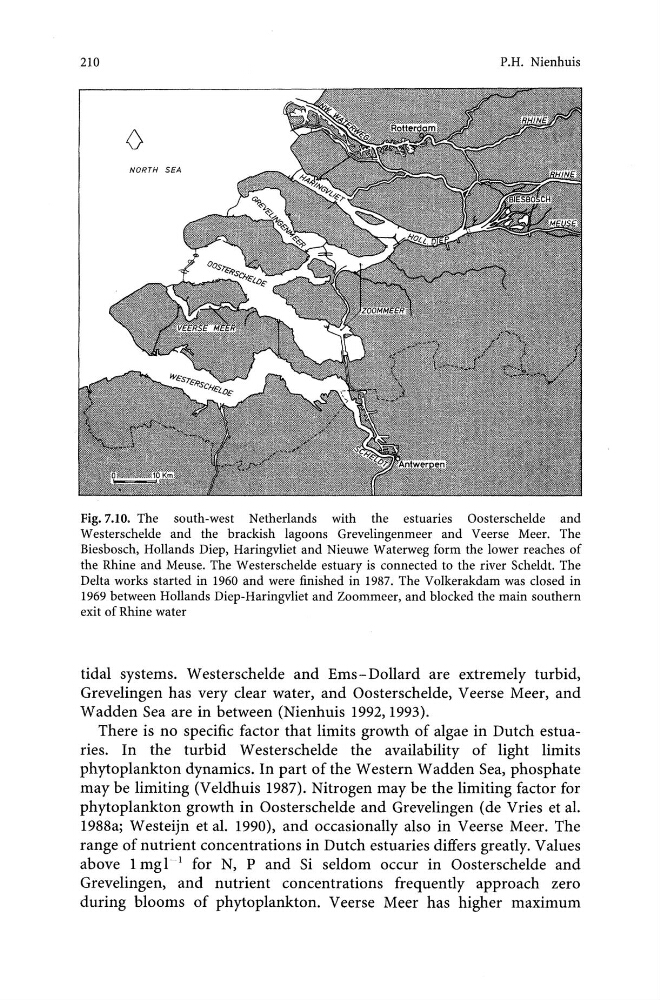
Fig. 7.10. The south-west Netherlands with the estuaries Oosterschelde and
Westerschelde and the brackish lagoons Grevelingenmeer and Veerse Meer. The
Biesbosch, Hollands Diep, Haringvliet and Nieuwe Waterweg form the lower reaches of
the Rhine and Meuse. The Westerschelde estuary is connected to the river ScheIdt. The
Delta works started in 1960 and were finished in 1987. The Volkerakdam was closed in
1969 between Hollands Diep-Haringvliet and Zoommeer, and blocked the main southern
exit of Rhine water
tidal systems. Westerschelde and Ems-Dollard are extremely turbid,
Grevelingen has very clear water, and Oosterschelde, Veerse Meer, and
Wadden Sea are in between (Nienhuis 1992,1993).
There is no specific factor that limits growth of algae in Dutch estuaries. In the turbid Westerschelde the availability of light limits
phytoplankton dynamics. In part of the Western Wadden Sea, phosphate
may be limiting (Veldhuis 1987). Nitrogen may be the limiting factor for
phytoplankton growth in Oosterschelde and Grevelingen (de Vries et al.
1988a; Westeijn et al. 1990), and occasionally also in Veerse Meer. The
range of nutrient concentrations in Dutch estuaries differs greatly. Values
above 1 mgl- 1 for N, P and Si seldom occur in Oosterschelde and
Grevelingen, and nutrient concentrations frequently approach zero
during blooms of phytoplankton. Veerse Meer has higher maximum
P.H. Nienhuis
Fig. 7.10. The south-west Netherlands with the estuaries Oosterschelde and
Westerschelde and the brackish lagoons Grevelingenmeer and Veerse Meer. The
Biesbosch, Hollands Diep, Haringvliet and Nieuwe Waterweg form the lower reaches of
the Rhine and Meuse. The Westerschelde estuary is connected to the river ScheIdt. The
Delta works started in 1960 and were finished in 1987. The Volkerakdam was closed in
1969 between Hollands Diep-Haringvliet and Zoommeer, and blocked the main southern
exit of Rhine water
tidal systems. Westerschelde and Ems-Dollard are extremely turbid,
Grevelingen has very clear water, and Oosterschelde, Veerse Meer, and
Wadden Sea are in between (Nienhuis 1992,1993).
There is no specific factor that limits growth of algae in Dutch estuaries. In the turbid Westerschelde the availability of light limits
phytoplankton dynamics. In part of the Western Wadden Sea, phosphate
may be limiting (Veldhuis 1987). Nitrogen may be the limiting factor for
phytoplankton growth in Oosterschelde and Grevelingen (de Vries et al.
1988a; Westeijn et al. 1990), and occasionally also in Veerse Meer. The
range of nutrient concentrations in Dutch estuaries differs greatly. Values
above 1 mgl- 1 for N, P and Si seldom occur in Oosterschelde and
Grevelingen, and nutrient concentrations frequently approach zero
during blooms of phytoplankton. Veerse Meer has higher maximum