

The North Sea Coasts
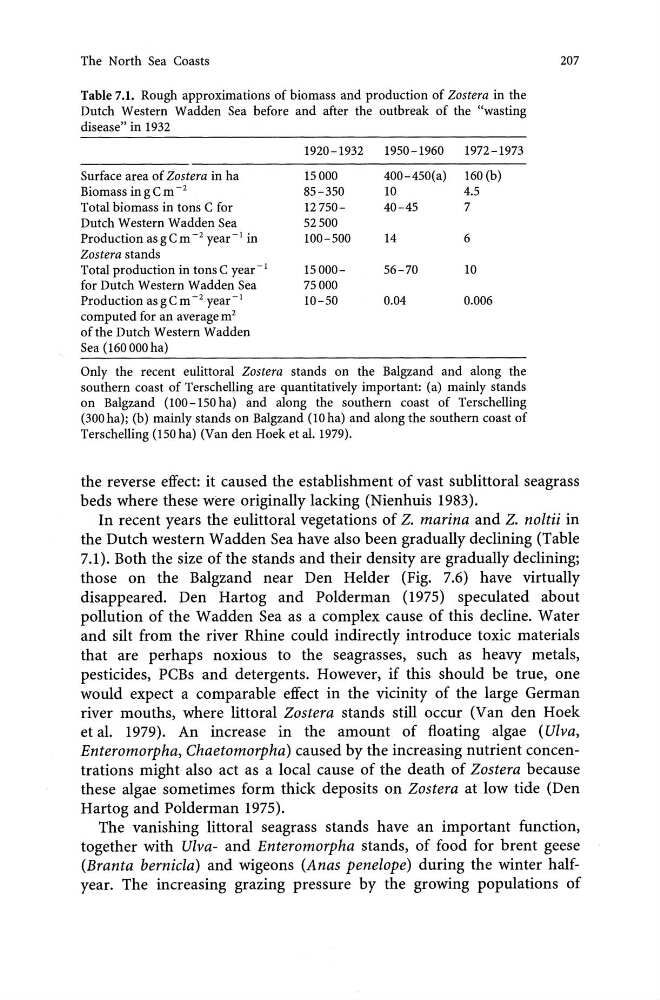
Table 7.1. Rough approximations of biomass and production of Zostera in the
Dutch W estern Wadden Sea before and after the outbreak of the "wasting
disease" in 1932
1920-1932
1950-1960
1972-1973
Surface area of Zostera in ha
15000
400-450(a) 160 (b)
Biomass in g C m- 2
85-350
10
4.5
Total biomass in tons C for
1275040-45
7
Dutch Western Wadden Sea
52500
Production as g C m - 2 year -1 in
100-500
14
6
Zostera stands
Total production in tons C year- 1
1500056-70
10
for Dutch Western Wadden Sea
75000
Production as g C m -2 year- 1
10-50
0.04
0.006
computed for an average m 2
of the Dutch Western Wadden
Sea (160000 ha)
Only the recent eulittoral Zostera stands on the Balgzand and along the
southern coast of Terschelling are quantitatively important: (a) mainly stands
on Balgzand (100-150 ha) and along the southern coast of Terschelling
(300ha); (b) mainly stands on Balgzand (lOha) and along the southern coast of
Terschelling (150 ha) (Van den Hoek et al. 1979).
207
the reverse effect: it caused the establishment of vast sublittoral seagrass
beds where these were originally lacking (Nienhuis 1983).
In recent years the eulittoral vegetations of Z. marina and Z. noltii in
the Dutch western Wadden Sea have also been gradually declining (Table
7.1). Both the size of the stands and their density are gradually declining;
those on the Balgzand near Den Helder (Fig. 7.6) have virtually
disappeared. Den Hartog and Polderman (1975) speculated about
pollution of the Wadden Sea as a complex cause of this decline. Water
and silt from the river Rhine could indirectly introduce toxic materials
that are perhaps noxious to the seagrasses, such as heavy metals,
pesticides, PCBs and detergents. However, if this should be true, one
would expect a comparable effect in the vicinity of the large German
river mouths, where littoral Zostera stands still occur (Van den Hoek
et al. 1979). An increase in the amount of floating algae (Ulva,
Enteromorpha, Chaetomorpha) caused by the increasing nutrient concentrations might also act as a local cause of the death of Zostera because
these algae sometimes form thick deposits on Zostera at low tide (Den
Hartog and Polderman 1975).
The vanishing littoral seagrass stands have an important function,
together with Ulva- and Enteromorpha stands, of food for brent geese
(Branta bernicla) and wigeons (Anas penelope) during the winter halfyear. The increasing grazing pressure by the growing populations of
Table 7.1. Rough approximations of biomass and production of Zostera in the
Dutch W estern Wadden Sea before and after the outbreak of the "wasting
disease" in 1932
1920-1932
1950-1960
1972-1973
Surface area of Zostera in ha
15000
400-450(a) 160 (b)
Biomass in g C m- 2
85-350
10
4.5
Total biomass in tons C for
1275040-45
7
Dutch Western Wadden Sea
52500
Production as g C m - 2 year -1 in
100-500
14
6
Zostera stands
Total production in tons C year- 1
1500056-70
10
for Dutch Western Wadden Sea
75000
Production as g C m -2 year- 1
10-50
0.04
0.006
computed for an average m 2
of the Dutch Western Wadden
Sea (160000 ha)
Only the recent eulittoral Zostera stands on the Balgzand and along the
southern coast of Terschelling are quantitatively important: (a) mainly stands
on Balgzand (100-150 ha) and along the southern coast of Terschelling
(300ha); (b) mainly stands on Balgzand (lOha) and along the southern coast of
Terschelling (150 ha) (Van den Hoek et al. 1979).
207
the reverse effect: it caused the establishment of vast sublittoral seagrass
beds where these were originally lacking (Nienhuis 1983).
In recent years the eulittoral vegetations of Z. marina and Z. noltii in
the Dutch western Wadden Sea have also been gradually declining (Table
7.1). Both the size of the stands and their density are gradually declining;
those on the Balgzand near Den Helder (Fig. 7.6) have virtually
disappeared. Den Hartog and Polderman (1975) speculated about
pollution of the Wadden Sea as a complex cause of this decline. Water
and silt from the river Rhine could indirectly introduce toxic materials
that are perhaps noxious to the seagrasses, such as heavy metals,
pesticides, PCBs and detergents. However, if this should be true, one
would expect a comparable effect in the vicinity of the large German
river mouths, where littoral Zostera stands still occur (Van den Hoek
et al. 1979). An increase in the amount of floating algae (Ulva,
Enteromorpha, Chaetomorpha) caused by the increasing nutrient concentrations might also act as a local cause of the death of Zostera because
these algae sometimes form thick deposits on Zostera at low tide (Den
Hartog and Polderman 1975).
The vanishing littoral seagrass stands have an important function,
together with Ulva- and Enteromorpha stands, of food for brent geese
(Branta bernicla) and wigeons (Anas penelope) during the winter halfyear. The increasing grazing pressure by the growing populations of