

The Baltic Sea and Its Transition Zones
~ ;0\ . . ~
:.;::::;
. ., ...... .
. . :::: •••• :!.::: ••• ~
3827
1:
. . . . . . . . . . . . . . . . .
":>:i;~i~~~~~~;i~ii ~<~~~H7~~~~
::L··· .. · .. ·:::·:'X::::"
KIELBAY
WESTERN BALTIC
151
N
t
s
6031
:::: .....
:1::::::::
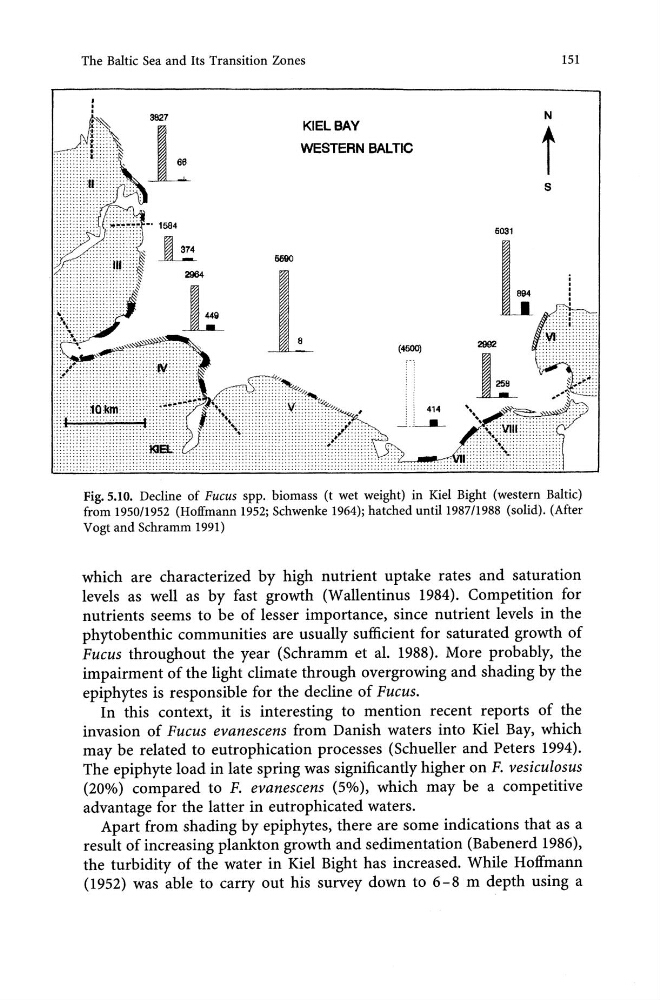
Fig. 5.10. Decline of Fucus spp. biomass (t wet weight) in Kiel Bight (western Baltic)
from 1950/1952 (Hoffmann 1952; Schwenke 1964); hatched until 1987/1988 (solid). (After
Vogt and Schramm 1991)
which are characterized by high nutrient uptake rates and saturation
levels as well as by fast growth (Wallentinus 1984). Competition for
nutrients seems to be of lesser importance, since nutrient levels in the
phytobenthic communities are usually sufficient for saturated growth of
Fucus throughout the year (Schramm et al. 1988). More probably, the
impairment of the light climate through overgrowing and shading by the
epiphytes is responsible for the decline of Fucus.
In this context, it is interesting to mention recent reports of the
invasion of Fucus evanescens from Danish waters into Kiel Bay, which
may be related to eutrophication processes (Schueller and Peters 1994).
The epiphyte load in late spring was significantly higher on F. vesiculosus
(20%) compared to F. evanescens (5%), which may be a competitive
advantage for the latter in eutrophicated waters.
Apart from shading by epiphytes, there are some indications that as a
result of increasing plankton growth and sedimentation (Babenerd 1986),
the turbidity of the water in Kiel Bight has increased. While Hoffmann
(1952) was able to carry out his survey down to 6-8 m depth using a
~ ;0\ . . ~
:.;::::;
. ., ...... .
. . :::: •••• :!.::: ••• ~
3827
1:
. . . . . . . . . . . . . . . . .
":>:i;~i~~~~~~;i~ii ~<~~~H7~~~~
::L··· .. · .. ·:::·:'X::::"
KIELBAY
WESTERN BALTIC
151
N
t
s
6031
:::: .....
:1::::::::
Fig. 5.10. Decline of Fucus spp. biomass (t wet weight) in Kiel Bight (western Baltic)
from 1950/1952 (Hoffmann 1952; Schwenke 1964); hatched until 1987/1988 (solid). (After
Vogt and Schramm 1991)
which are characterized by high nutrient uptake rates and saturation
levels as well as by fast growth (Wallentinus 1984). Competition for
nutrients seems to be of lesser importance, since nutrient levels in the
phytobenthic communities are usually sufficient for saturated growth of
Fucus throughout the year (Schramm et al. 1988). More probably, the
impairment of the light climate through overgrowing and shading by the
epiphytes is responsible for the decline of Fucus.
In this context, it is interesting to mention recent reports of the
invasion of Fucus evanescens from Danish waters into Kiel Bay, which
may be related to eutrophication processes (Schueller and Peters 1994).
The epiphyte load in late spring was significantly higher on F. vesiculosus
(20%) compared to F. evanescens (5%), which may be a competitive
advantage for the latter in eutrophicated waters.
Apart from shading by epiphytes, there are some indications that as a
result of increasing plankton growth and sedimentation (Babenerd 1986),
the turbidity of the water in Kiel Bight has increased. While Hoffmann
(1952) was able to carry out his survey down to 6-8 m depth using a