

The Baltic Sea and Its Transition Zones
50 N
40
30
20
Fucus
N
Phycodrys
. ......
-...,
OIl-L..L-'-~.L.....L...L.L.I-ILI.a......J'-LLL-L- 1l..Ll...J.LJ--LJlll.l~I:f::jt::.l..lJ....
ONDJFMAMJJAS
135
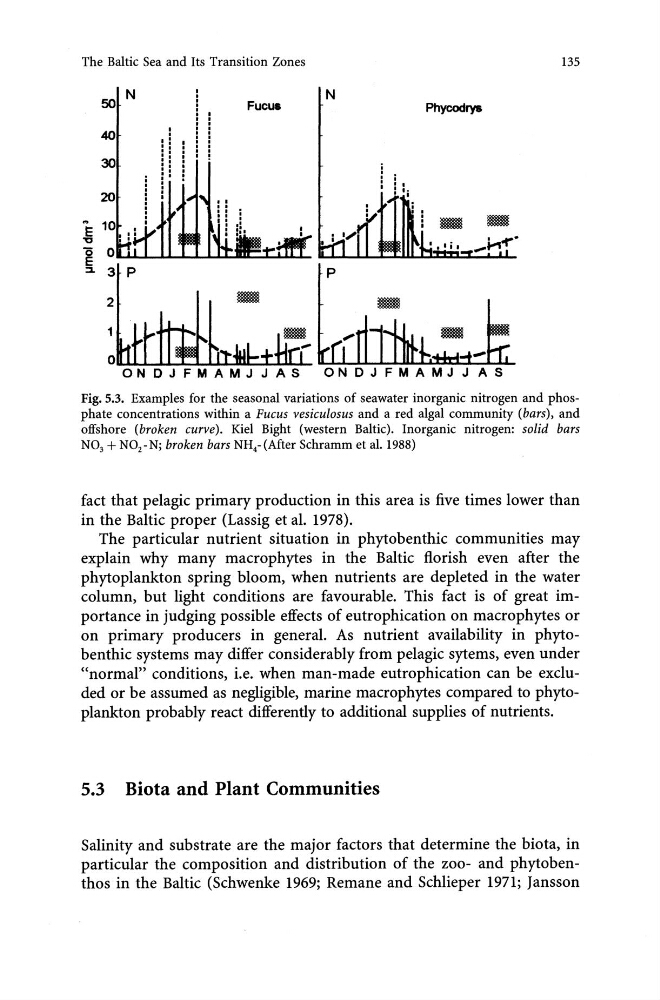
Fig. 5.3. Examples for the seasonal variations of seawater inorganic nitrogen and phosphate concentrations within a Fucus vesiculosus and a red algal community (bars), and
offshore (broken curve). Kiel Bight (western Baltic). Inorganic nitrogen: solid bars
N03 + NOz-N; broken bars NH4-(After Schramm et al. 1988)
fact that pelagic primary production in this area is five times lower than
in the Baltic proper (Lassig et al. 1978).
The particular nutrient situation in phytobenthic communities may
explain why many macrophytes in the Baltic florish even after the
phytoplankton spring bloom, when nutrients are depleted in the water
column, but light conditions are favourable. This fact is of great importance in judging possible effects of eutrophication on macrophytes or
on primary producers in general. As nutrient availability in phytobenthic systems may differ considerably from pelagic sytems, even under
"normal" conditions, i.e. when man-made eutrophication can be excluded or be assumed as negligible, marine macrophytes compared to phytoplankton probably react differently to additional supplies of nutrients.
5.3 Biota and Plant Communities
Salinity and substrate are the major factors that determine the biota, in
particular the composition and distribution of the zoo- and phytobenthos in the Baltic (Schwenke 1969; Remane and Schlieper 1971; Jansson
50 N
40
30
20
Fucus
N
Phycodrys
. ......
-...,
OIl-L..L-'-~.L.....L...L.L.I-ILI.a......J'-LLL-L- 1l..Ll...J.LJ--LJlll.l~I:f::jt::.l..lJ....
ONDJFMAMJJAS
135
Fig. 5.3. Examples for the seasonal variations of seawater inorganic nitrogen and phosphate concentrations within a Fucus vesiculosus and a red algal community (bars), and
offshore (broken curve). Kiel Bight (western Baltic). Inorganic nitrogen: solid bars
N03 + NOz-N; broken bars NH4-(After Schramm et al. 1988)
fact that pelagic primary production in this area is five times lower than
in the Baltic proper (Lassig et al. 1978).
The particular nutrient situation in phytobenthic communities may
explain why many macrophytes in the Baltic florish even after the
phytoplankton spring bloom, when nutrients are depleted in the water
column, but light conditions are favourable. This fact is of great importance in judging possible effects of eutrophication on macrophytes or
on primary producers in general. As nutrient availability in phytobenthic systems may differ considerably from pelagic sytems, even under
"normal" conditions, i.e. when man-made eutrophication can be excluded or be assumed as negligible, marine macrophytes compared to phytoplankton probably react differently to additional supplies of nutrients.
5.3 Biota and Plant Communities
Salinity and substrate are the major factors that determine the biota, in
particular the composition and distribution of the zoo- and phytobenthos in the Baltic (Schwenke 1969; Remane and Schlieper 1971; Jansson