

Aquaculture Methods for Use in Managing Eutrophicated Waters
125
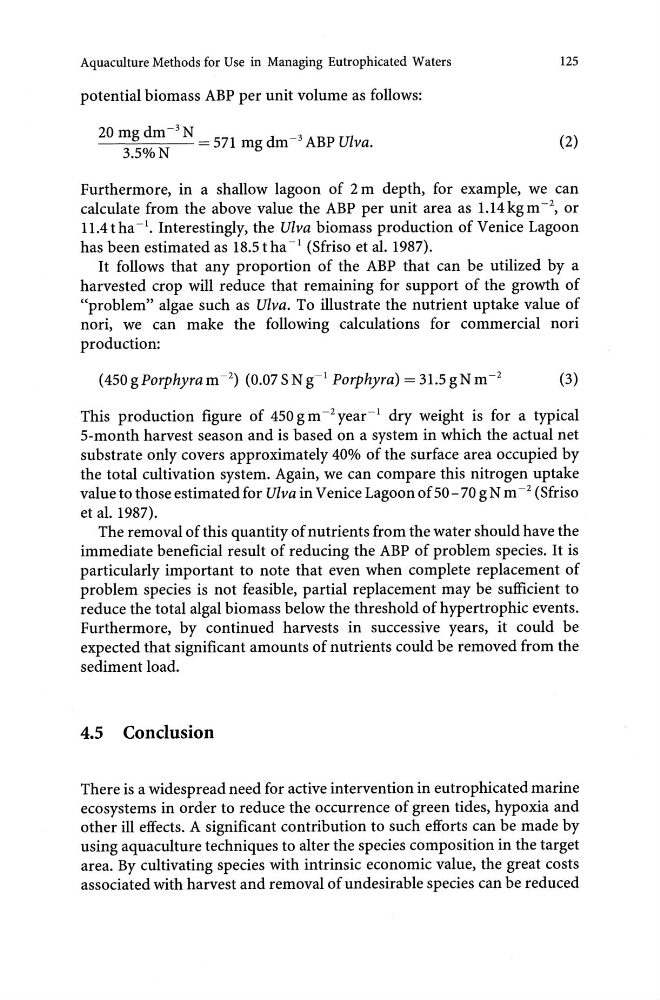
potential biomass ABP per unit volume as follows:
20 mg dm3
N _ 571
d -3 ABP Ul
3.5%N
-
mg m
va.
(2)
Furthermore, in a shallow lagoon of 2 m depth, for example, we can
calculate from the above value the ABP per unit area as 1.14kgm- 2 , or
11.4tha- l • Interestingly, the Ulva biomass production of Venice Lagoon
has been estimated as 18.5 t ha -I (Sfriso et al. 1987).
It follows that any proportion of the ABP that can be utilized by a
harvested crop will reduce that remaining for support of the growth of
"problem" algae such as Ulva. To illustrate the nutrient uptake value of
nori, we can make the following calculations for commercial nori
production:
(450gPorphyram-2) (0.07SNg- 1 Porphyra) =31.5gNm- 2
(3)
This production figure of 450 g m -2 year- I dry weight is for a typical
5-month harvest season and is based on a system in which the actual net
substrate only covers approximately 40% of the surface area occupied by
the total cultivation system. Again, we can compare this nitrogen uptake
value to those estimated for Ulva in Venice Lagoon of 50 -70 g N m -2 (Sfriso
et al. 1987).
The removal of this quantity of nutrients from the water should have the
immediate beneficial result of reducing the ABP of problem species. It is
particularly important to note that even when complete replacement of
problem species is not feasible, partial replacement may be sufficient to
reduce the total algal biomass below the threshold of hypertrophic events.
Furthermore, by continued harvests in successive years, it could be
expected that significant amounts of nutrients could be removed from the
sediment load.
4.5 Conclusion
There is a widespread need for active intervention in eutrophicated marine
ecosystems in order to reduce the occurrence of green tides, hypoxia and
other ill effects. A significant contribution to such efforts can be made by
using aquaculture techniques to alter the species composition in the target
area. By cultivating species with intrinsic economic value, the great costs
associated with harvest and removal of undesirable species can be reduced
125
potential biomass ABP per unit volume as follows:
20 mg dm3
N _ 571
d -3 ABP Ul
3.5%N
-
mg m
va.
(2)
Furthermore, in a shallow lagoon of 2 m depth, for example, we can
calculate from the above value the ABP per unit area as 1.14kgm- 2 , or
11.4tha- l • Interestingly, the Ulva biomass production of Venice Lagoon
has been estimated as 18.5 t ha -I (Sfriso et al. 1987).
It follows that any proportion of the ABP that can be utilized by a
harvested crop will reduce that remaining for support of the growth of
"problem" algae such as Ulva. To illustrate the nutrient uptake value of
nori, we can make the following calculations for commercial nori
production:
(450gPorphyram-2) (0.07SNg- 1 Porphyra) =31.5gNm- 2
(3)
This production figure of 450 g m -2 year- I dry weight is for a typical
5-month harvest season and is based on a system in which the actual net
substrate only covers approximately 40% of the surface area occupied by
the total cultivation system. Again, we can compare this nitrogen uptake
value to those estimated for Ulva in Venice Lagoon of 50 -70 g N m -2 (Sfriso
et al. 1987).
The removal of this quantity of nutrients from the water should have the
immediate beneficial result of reducing the ABP of problem species. It is
particularly important to note that even when complete replacement of
problem species is not feasible, partial replacement may be sufficient to
reduce the total algal biomass below the threshold of hypertrophic events.
Furthermore, by continued harvests in successive years, it could be
expected that significant amounts of nutrients could be removed from the
sediment load.
4.5 Conclusion
There is a widespread need for active intervention in eutrophicated marine
ecosystems in order to reduce the occurrence of green tides, hypoxia and
other ill effects. A significant contribution to such efforts can be made by
using aquaculture techniques to alter the species composition in the target
area. By cultivating species with intrinsic economic value, the great costs
associated with harvest and removal of undesirable species can be reduced