

96
1. De Vries et al.
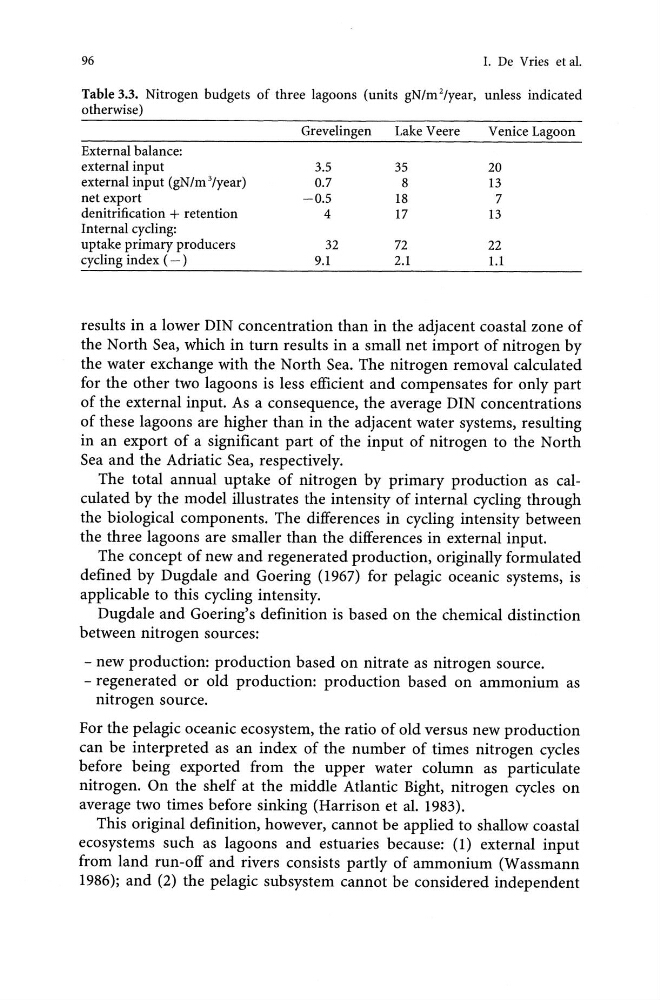
Table 3.3. Nitrogen budgets of three lagoons (units gNfm 2fyear, unless indicated
otherwise)
Grevelingen
External balance:
external input
3.5
external input (gNfm 3fyear)
0.7
net export
-0.5
denitrification + retention
4
Internal cycling:
uptake primary producers
32
cycling index ( - )
9.1
Lake Veere
35
8
18
17
72
2.1
Venice Lagoon
20
13
7
13
22
l.l
results in a lower DIN concentration than in the adjacent coastal zone of
the North Sea, which in turn results in a small net import of nitrogen by
the water exchange with the North Sea. The nitrogen removal calculated
for the other two lagoons is less efficient and compensates for only part
of the external input. As a consequence, the average DIN concentrations
of these lagoons are higher than in the adjacent water systems, resulting
in an export of a significant part of the input of nitrogen to the North
Sea and the Adriatic Sea, respectively.
The total annual uptake of nitrogen by primary production as calculated by the model illustrates the intensity of internal cycling through
the biological components. The differences in cycling intensity between
the three lagoons are smaller than the differences in external input.
The concept of new and regenerated production, originally formulated
defined by Dugdale and Goering (1967) for pelagic oceanic systems, is
applicable to this cycling intensity.
Dugdale and Goering's definition is based on the chemical distinction
between nitrogen sources:
- new production: production based on nitrate as nitrogen source.
- regenerated or old production: production based on ammonium as
nitrogen source.
For the pelagic oceanic ecosystem, the ratio of old versus new production
can be interpreted as an index of the number of times nitrogen cycles
before being exported from the upper water column as particulate
nitrogen. On the shelf at the middle Atlantic Bight, nitrogen cycles on
average two times before sinking (Harrison et al. 1983).
This original definition, however, cannot be applied to shallow coastal
ecosystems such as lagoons and estuaries because: (1) external input
from land run-off and rivers consists partly of ammonium (Wassmann
1986); and (2) the pelagic subsystem cannot be considered independent
1. De Vries et al.
Table 3.3. Nitrogen budgets of three lagoons (units gNfm 2fyear, unless indicated
otherwise)
Grevelingen
External balance:
external input
3.5
external input (gNfm 3fyear)
0.7
net export
-0.5
denitrification + retention
4
Internal cycling:
uptake primary producers
32
cycling index ( - )
9.1
Lake Veere
35
8
18
17
72
2.1
Venice Lagoon
20
13
7
13
22
l.l
results in a lower DIN concentration than in the adjacent coastal zone of
the North Sea, which in turn results in a small net import of nitrogen by
the water exchange with the North Sea. The nitrogen removal calculated
for the other two lagoons is less efficient and compensates for only part
of the external input. As a consequence, the average DIN concentrations
of these lagoons are higher than in the adjacent water systems, resulting
in an export of a significant part of the input of nitrogen to the North
Sea and the Adriatic Sea, respectively.
The total annual uptake of nitrogen by primary production as calculated by the model illustrates the intensity of internal cycling through
the biological components. The differences in cycling intensity between
the three lagoons are smaller than the differences in external input.
The concept of new and regenerated production, originally formulated
defined by Dugdale and Goering (1967) for pelagic oceanic systems, is
applicable to this cycling intensity.
Dugdale and Goering's definition is based on the chemical distinction
between nitrogen sources:
- new production: production based on nitrate as nitrogen source.
- regenerated or old production: production based on ammonium as
nitrogen source.
For the pelagic oceanic ecosystem, the ratio of old versus new production
can be interpreted as an index of the number of times nitrogen cycles
before being exported from the upper water column as particulate
nitrogen. On the shelf at the middle Atlantic Bight, nitrogen cycles on
average two times before sinking (Harrison et al. 1983).
This original definition, however, cannot be applied to shallow coastal
ecosystems such as lagoons and estuaries because: (1) external input
from land run-off and rivers consists partly of ammonium (Wassmann
1986); and (2) the pelagic subsystem cannot be considered independent