

4.1.10.2 The Three Scenarios
Currently, three main scenarios are proposed to describe
the evolutionary relationship between the three domains
of life:
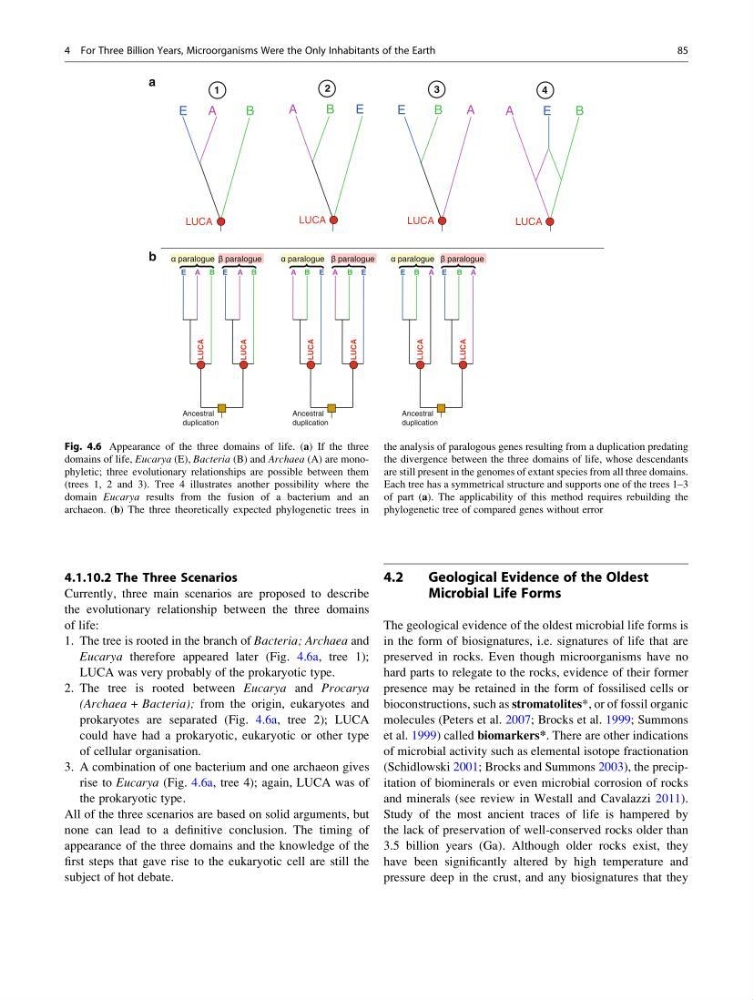
1. The tree is rooted in the branch of Bacteria; Archaea and
Eucarya therefore appeared later (Fig. 4.6a, tree 1);
LUCA was very probably of the prokaryotic type.
2. The tree is rooted between Eucarya and Procarya
(Archaea + Bacteria); from the origin, eukaryotes and
prokaryotes are separated (Fig. 4.6a, tree 2); LUCA
could have had a prokaryotic, eukaryotic or other type
of cellular organisation.
3. A combination of one bacterium and one archaeon gives
rise to Eucarya (Fig. 4.6a, tree 4); again, LUCA was of
the prokaryotic type.
All of the three scenarios are based on solid arguments, but
none can lead to a definitive conclusion. The timing of
appearance of the three domains and the knowledge of the
first steps that gave rise to the eukaryotic cell are still the
subject of hot debate.
4.2
Geological Evidence of the Oldest
Microbial Life Forms
The geological evidence of the oldest microbial life forms is
in the form of biosignatures, i.e. signatures of life that are
preserved in rocks. Even though microorganisms have no
hard parts to relegate to the rocks, evidence of their former
presence may be retained in the form of fossilised cells or
bioconstructions, such as stromatolites*, or of fossil organic
molecules (Peters et al. 2007; Brocks et al. 1999; Summons
et al. 1999) called biomarkers*. There are other indications
of microbial activity such as elemental isotope fractionation
(Schidlowski 2001; Brocks and Summons 2003), the precipitation of biominerals or even microbial corrosion of rocks
and minerals (see review in Westall and Cavalazzi 2011).
Study of the most ancient traces of life is hampered by
the lack of preservation of well-conserved rocks older than
3.5 billion years (Ga). Although older rocks exist, they
have been significantly altered by high temperature and
pressure deep in the crust, and any biosignatures that they
a
b
4
A
E
B
LUCA
3
E
A
B
LUCA
A
B
E
A
B
E
LUCA
LUCA
Ancestral
duplication
α paralogue β paralogue
2
E
A
B
LUCA
LUCA
LUCA
Ancestral
duplication
E
B
A
E
B
A
α paralogue β paralogue
LUCA
1
E
A
B
LUCA
LUCA
Ancestral
duplication
B
A
E
B
A
E
α paralogue β paralogue
Fig. 4.6 Appearance of the three domains of life. (a) If the three
domains of life, Eucarya (E), Bacteria (B) and Archaea (A) are monophyletic; three evolutionary relationships are possible between them
(trees 1, 2 and 3). Tree 4 illustrates another possibility where the
domain Eucarya results from the fusion of a bacterium and an
archaeon. (b) The three theoretically expected phylogenetic trees in
the analysis of paralogous genes resulting from a duplication predating
the divergence between the three domains of life, whose descendants
are still present in the genomes of extant species from all three domains.
Each tree has a symmetrical structure and supports one of the trees 1–3
of part (a). The applicability of this method requires rebuilding the
phylogenetic tree of compared genes without error
4 For Three Billion Years, Microorganisms Were the Only Inhabitants of the Earth
85
Currently, three main scenarios are proposed to describe
the evolutionary relationship between the three domains
of life:
1. The tree is rooted in the branch of Bacteria; Archaea and
Eucarya therefore appeared later (Fig. 4.6a, tree 1);
LUCA was very probably of the prokaryotic type.
2. The tree is rooted between Eucarya and Procarya
(Archaea + Bacteria); from the origin, eukaryotes and
prokaryotes are separated (Fig. 4.6a, tree 2); LUCA
could have had a prokaryotic, eukaryotic or other type
of cellular organisation.
3. A combination of one bacterium and one archaeon gives
rise to Eucarya (Fig. 4.6a, tree 4); again, LUCA was of
the prokaryotic type.
All of the three scenarios are based on solid arguments, but
none can lead to a definitive conclusion. The timing of
appearance of the three domains and the knowledge of the
first steps that gave rise to the eukaryotic cell are still the
subject of hot debate.
4.2
Geological Evidence of the Oldest
Microbial Life Forms
The geological evidence of the oldest microbial life forms is
in the form of biosignatures, i.e. signatures of life that are
preserved in rocks. Even though microorganisms have no
hard parts to relegate to the rocks, evidence of their former
presence may be retained in the form of fossilised cells or
bioconstructions, such as stromatolites*, or of fossil organic
molecules (Peters et al. 2007; Brocks et al. 1999; Summons
et al. 1999) called biomarkers*. There are other indications
of microbial activity such as elemental isotope fractionation
(Schidlowski 2001; Brocks and Summons 2003), the precipitation of biominerals or even microbial corrosion of rocks
and minerals (see review in Westall and Cavalazzi 2011).
Study of the most ancient traces of life is hampered by
the lack of preservation of well-conserved rocks older than
3.5 billion years (Ga). Although older rocks exist, they
have been significantly altered by high temperature and
pressure deep in the crust, and any biosignatures that they
a
b
4
A
E
B
LUCA
3
E
A
B
LUCA
A
B
E
A
B
E
LUCA
LUCA
Ancestral
duplication
α paralogue β paralogue
2
E
A
B
LUCA
LUCA
LUCA
Ancestral
duplication
E
B
A
E
B
A
α paralogue β paralogue
LUCA
1
E
A
B
LUCA
LUCA
Ancestral
duplication
B
A
E
B
A
E
α paralogue β paralogue
Fig. 4.6 Appearance of the three domains of life. (a) If the three
domains of life, Eucarya (E), Bacteria (B) and Archaea (A) are monophyletic; three evolutionary relationships are possible between them
(trees 1, 2 and 3). Tree 4 illustrates another possibility where the
domain Eucarya results from the fusion of a bacterium and an
archaeon. (b) The three theoretically expected phylogenetic trees in
the analysis of paralogous genes resulting from a duplication predating
the divergence between the three domains of life, whose descendants
are still present in the genomes of extant species from all three domains.
Each tree has a symmetrical structure and supports one of the trees 1–3
of part (a). The applicability of this method requires rebuilding the
phylogenetic tree of compared genes without error
4 For Three Billion Years, Microorganisms Were the Only Inhabitants of the Earth
85