

Box 17.1 (continued)
samples from wellheads: it necessitates the sterilization
of the tubing throughout its length, i.e., sometimes a
few thousand meters! The operation is obviously
extremely cumbersome and costly, since it uses
mechanical and chemical treatments involving specific
equipments and specialized teams and lasts several
weeks. But it is efficient, and the relevance of this
approach was demonstrated (Basso et al. 2005).
Deep Drillings Dedicated to Microbiological
Studies
Specific drilling operations taking into account all the
constraints of microbiological sampling is the dream of
any scientist interested in the deep biosphere. This has
been done, albeit with some compromises, in the context of two major research programs (“Subsurface
Science Microbiology” of the US Department of
Energy – DOE – and Integrated Ocean Drilling Program – IODP) and some more specific operations. In
the DOE program for which drilling down to a few
hundred meters deep has been made, specific drilling
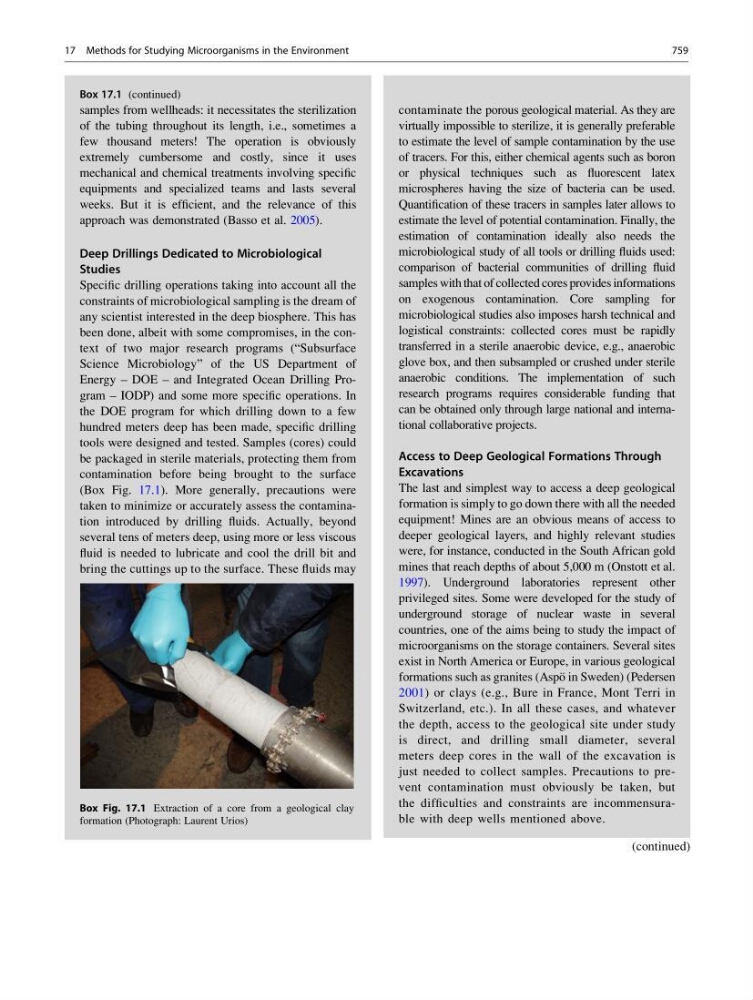
tools were designed and tested. Samples (cores) could
be packaged in sterile materials, protecting them from
contamination before being brought to the surface
(Box Fig. 17.1). More generally, precautions were
taken to minimize or accurately assess the contamination introduced by drilling fluids. Actually, beyond
several tens of meters deep, using more or less viscous
fluid is needed to lubricate and cool the drill bit and
bring the cuttings up to the surface. These fluids may
(continued)
Box 17.1 (continued)
contaminate the porous geological material. As they are
virtually impossible to sterilize, it is generally preferable
to estimate the level of sample contamination by the use
of tracers. For this, either chemical agents such as boron
or physical techniques such as fluorescent latex
microspheres having the size of bacteria can be used.
Quantification of these tracers in samples later allows to
estimate the level of potential contamination. Finally, the
estimation of contamination ideally also needs the
microbiological study of all tools or drilling fluids used:
comparison of bacterial communities of drilling fluid
samples with that of collected cores provides informations
on exogenous contamination. Core sampling for
microbiological studies also imposes harsh technical and
logistical constraints: collected cores must be rapidly
transferred in a sterile anaerobic device, e.g., anaerobic
glove box, and then subsampled or crushed under sterile
anaerobic conditions. The implementation of such
research programs requires considerable funding that
can be obtained only through large national and international collaborative projects.
Access to Deep Geological Formations Through
Excavations
The last and simplest way to access a deep geological
formation is simply to go down there with all the needed
equipment! Mines are an obvious means of access to
deeper geological layers, and highly relevant studies
were, for instance, conducted in the South African gold
mines that reach depths of about 5,000 m (Onstott et al.
1997). Underground laboratories represent other
privileged sites. Some were developed for the study of
underground storage of nuclear waste in several
countries, one of the aims being to study the impact of
microorganisms on the storage containers. Several sites
exist in North America or Europe, in various geological
formations such as granites (Aspo ¨ in Sweden) (Pedersen
2001) or clays (e.g., Bure in France, Mont Terri in
Switzerland, etc.). In all these cases, and whatever
the depth, access to the geological site under study
is direct, and drilling small diameter, several
meters deep cores in the wall of the excavation is
just needed to collect samples. Precautions to prevent contamination must obviously be taken, but
the difficulties and constraints are incommensurable with deep wells mentioned above.
(continued)
Box Fig. 17.1 Extraction of a core from a geological clay
formation (Photograph: Laurent Urios)
17 Methods for Studying Microorganisms in the Environment
759