

Box 16.6 (continued)
biodegradation of high molecular weight compounds.
However, such root exudates represent organic carbon
sources that may be easier to degrade than the PAH and
could reduce pollutant biodegradation rate.
Which Plant for the Phytoremediation of PAHs
Plants like fescue, ryegrass and other grasses, legumes
such as alfalfa, clover, or trees such as willow and birch
have been tested, and their ability to increase PAH degradation in soil was shown. Among a large number of
plants tested, crushed roots of celery, carrots, and
potatoes showed interesting pyrene degradation rates
that were attributed to their content in linoleic acid, promoting PAH degradation (Yi and Crowley 2007). The
association of plant roots with a symbiotic fungus also
increased PAH degradation in comparison to a nonmycorrhizal plant (Joner and Leyval 2003).
Bioavailability of PAHs in the Rhizosphere
The dissipation (decrease of extractible concentration)
of PAHs also depends on their bioavailability. Due
to their high hydrophobicity, they tend to adsorb to
soil organic matter, which limits their accessibility and
ability to be biodegraded. However, the production of
molecules with tensioactive properties can modify the
availability of PAHs and their biodegradation. The production of linoleic acid and saponins by some
(continued)
Box 16.6 (continued)
plants, of linoleic acid, or rhamnolipids by some
rhizosphere bacteria or fungi could increase PAH availability (Yi and Crowley 2007). The concentration of
PAHs in plant rhizosphere is therefore the result of degradation processes, but also of mobilization processes,
which can explain some of the contrasted results.
PAH Phytoremediation of PAH In Situ: Which
Perspectives
A large number of studies on PAH phytoremediation
were performed in laboratory conditions, in growth
chamber, pots, and columns. In situ studies are less
numerous and not always convincing. PAH
rhizodegradation has been studied in situ, but real application of this remediation technique is still limited. As an
example, in Nord Pas de Calais region, a
phytoremediation treatment using poplar was set up
after a biological treatment in a pile (Info Chimie Magazine, Mars/Avril 2005, N
462). It was a complementary
treatment associating phytostabilization and landscaping
to pollution remediation.
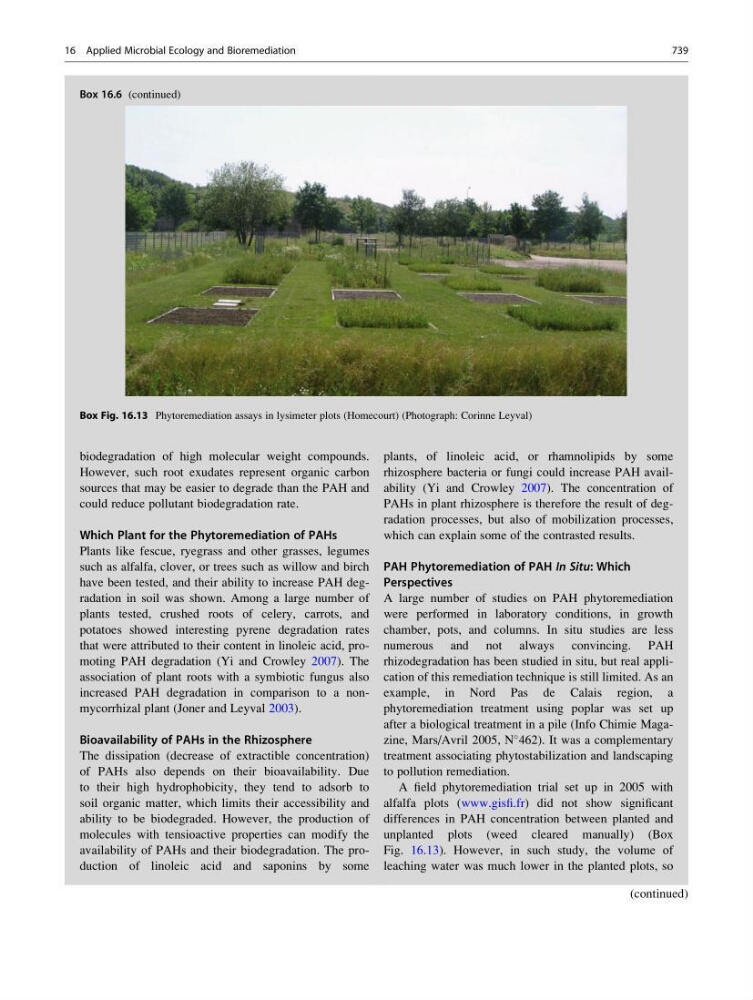
A field phytoremediation trial set up in 2005 with
alfalfa plots (www.gisfi.fr) did not show significant
differences in PAH concentration between planted and
unplanted plots (weed cleared manually) (Box
Fig. 16.13). However, in such study, the volume of
leaching water was much lower in the planted plots, so
(continued)
Box Fig. 16.13 Phytoremediation assays in lysimeter plots (Homecourt) (Photograph: Corinne Leyval)
16 Applied Microbial Ecology and Bioremediation
739