

(ii) Biodegradation levels decrease with the number of
chlorine atoms of the congeners.
(iii) Two chlorine atoms in ortho position on the same
aromatic ring (2,6) or on different rings (2,2
0 ), are
biodegradation resistant.
(iv) If chlorine atoms are present on both rings, that with
the lower number of chlorine atoms will be first
hydroxylated.
(v) Congeners chlorine substituted on the same aromatic
ring are more rapidly metabolized than those with the
same chlorine atom number but distributed on both
aromatic rings. Thus, 3,4-CB will be more easily
metabolized than 3
0 ,4-CB.
(vi) PCBs containing chlorine atoms on 2 and 3 positions
(2,2
0 3,3
0 -tetrachlorobyphenyl), 2,2
0 ,3,5
0 -tetrachlorobiphenyl and 2,2
0 ,3
0 ,4,5-pentachlorobiphenyl, are
more rapidly biodegraded than tetra- and pentachlorinated congeners.
(vii) An aromatic ring cleavage preferentially takes place on
an unsubstituted ring.
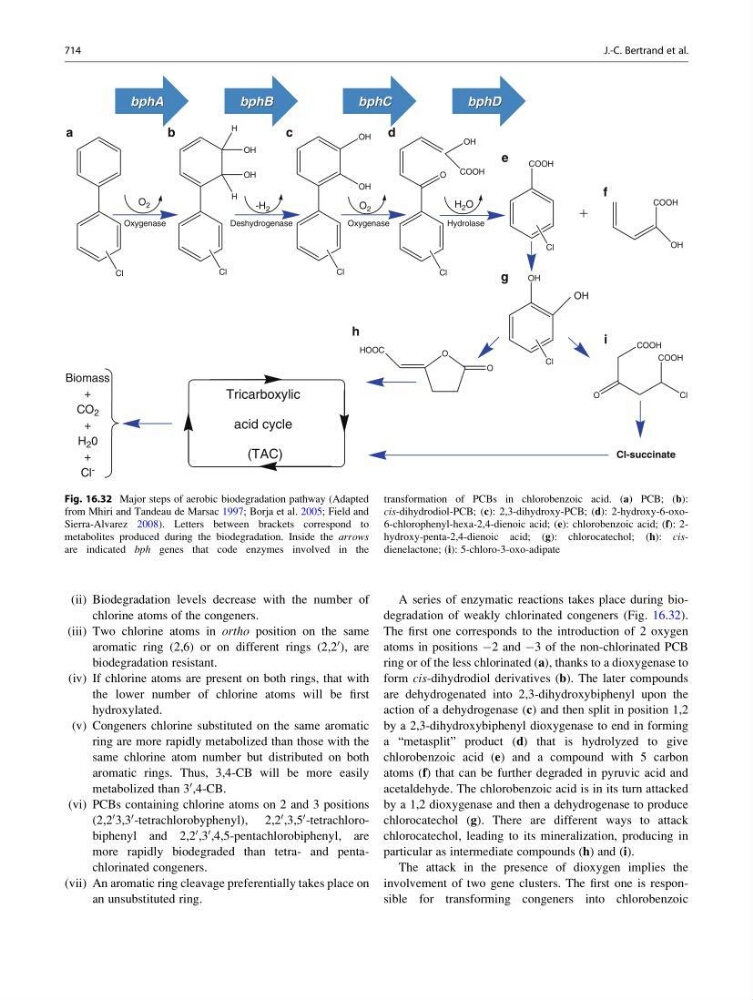
A series of enzymatic reactions takes place during biodegradation of weakly chlorinated congeners (Fig. 16.32).
The first one corresponds to the introduction of 2 oxygen
atoms in positions À2 and À3 of the non-chlorinated PCB
ring or of the less chlorinated (a), thanks to a dioxygenase to
form cis-dihydrodiol derivatives (b). The later compounds
are dehydrogenated into 2,3-dihydroxybiphenyl upon the
action of a dehydrogenase (c) and then split in position 1,2
by a 2,3-dihydroxybiphenyl dioxygenase to end in forming
a “metasplit” product (d) that is hydrolyzed to give
chlorobenzoic acid (e) and a compound with 5 carbon
atoms (f) that can be further degraded in pyruvic acid and
acetaldehyde. The chlorobenzoic acid is in its turn attacked
by a 1,2 dioxygenase and then a dehydrogenase to produce
chlorocatechol (g). There are different ways to attack
chlorocatechol, leading to its mineralization, producing in
particular as intermediate compounds (h) and (i).
The attack in the presence of dioxygen implies the
involvement of two gene clusters. The first one is responsible for transforming congeners into chlorobenzoic
bphA
bphA
bphB
bphB
bphD
bphD
bphC
bphC
O
COOH
Cl
Cl
Cl
Cl
OH
OH
OH
H
OH
H
COOH
OH
COOH
OH
Cl
+
O 2
O 2
-H 2
H 2 O
Deshydrogenase
Hydrolase
Oxygenase
Oxygenase
COOH
COOH
O
Cl
O
O
HOOC
Cl-succinate
Tricarboxylic
acid cycle
(TAC)
a
b
c
d
e
f
g
h
OH
Cl
OH
i
Biomass
+
CO 2
+
H 2 0
+
Cl -
Fig. 16.32 Major steps of aerobic biodegradation pathway (Adapted
from Mhiri and Tandeau de Marsac 1997; Borja et al. 2005; Field and
Sierra-Alvarez 2008). Letters between brackets correspond to
metabolites produced during the biodegradation. Inside the arrows
are indicated bph genes that code enzymes involved in the
transformation of PCBs in chlorobenzoic acid. (a) PCB; (b):
cis-dihydrodiol-PCB; (c): 2,3-dihydroxy-PCB; (d): 2-hydroxy-6-oxo6-chlorophenyl-hexa-2,4-dienoic acid; (e): chlorobenzoic acid; (f): 2hydroxy-penta-2,4-dienoic acid; (g): chlorocatechol; (h): cisdienelactone; (i): 5-chloro-3-oxo-adipate
714
J.-C. Bertrand et al.