

They showed that both genes were expressed in the
transformant strain resulting in the transformation of
atrazine to cyanuric acid which is easily degraded by
the soil microflora. Taking in consideration that
rhodococci are ubiquitous and that members of this
genus have already been successfully used in industry,
this makes them ideal candidates for manipulation of
pesticide-degrading-genetic potential to exploit bioremediation technologies (Shao et al. 1995). The isolation of
a wide diversity of atrazine-degrading strains having
different atrazine-degrading gene modules constitutes a
stock of atrazine-degrading-genetic modules that could
be used to “design on request” recombinant microbial
strains able to cope with different s-triazine type of
pollution. One could even think that application of new
genetic technologies such as directed mutagenesis or
DNA shuffling could allow extending the range of substrate that an enzyme can catalyze (Scott et al. 2009).
Experiments of directed evolution applying “DNA shuffling” have indeed shown that they could generate
functional diversity (Raillard et al. 2001) (Box 16.3).
Thus, starting from two genes, atzA and triA, encoding
hydrolases responsible for the dechlorination of atrazine
and the deamination of aminoatrazine, respectively, it was
possible to produce up to 1,600 recombinant sequences.
Of these, some encode enzymes whose catalytic constants
are 150-times higher than those of the two original
enzymes. Others were capable of hydrolyzing a range of
s-triazines which were not recognized as substrates by the
two original enzymes (Raillard et al. 2001).
For reasons already given, the introduced strain, from
natural origin or genetically modified, may have
difficulties to survive in the soil environment at the population level consistent with desired degrading activity.
In order to avoid this problem, another solution has
recently been considered. It comprises of introducing a
mobile genetic element carrying the catabolic genes
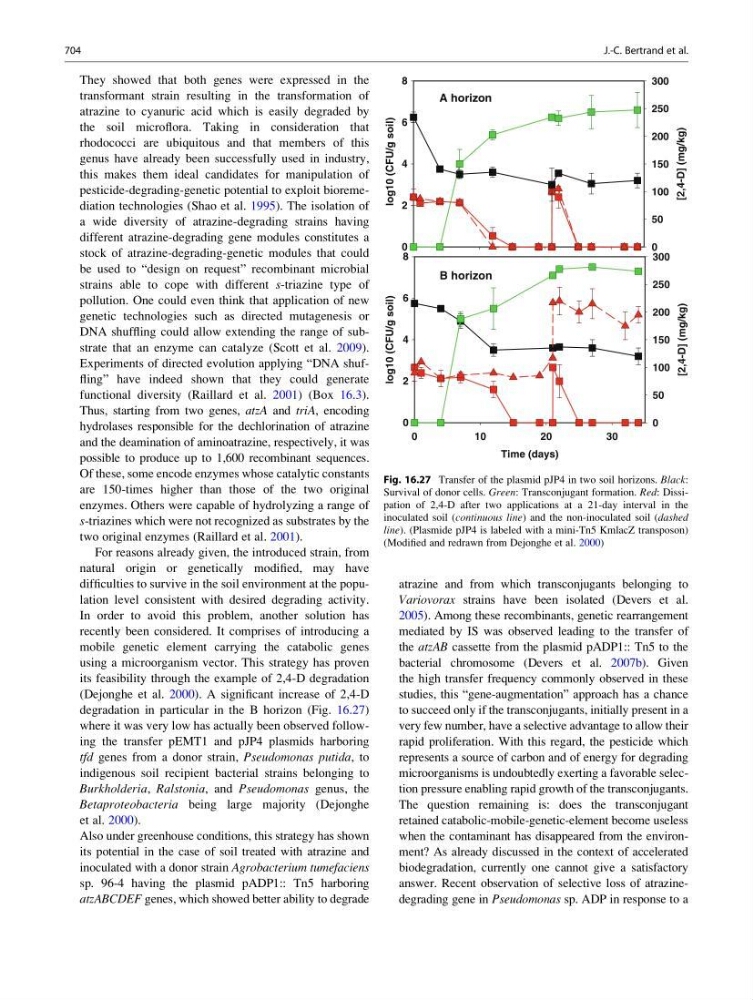
using a microorganism vector. This strategy has proven
its feasibility through the example of 2,4-D degradation
(Dejonghe et al. 2000). A significant increase of 2,4-D
degradation in particular in the B horizon (Fig. 16.27)
where it was very low has actually been observed following the transfer pEMT1 and pJP4 plasmids harboring
tfd genes from a donor strain, Pseudomonas putida, to
indigenous soil recipient bacterial strains belonging to
Burkholderia, Ralstonia, and Pseudomonas genus, the
Betaproteobacteria being large majority (Dejonghe
et al. 2000).
Also under greenhouse conditions, this strategy has shown
its potential in the case of soil treated with atrazine and
inoculated with a donor strain Agrobacterium tumefaciens
sp. 96-4 having the plasmid pADP1:: Tn5 harboring
atzABCDEF genes, which showed better ability to degrade
atrazine and from which transconjugants belonging to
Variovorax strains have been isolated (Devers et al.
2005). Among these recombinants, genetic rearrangement
mediated by IS was observed leading to the transfer of
the atzAB cassette from the plasmid pADP1:: Tn5 to the
bacterial chromosome (Devers et al. 2007b). Given
the high transfer frequency commonly observed in these
studies, this “gene-augmentation” approach has a chance
to succeed only if the transconjugants, initially present in a
very few number, have a selective advantage to allow their
rapid proliferation. With this regard, the pesticide which
represents a source of carbon and of energy for degrading
microorganisms is undoubtedly exerting a favorable selection pressure enabling rapid growth of the transconjugants.
The question remaining is: does the transconjugant
retained catabolic-mobile-genetic-element become useless
when the contaminant has disappeared from the environment? As already discussed in the context of accelerated
biodegradation, currently one cannot give a satisfactory
answer. Recent observation of selective loss of atrazinedegrading gene in Pseudomonas sp. ADP in response to a
A horizon
log10 (CFU/g soil)
0
2
4
6
8
[2,4-D] (mg/kg)
0
50
100
150
200
250
300
B horizon
Time (days)
0
1 0
2 0
3 0
log10 (CFU/g soil)
0
2
4
6
8
[2,4-D] (mg/kg)
0
50
100
150
200
250
300
Fig. 16.27 Transfer of the plasmid pJP4 in two soil horizons. Black:
Survival of donor cells. Green: Transconjugant formation. Red: Dissipation of 2,4-D after two applications at a 21-day interval in the
inoculated soil (continuous line) and the non-inoculated soil (dashed
line). (Plasmide pJP4 is labeled with a mini-Tn5 KmlacZ transposon)
(Modified and redrawn from Dejonghe et al. 2000)
704
J.-C. Bertrand et al.