

isolated by Mandelbaum et al. (1995) almost 50 years
after its discovery and that atrazine from this point of
view represents an exception since for the vast majority
of xenobiotics, no mineralizing-bacterial strains are
known. It turns out that isolation of pesticide-degrading
strains, usually by enrichment cultures with or without
co-substrate carried out under laboratory conditions, is an
essential prerequisite. Their biotechnological use for land
reclamation is not always successful, especially over
time, including after large inoculations. The most cited
reason is the difficulty for the introduced strain to find an
ecological niche allowing its permanent in situ settlement. This may appear as a consequence of the Pareto
law (Dejonghe et al. 2001) showing that 20 % of
microorganisms in an ecosystem control 80 % of the
energy flow. One could hypothesize that only physiological capacities consistent with those of the dominant
microbial populations can ensure the survival of the
introduced pesticide-degrading strain. From this point
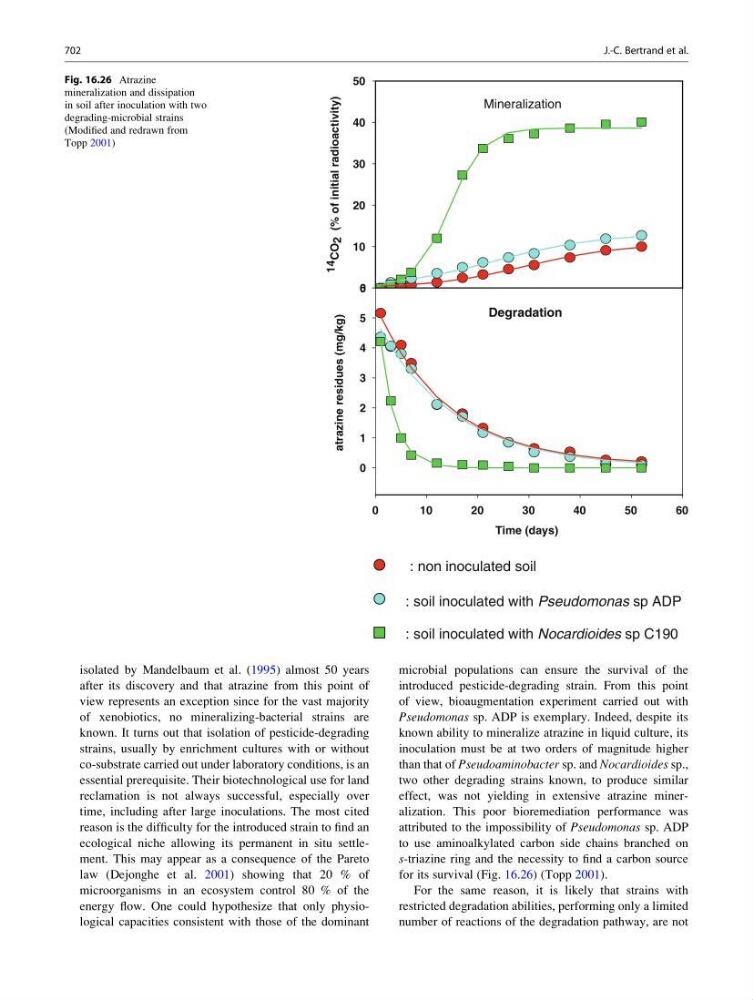
of view, bioaugmentation experiment carried out with
Pseudomonas sp. ADP is exemplary. Indeed, despite its
known ability to mineralize atrazine in liquid culture, its
inoculation must be at two orders of magnitude higher
than that of Pseudoaminobacter sp. and Nocardioides sp.,
two other degrading strains known, to produce similar
effect, was not yielding in extensive atrazine mineralization. This poor bioremediation performance was
attributed to the impossibility of Pseudomonas sp. ADP
to use aminoalkylated carbon side chains branched on
s-triazine ring and the necessity to find a carbon source
for its survival (Fig. 16.26) (Topp 2001).
For the same reason, it is likely that strains with
restricted degradation abilities, performing only a limited
number of reactions of the degradation pathway, are not
14
CO
2 (% of initial radioactivity)
0
10
20
30
40
50
Degradation
Time (days)
0
1 0
2 0
3 0
4 0
5 0
6 0
atrazine residues (mg/kg)
0
1
2
3
4
5
6
Mineralization
: soil inoculated with Pseudomonas sp ADP
: soil inoculated with Nocardioides sp C190
: non inoculated soil
Fig. 16.26 Atrazine
mineralization and dissipation
in soil after inoculation with two
degrading-microbial strains
(Modified and redrawn from
Topp 2001)
702
J.-C. Bertrand et al.