

economic competitiveness of different treatment methods
based on a diagram flow/concentration. It should be noted
that the proposed schemes keep a general appearance, and
the limits of economic competitiveness data are dependent
on the nature of the processed air.
16.6.2.1 The Recuperative Treatment
The condensation is achieved by reaching the dew point* of
the gas by reducing the temperature or by increasing the
pressure. For economic and technical reasons, the organic
compounds to be treated must have a dew point temperature
above 40
C.
Absorption consists to transfer the organic compounds of
the air to a liquid phase. The effectiveness of treatment
depends mainly on the affinity of the pollutant with the
liquid phase. From the technical point of view, the contact
of the two phases is performed by dispersing the liquid phase
in the gas phase using columns (filled or with beds) or spray
towers. This method has the advantage of being well known.
Adsorption is a process of transferring the pollutant from
the gas phase to the surface of a solid. Conventionally, the
process is done in a fixed bed and operated alternately with
two adsorbent beds in a regeneration system. This regeneration is usually done at warm temperature. Gas permeation is
also conceivable for transferring the pollutant from a gas
phase to another concentrated gas phase. This technology
has emerged through the use of semipermeable membranes.
According to the separation factor of the membrane, a permeate gas more or less concentrated is obtained downstream
of the membrane simultaneously depleting the retentate.
16.6.2.2 Destructive Treatments
Incineration Treatments
It is commonly found in the industry and led to the destruction of molecules forming CO 2 and water if combustion is
complete. Two types of incineration can be distinguished:
(i) At hot temperature from 600 to 850
C depending on the
compounds.
(ii) Catalytic which involves oxidation catalysts and lower
temperatures (370 < T < 480
C). These incinerators
are known as regenerative or recuperative according to
the mode of recovered energy obtained during combustion. This process of easy implementation is suitable for
a wide range of flow and enhances the recovered energy.
However, it is not suitable when the gas to be treated
contains dust (dirt), heteroatoms (chlorine atoms lead to
the formation of hydrochloric acid), or poisons. Systems
for pretreatment or posttreatment of gases are possible
(filters, washing).
Biological Treatments
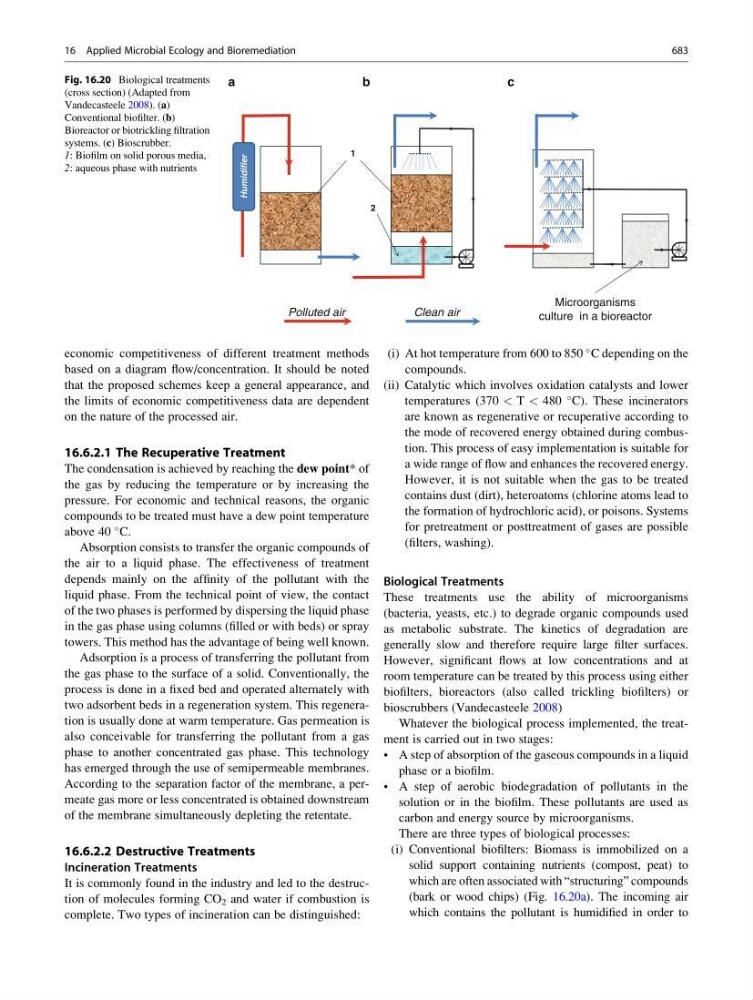
These treatments use the ability of microorganisms
(bacteria, yeasts, etc.) to degrade organic compounds used
as metabolic substrate. The kinetics of degradation are
generally slow and therefore require large filter surfaces.
However, significant flows at low concentrations and at
room temperature can be treated by this process using either
biofilters, bioreactors (also called trickling biofilters) or
bioscrubbers (Vandecasteele 2008)
Whatever the biological process implemented, the treatment is carried out in two stages:
• A step of absorption of the gaseous compounds in a liquid
phase or a biofilm.
• A step of aerobic biodegradation of pollutants in the
solution or in the biofilm. These pollutants are used as
carbon and energy source by microorganisms.
There are three types of biological processes:
(i) Conventional biofilters: Biomass is immobilized on a
solid support containing nutrients (compost, peat) to
which are often associated with “structuring” compounds
(bark or wood chips) (Fig. 16.20a). The incoming air
which contains the pollutant is humidified in order to
Humidifier
Polluted air
Clean air
Microorganisms
culture in a bioreactor
a
b
1
2
c
Fig. 16.20 Biological treatments
(cross section) (Adapted from
Vandecasteele 2008). (a)
Conventional biofilter. (b)
Bioreactor or biotrickling filtration
systems. (c) Bioscrubber.
1: Biofilm on solid porous media,
2: aqueous phase with nutrients
16 Applied Microbial Ecology and Bioremediation
683