

(ii) The anaerobic degradation of organic matter is the
dominant mechanism in landfills. Under anaerobic
conditions, the metabolites resulting from hydrolysis are
converted into intermediate metabolites consisting mainly
of volatile fatty acids (VFA), monocarboxylic linear
saturated short chain (acetic, propionic, butyric acids,
etc.), and end gaseous metabolites, responsible for the
offshoot of biogas in landfills (CO 2 , CH 4 , H 2 S). Figure 16.18 is a synthetic representation of the biological
degradation of organic matter under anaerobic conditions.
16.6 The Gaseous Effluents
16.6.1 Sources
Increase in energy consumption, development of industries,
increased road and air traffic, garbage incineration,
and increasing number of sewage treatment plants are
sources of air pollution, especially in urban areas. Air
pollutants can be gaseous, organic volatile, or particulate.
Gaseous pollutants are mainly the sulfur compounds (SO 3 ,
H 2 S), carbon oxides (CO, CO 2 ), nitrogen oxides (NOx),
ammonia (NH 3 ), ozone, acid aerosols (Cl
À , F
À ), and
cyanides. The main volatile organic compounds (VOCs) are:
(i) n-Alkanes (methane, ethane, pentane, heptane,
octane, etc.)
(ii) Aromatic hydrocarbons (benzene, toluene, xylene,
benzopyrene, etc.), olefins (ethylene, butadiene)
(iii) Halogenated hydrocarbons
(iv) Oxygenate compounds (alcohols, aldehydes, ketones)
(v) Sulfur compounds (mercaptans, dimethylsulfide, etc.)
16.6.2 Treatments
Treatment of waste gases can be classified according to the
type of process: regenerative or destructive. All of these
processes, as well as going technological variants, are
detailed in Fig. 16.19. Each process will be more efficient
according to the specific gas to be processed (flow ranges,
concentrations, and nature of chemical pollutants) and the
peculiarities of the production site (reusability of pollutants,
availability of refrigerant vapor or water, etc.). The final
choice will be made primarily on physicochemical considerations, since they will determine the technical
feasibility of a particular process. Then, it will be based on
economic criteria like the annual capital and operating costs
of industrial equipment. To facilitate the process selection,
many authors have evaluated and represented areas of
Hydrolysis
Acidogenesis
Acetogenesis
Methanogenesis
Inorganic part of
sewage
Dissolving of
soluble salts
Dissolving of silicates and
carbonate in environments
rich in CO 2
Nitrate, iron and
manganese reduction
Sulfate reduction and
sulfide precipitation
PHYSICO - CHEMICAL PROCESSES
BIOLOGICAL
PROCESSES
Major
elements
Metals, nitrogen,
ammonia
Sulfide
CO 2
CO 2
Redox control
Redox control
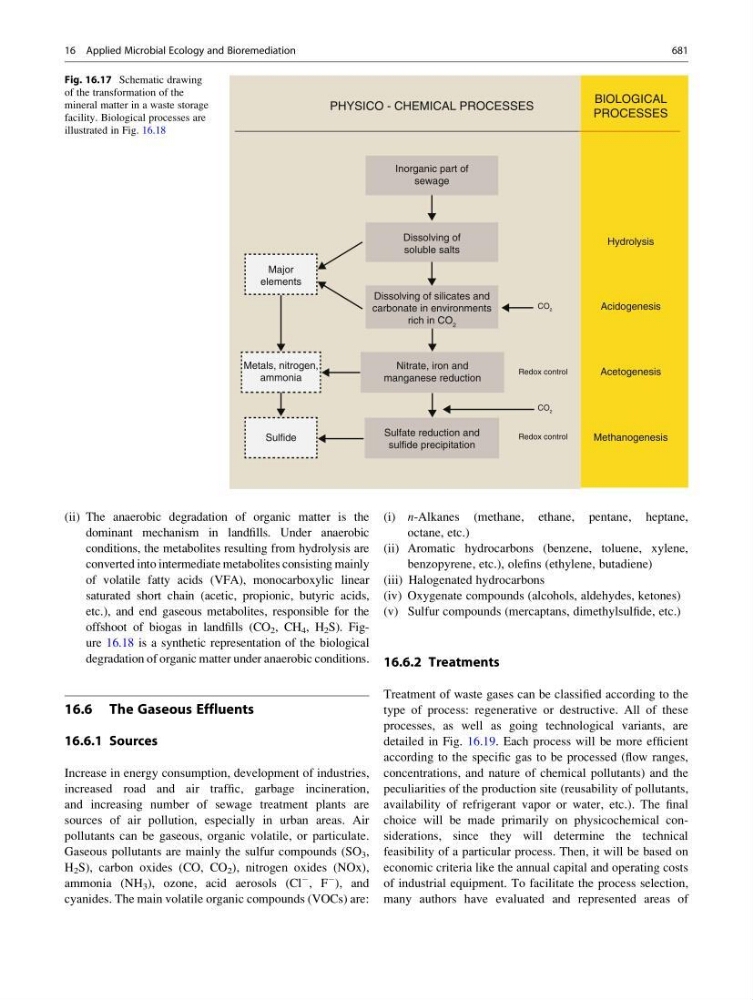
Fig. 16.17 Schematic drawing
of the transformation of the
mineral matter in a waste storage
facility. Biological processes are
illustrated in Fig. 16.18
16 Applied Microbial Ecology and Bioremediation
681