

Since the work of Xu et al. (1982), VNC forms
have been described in many bacterial groups including
several pathogenic species, e.g., Legionella pneumophila,
Francisella tularensis, Enterococcus faecium, Helicobacter pylori, Listeria monocytogenes, Burkholderia
pseudomallei, Burkholderia of the cepacia complex, and
many others (for a review see Oliver 2010; Colwell and
Grimes 2000). The VNC state has now been induced by a
variety of factors such as temperature, nutrient deficiency,
hydrostatic pressure, pH, or salinity changes. These factors
induce a series of events resulting in morphological
changes (usually a reduction in cell size) and changes in
the concentration of major polymers (proteins, membrane
lipids, nucleic acids). They lead to a progressive loss of the
cell ability at multiplying on agar plates or in broths normally used as standard growth media for these bacteria.
The nature of the changes to be considered in defining
the VNC status, however, remains debated. Operational
definitions have been introduced to clarify the situation
such as the terms bacteria “immediately cultivated,”
“ultimately cultivated,” or “active but non-culturable”
highlighting that procedures used for growing bacteria on
agar media could change the proportions of estimated VNC
forms. VNC bacteria are also sometimes defined as “dormant” or “inactive.” This ambiguity is based on the fact
that the criteria to define the state of bacterial viability
remain unclear, and therefore it remains hard to declare a
cell as being dead, dying, or alive. Some authors consider
that the VNC forms shall evolve to cell death, while others
believe that the non-culturable state is a part of the life
cycle of the cell, while also reflecting a survival strategy
when environmental conditions are unfavorable. This latter
vision of the VNC state would need to be built on the
existence of reversible bacterial processes regulated by
environmental factors to be identified.
Work has been performed to verify the existence
of processes inducing a transition to the VNC form in
E. coli. A significant finding was the observation of an
increase in oxidized proteins in VNC forms of E. coli
associated with an induction of the defense processes
against reactive oxygen species (ROS) (Dukan and
Box 15.4 (continued)
– Some bacteria of the community may be moribund
or dead. These cells can persist in the environment
and be detected by direct observation by flow
cytometry until their effective lysis.
– Some other bacterial cells, which are normally able
to form colony on an agar culture medium, may
have undergone various stress factors (temperature,
salinity, ultraviolet radiation, nutrient deficiency,
etc.), and although they conserve a cellular activity,
they can be temporarily unable to grow on this
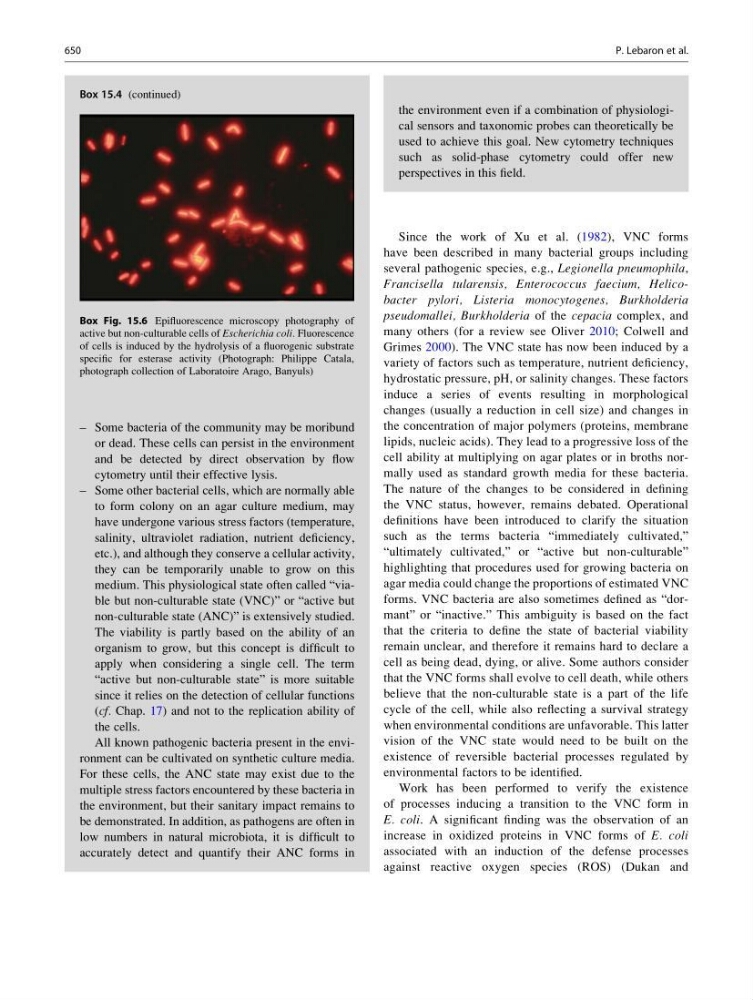
medium. This physiological state often called “viable but non-culturable state (VNC)” or “active but
non-culturable state (ANC)” is extensively studied.
The viability is partly based on the ability of an
organism to grow, but this concept is difficult to
apply when considering a single cell. The term
“active but non-culturable state” is more suitable
since it relies on the detection of cellular functions
(cf. Chap. 17) and not to the replication ability of
the cells.
All known pathogenic bacteria present in the environment can be cultivated on synthetic culture media.
For these cells, the ANC state may exist due to the
multiple stress factors encountered by these bacteria in
the environment, but their sanitary impact remains to
be demonstrated. In addition, as pathogens are often in
low numbers in natural microbiota, it is difficult to
accurately detect and quantify their ANC forms in
(continued)
Box Fig. 15.6 Epifluorescence microscopy photography of
active but non-culturable cells of Escherichia coli. Fluorescence
of cells is induced by the hydrolysis of a fluorogenic substrate
specific for esterase activity (Photograph: Philippe Catala,
photograph collection of Laboratoire Arago, Banyuls)
Box 15.4 (continued)
the environment even if a combination of physiological sensors and taxonomic probes can theoretically be
used to achieve this goal. New cytometry techniques
such as solid-phase cytometry could offer new
perspectives in this field.
650
P. Lebaron et al.