

concentrations of pathogens are high but also when the
abundance of protozoa is important. The latter varies from
one environment to another; in a given environment, it
generally increases with increasing temperature. As the
rate of ingestion of bacteria by protozoa also increases
with temperature, this implies a larger grazing in summer
than in winter. This may partly explain the better survival of
pathogenic microorganisms at low temperatures reported by
some authors.
Viral lysis is also concentration dependent and is exerted
especially when a pathogenic species becomes abundant.
It may be important in the case of blooms of cyanobacteria.
The exact effect of viral lysis in the natural environment is
difficult to estimate.
Competition for food resources is also important, especially in environments where this resource is limited and
where native species are much more competitive.
15.7.4 Global Change Effects
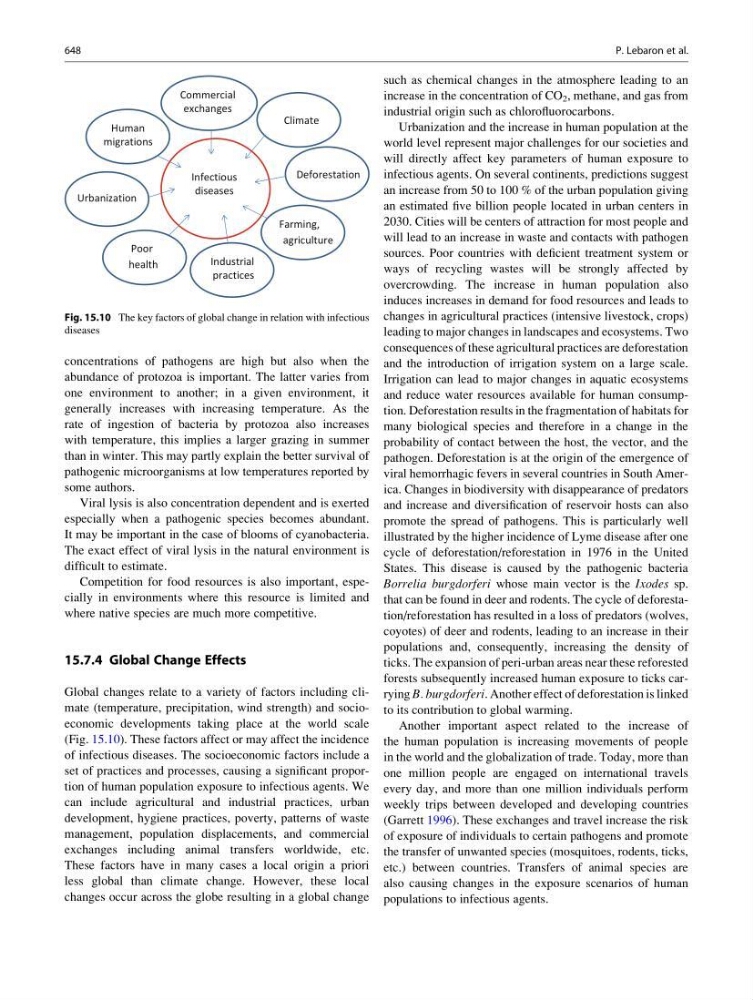
Global changes relate to a variety of factors including climate (temperature, precipitation, wind strength) and socioeconomic developments taking place at the world scale
(Fig. 15.10). These factors affect or may affect the incidence
of infectious diseases. The socioeconomic factors include a
set of practices and processes, causing a significant proportion of human population exposure to infectious agents. We
can include agricultural and industrial practices, urban
development, hygiene practices, poverty, patterns of waste
management, population displacements, and commercial
exchanges including animal transfers worldwide, etc.
These factors have in many cases a local origin a priori
less global than climate change. However, these local
changes occur across the globe resulting in a global change
such as chemical changes in the atmosphere leading to an
increase in the concentration of CO 2 , methane, and gas from
industrial origin such as chlorofluorocarbons.
Urbanization and the increase in human population at the
world level represent major challenges for our societies and
will directly affect key parameters of human exposure to
infectious agents. On several continents, predictions suggest
an increase from 50 to 100 % of the urban population giving
an estimated five billion people located in urban centers in
2030. Cities will be centers of attraction for most people and
will lead to an increase in waste and contacts with pathogen
sources. Poor countries with deficient treatment system or
ways of recycling wastes will be strongly affected by
overcrowding. The increase in human population also
induces increases in demand for food resources and leads to
changes in agricultural practices (intensive livestock, crops)
leading to major changes in landscapes and ecosystems. Two
consequences of these agricultural practices are deforestation
and the introduction of irrigation system on a large scale.
Irrigation can lead to major changes in aquatic ecosystems
and reduce water resources available for human consumption. Deforestation results in the fragmentation of habitats for
many biological species and therefore in a change in the
probability of contact between the host, the vector, and the
pathogen. Deforestation is at the origin of the emergence of
viral hemorrhagic fevers in several countries in South America. Changes in biodiversity with disappearance of predators
and increase and diversification of reservoir hosts can also
promote the spread of pathogens. This is particularly well
illustrated by the higher incidence of Lyme disease after one
cycle of deforestation/reforestation in 1976 in the United
States. This disease is caused by the pathogenic bacteria
Borrelia burgdorferi whose main vector is the Ixodes sp.
that can be found in deer and rodents. The cycle of deforestation/reforestation has resulted in a loss of predators (wolves,
coyotes) of deer and rodents, leading to an increase in their
populations and, consequently, increasing the density of
ticks. The expansion of peri-urban areas near these reforested
forests subsequently increased human exposure to ticks carrying B. burgdorferi. Another effect of deforestation is linked
to its contribution to global warming.
Another important aspect related to the increase of
the human population is increasing movements of people
in the world and the globalization of trade. Today, more than
one million people are engaged on international travels
every day, and more than one million individuals perform
weekly trips between developed and developing countries
(Garrett 1996). These exchanges and travel increase the risk
of exposure of individuals to certain pathogens and promote
the transfer of unwanted species (mosquitoes, rodents, ticks,
etc.) between countries. Transfers of animal species are
also causing changes in the exposure scenarios of human
populations to infectious agents.
Farming,
agriculture
Commercial
exchanges
Human
migrations
Urbanization
Poor
health
Deforestation
Industrial
practices
Climate
Infectious
diseases
Fig. 15.10 The key factors of global change in relation with infectious
diseases
648
P. Lebaron et al.