

15.5 Soil and Dissemination
of Pathogenic Agents
Soil environments are extremely diverse both considering
their microbial composition and the extent of their chemical,
physical, and structural characteristics. A current global
estimate suggests that one gram of soil contains as many as
10
10 –10
11 bacteria and as many as 10
4 –10
6 bacterial species.
The distribution of these species depends on abiotic soil
characteristics, on their ability to grow under anaerobic or
aerobic conditions, as well as on their interactions with
higher organisms including plants and micro(macro)-fauna.
Soil can act as a reservoir of pathogenic agents either
because they are indigenous soil inhabitants or as transient
visitors introduced through anthropogenic activities. It is
now recognized or hypothesized that soil constitutes the
natural habitat of several bacterial pathogens belonging to
genus Clostridium (C. perfringens, C. tetani, C. botulinum),
Bacillus (B. anthracis), Nocardia, Mycobacterium
(M. tuberculosis), and Burkholderia (B. pseudomallei).
Phylogenetically related species (i.e., B. cereus, M. bovis)
to these pathogens have been isolated from soils (Kuske
et al. 2006). Researches on C. difficile, a pathogen responsible for nosocomial infections, evidence its occurrence in
21–37 % of the soil samples tested (Simango 2006). Intrinsic
properties as spore-forming ability could favor their longterm survival. The occurrence of B. pseudomallei, the agent
responsible for melioidosis, a potentially fatal septicemic
infectious disease among humans and an endemic disease
in Southeast Asia (particularly Thailand) and Northern
Australia, is intensively studied in these countries. Palasatien
and collaborators (2008) investigated the presence of
B. pseudomallei in relation to the physicochemical
properties of soil from the Khon Kaen Province, northeast
Thailand. The authors evidenced that the organism was
found mainly at a depth of 30 cm and was significantly
associated with some soil physicochemical parameters,
including a pH of 5.0–6.0, a moisture content >10 %, and
a higher chemical oxygen demand and total nitrogen than
those reported for negative sites. They concluded on an
uneven distribution of B. pseudomallei in this area, with
the pH of the soil being the major determinant for the
presence of the organism. Analysis of 104 collected soil
samples in northern Australia has revealed a significant
association between B. pseudomallei-positive sites and the
presence of animals at these locations and also with moist,
reddish brown to reddish gray soils (Kaestli et al. 2007).
Among opportunistic pathogens, many of them are abundant populations in plant rhizosphere. Various species
involved in infections among cystic fibrosis individuals
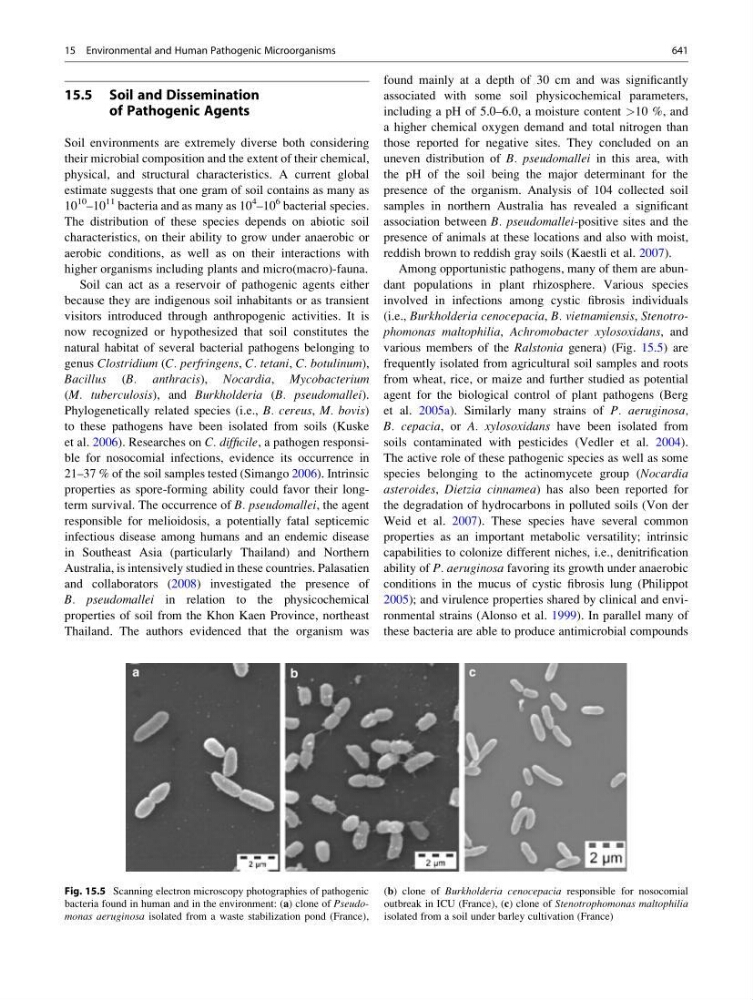
(i.e., Burkholderia cenocepacia, B. vietnamiensis, Stenotrophomonas maltophilia, Achromobacter xylosoxidans, and
various members of the Ralstonia genera) (Fig. 15.5) are
frequently isolated from agricultural soil samples and roots
from wheat, rice, or maize and further studied as potential
agent for the biological control of plant pathogens (Berg
et al. 2005a). Similarly many strains of P. aeruginosa,
B. cepacia, or A. xylosoxidans have been isolated from
soils contaminated with pesticides (Vedler et al. 2004).
The active role of these pathogenic species as well as some
species belonging to the actinomycete group (Nocardia
asteroides, Dietzia cinnamea) has also been reported for
the degradation of hydrocarbons in polluted soils (Von der
Weid et al. 2007). These species have several common
properties as an important metabolic versatility; intrinsic
capabilities to colonize different niches, i.e., denitrification
ability of P. aeruginosa favoring its growth under anaerobic
conditions in the mucus of cystic fibrosis lung (Philippot
2005); and virulence properties shared by clinical and environmental strains (Alonso et al. 1999). In parallel many of
these bacteria are able to produce antimicrobial compounds
Fig. 15.5 Scanning electron microscopy photographies of pathogenic
bacteria found in human and in the environment: (a) clone of Pseudomonas aeruginosa isolated from a waste stabilization pond (France),
(b) clone of Burkholderia cenocepacia responsible for nosocomial
outbreak in ICU (France), (c) clone of Stenotrophomonas maltophilia
isolated from a soil under barley cultivation (France)
15 Environmental and Human Pathogenic Microorganisms
641