

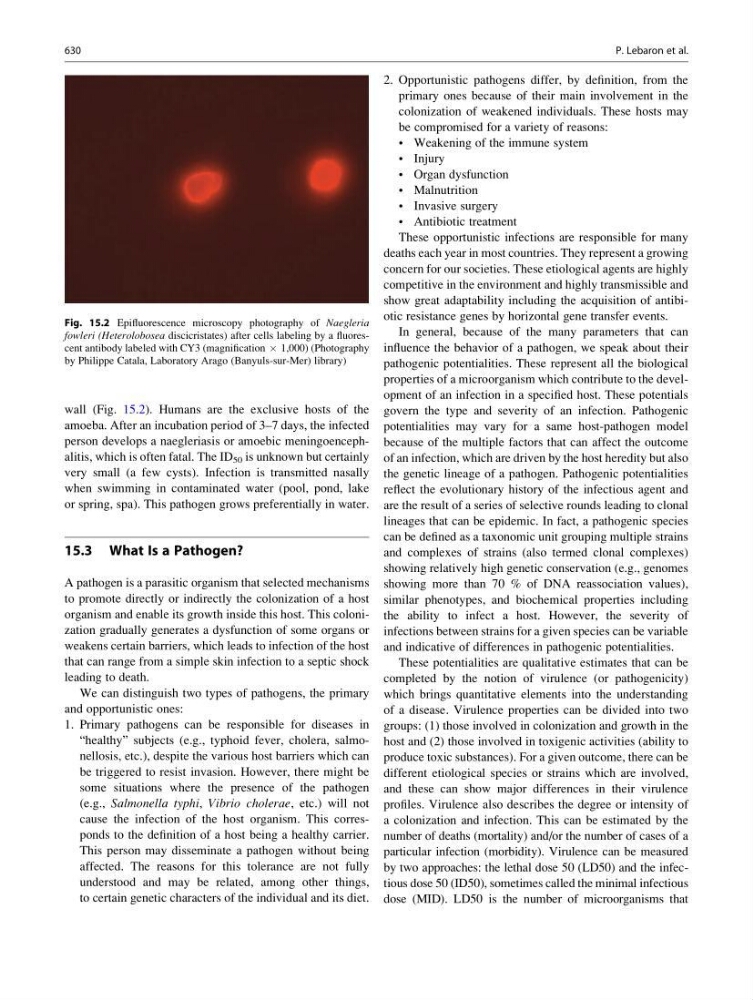
wall (Fig. 15.2). Humans are the exclusive hosts of the
amoeba. After an incubation period of 3–7 days, the infected
person develops a naegleriasis or amoebic meningoencephalitis, which is often fatal. The ID 50 is unknown but certainly
very small (a few cysts). Infection is transmitted nasally
when swimming in contaminated water (pool, pond, lake
or spring, spa). This pathogen grows preferentially in water.
15.3 What Is a Pathogen?
A pathogen is a parasitic organism that selected mechanisms
to promote directly or indirectly the colonization of a host
organism and enable its growth inside this host. This colonization gradually generates a dysfunction of some organs or
weakens certain barriers, which leads to infection of the host
that can range from a simple skin infection to a septic shock
leading to death.
We can distinguish two types of pathogens, the primary
and opportunistic ones:
1. Primary pathogens can be responsible for diseases in
“healthy” subjects (e.g., typhoid fever, cholera, salmonellosis, etc.), despite the various host barriers which can
be triggered to resist invasion. However, there might be
some situations where the presence of the pathogen
(e.g., Salmonella typhi, Vibrio cholerae, etc.) will not
cause the infection of the host organism. This corresponds to the definition of a host being a healthy carrier.
This person may disseminate a pathogen without being
affected. The reasons for this tolerance are not fully
understood and may be related, among other things,
to certain genetic characters of the individual and its diet.
2. Opportunistic pathogens differ, by definition, from the
primary ones because of their main involvement in the
colonization of weakened individuals. These hosts may
be compromised for a variety of reasons:
• Weakening of the immune system
• Injury
• Organ dysfunction
• Malnutrition
• Invasive surgery
• Antibiotic treatment
These opportunistic infections are responsible for many
deaths each year in most countries. They represent a growing
concern for our societies. These etiological agents are highly
competitive in the environment and highly transmissible and
show great adaptability including the acquisition of antibiotic resistance genes by horizontal gene transfer events.
In general, because of the many parameters that can
influence the behavior of a pathogen, we speak about their
pathogenic potentialities. These represent all the biological
properties of a microorganism which contribute to the development of an infection in a specified host. These potentials
govern the type and severity of an infection. Pathogenic
potentialities may vary for a same host-pathogen model
because of the multiple factors that can affect the outcome
of an infection, which are driven by the host heredity but also
the genetic lineage of a pathogen. Pathogenic potentialities
reflect the evolutionary history of the infectious agent and
are the result of a series of selective rounds leading to clonal
lineages that can be epidemic. In fact, a pathogenic species
can be defined as a taxonomic unit grouping multiple strains
and complexes of strains (also termed clonal complexes)
showing relatively high genetic conservation (e.g., genomes
showing more than 70 % of DNA reassociation values),
similar phenotypes, and biochemical properties including
the ability to infect a host. However, the severity of
infections between strains for a given species can be variable
and indicative of differences in pathogenic potentialities.
These potentialities are qualitative estimates that can be
completed by the notion of virulence (or pathogenicity)
which brings quantitative elements into the understanding
of a disease. Virulence properties can be divided into two
groups: (1) those involved in colonization and growth in the
host and (2) those involved in toxigenic activities (ability to
produce toxic substances). For a given outcome, there can be
different etiological species or strains which are involved,
and these can show major differences in their virulence
profiles. Virulence also describes the degree or intensity of
a colonization and infection. This can be estimated by the
number of deaths (mortality) and/or the number of cases of a
particular infection (morbidity). Virulence can be measured
by two approaches: the lethal dose 50 (LD50) and the infectious dose 50 (ID50), sometimes called the minimal infectious
dose (MID). LD50 is the number of microorganisms that
Fig. 15.2 Epifluorescence microscopy photography of Naegleria
fowleri (Heterolobosea discicristates) after cells labeling by a fluorescent antibody labeled with CY3 (magnification  1,000) (Photography
by Philippe Catala, Laboratory Arago (Banyuls-sur-Mer) library)
630
P. Lebaron et al.