

Box 15.2 (continued)
as eukaryotic microalgae to primary production, and
therefore both belong to the first trophic level of the
food chain. Under certain environmental conditions,
these microorganisms may experience phases of
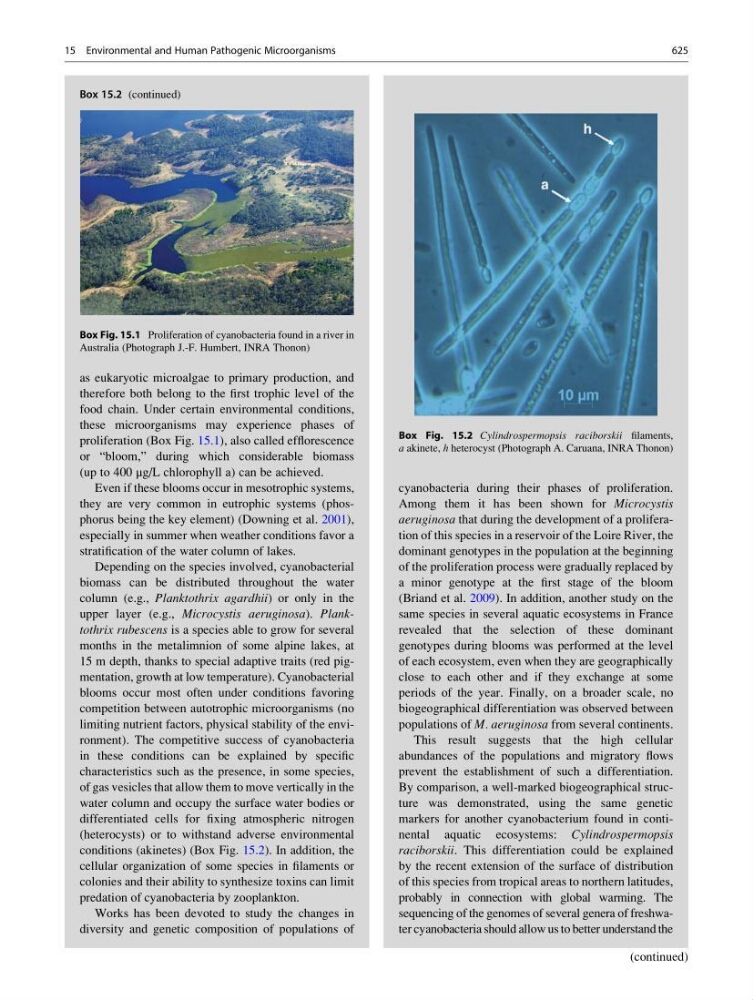
proliferation (Box Fig. 15.1), also called efflorescence
or “bloom,” during which considerable biomass
(up to 400 μg/L chlorophyll a) can be achieved.
Even if these blooms occur in mesotrophic systems,
they are very common in eutrophic systems (phosphorus being the key element) (Downing et al. 2001),
especially in summer when weather conditions favor a
stratification of the water column of lakes.
Depending on the species involved, cyanobacterial
biomass can be distributed throughout the water
column (e.g., Planktothrix agardhii) or only in the
upper layer (e.g., Microcystis aeruginosa). Planktothrix rubescens is a species able to grow for several
months in the metalimnion of some alpine lakes, at
15 m depth, thanks to special adaptive traits (red pigmentation, growth at low temperature). Cyanobacterial
blooms occur most often under conditions favoring
competition between autotrophic microorganisms (no
limiting nutrient factors, physical stability of the environment). The competitive success of cyanobacteria
in these conditions can be explained by specific
characteristics such as the presence, in some species,
of gas vesicles that allow them to move vertically in the
water column and occupy the surface water bodies or
differentiated cells for fixing atmospheric nitrogen
(heterocysts) or to withstand adverse environmental
conditions (akinetes) (Box Fig. 15.2). In addition, the
cellular organization of some species in filaments or
colonies and their ability to synthesize toxins can limit
predation of cyanobacteria by zooplankton.
Works has been devoted to study the changes in
diversity and genetic composition of populations of
(continued)
Box 15.2 (continued)
cyanobacteria during their phases of proliferation.
Among them it has been shown for Microcystis
aeruginosa that during the development of a proliferation of this species in a reservoir of the Loire River, the
dominant genotypes in the population at the beginning
of the proliferation process were gradually replaced by
a minor genotype at the first stage of the bloom
(Briand et al. 2009). In addition, another study on the
same species in several aquatic ecosystems in France
revealed that the selection of these dominant
genotypes during blooms was performed at the level
of each ecosystem, even when they are geographically
close to each other and if they exchange at some
periods of the year. Finally, on a broader scale, no
biogeographical differentiation was observed between
populations of M. aeruginosa from several continents.
This result suggests that the high cellular
abundances of the populations and migratory flows
prevent the establishment of such a differentiation.
By comparison, a well-marked biogeographical structure was demonstrated, using the same genetic
markers for another cyanobacterium found in continental aquatic ecosystems: Cylindrospermopsis
raciborskii. This differentiation could be explained
by the recent extension of the surface of distribution
of this species from tropical areas to northern latitudes,
probably in connection with global warming. The
sequencing of the genomes of several genera of freshwater cyanobacteria should allow us to better understand the
(continued)
Box Fig. 15.2 Cylindrospermopsis raciborskii filaments,
a akinete, h heterocyst (Photograph A. Caruana, INRA Thonon)
Box Fig. 15.1 Proliferation of cyanobacteria found in a river in
Australia (Photograph J.-F. Humbert, INRA Thonon)
15 Environmental and Human Pathogenic Microorganisms
625