

Campylobacter organisms are microaerophilic microorganisms with a spirillum shape. Campylobacter bacteria
are the number one cause of food-related gastrointestinal
illness in the United States. The main reservoirs are animals
(pigs, sheep, cats, dogs, rodents) and birds (wild and
farmed). Humans usually become infected after eating
poorly prepared meat, especially undercooked chicken,
through ingestion of contaminated water or by contact with
the animal. Ingestion of approximately 500 cells and an
incubation of 2–5 days are enough to cause diarrhea, fever,
and abdominal cramps. This germ is responsible for 5–14 %
of diarrheal diseases in the world.
Yersinia enterocolitica and Yersinia pseudotuberculosis
are two pathogenic species of the Yersinia genus. Some
strains produce a heat-labile enterotoxin. The main reservoirs
are animals (pigs, rodents, rabbits, sheep, cattle, etc.).
Yersinia infection is a yersiniosis, an enterocolitis or pseudotuberculosis. The main symptoms are bloody diarrhea, fever,
and abdominal pain. ID 50 is on the order of 10
6 bacterial cells
and incubation of 2–7 days. Transmission is by contact from
person to person by fecal-oral route or by ingestion of
contaminated food or water. The main reservoir is the animal.
Escherichia coli belongs to the family of
Enterobacteriaceae. Its main habitat is the gastrointestinal
tract of humans and warm-blooded animals, and most are
harmless to humans. However, some strains are pathogenic
and responsible for gastroenteritis. In the environment it is
mainly enterohemorrhagic E. coli (EHEC), enteroinvasive E.
coli (EIEC), enterotoxigenic E. coli (ETEC), and enteropathogenic E. coli (EPEC). EHEC is responsible for food
poisoning, but the waterborne transmission is recognized
today. Infections can result from ingesting contaminated drinking water or by the contact with contaminated
water during recreational activities. Serotype 0157: H7 is the
most common, and ingestion of 10–100 cells is enough to
trigger colitis*. The incubation period is 2–8 days. EPEC
strain is rare, and it is necessary to ingest a large amount of
cells (more than 10
8 ) to trigger an intestinal infection and
acute diarrhea. Contamination pathways are similar to those
of EHEC, but waterborne infections are rare due to the high
ID 50 . EIEC strain has characteristics of infection rather similar to those of the EHEC strain. It triggers bacillary dysentery
and infects only humans. The ETEC strain is mainly found in
hot and humid countries and is responsible for the traveler’s
diarrhea. It produces heat-stable enterotoxins* and others
that are thermolabile. Many strains of E. coli are
uropathogenic (UPEC) and responsible for cystitis*, sometimes associated with swimming in contaminated water.
The genus Vibrio includes a large number of species, but
only a few species can infect humans. The most common
example is Vibrio cholerae which is responsible for cholera
in humans only. It is necessary to ingest 10
6 –10
11 cells to
trigger the disease after an incubation period of a few hours
to 5 days. Contamination occurs by ingestion of food or
water contaminated with feces. The disease can be cured
easily, but it must be treated quickly to minimize loss of fluid
and minerals. The bacterium survives very long in water and
soil. It grows well in waters whose temperature is above
15
C, alkaline (pH >8), and salty wetlands. Vibrio also
grows well in brackish* water rather warm, but also
survives for years in deep waters. It has been observed in
Bangladesh that the resurgence of endemic cholera is
correlated with the seasonal increase in the temperature of
surface waters. Serogroups* O1 and O139 are responsible
for the disease, and serogroup O1 has spread all over the
planet who actually knows the seventh cholera pandemic.
In 2003, 111,575 cases and 1,894 deaths were reported to the
WHO by 45 countries, and among those, African countries
were the most affected. However, this number is underestimated since, for example, between 100,000 and 600,000
cases per year are reported in Bangladesh. Serogroup
0139 has emerged in 1992 and is now spreading in Asia.
It could be the origin of the eighth cholera pandemics. There
are other pathogenic Vibrio species: V. alginolyticus,
V. parahaemolyticus, V. vulnificus, and V. mimicus. All
these species are responsible for gastroenteritis characterized by watery diarrhea and abdominal cramps. They
can also infect open wounds. The ID 50 is the order of 10
6
cells, and the incubation period ranges from 4 to 96 h.
Contamination is through raw or undercooked seafood or
by direct contact of a wound with contaminated water.
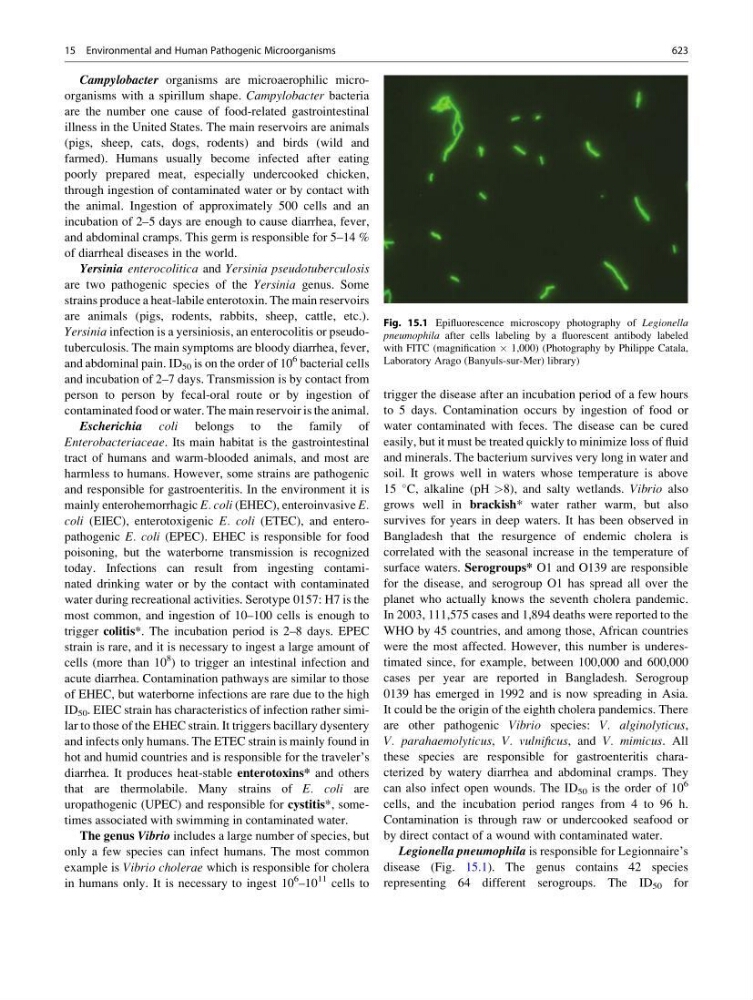
Legionella pneumophila is responsible for Legionnaire’s
disease (Fig. 15.1). The genus contains 42 species
representing 64 different serogroups. The ID 50 for
Fig. 15.1 Epifluorescence microscopy photography of Legionella
pneumophila after cells labeling by a fluorescent antibody labeled
with FITC (magnification  1,000) (Photography by Philippe Catala,
Laboratory Arago (Banyuls-sur-Mer) library)
15 Environmental and Human Pathogenic Microorganisms
623