

Box 14.14 (continued)
(continued)
Box 14.14 (continued)
activity is still uncertain, since these events are sporadic and relatively difficult to study with conventional oceanographic campaigns. However, there are
some clues suggesting that dustinputs in oligotrophic
regions of the ocean (e.g., Mediterranean, subtropical
gyres) could benefit diazotrophic organisms. Indeed,
the contribution of atmospheric iron would favor
N 2 fixation metabolism that has a high iron requirement, and thus provide a competitive advantage
to these organisms in a medium poor in nitrogen
(Mills et al. 2005).
Major Unknowns of Iron Cycle, Speciation,
and Bioavailability
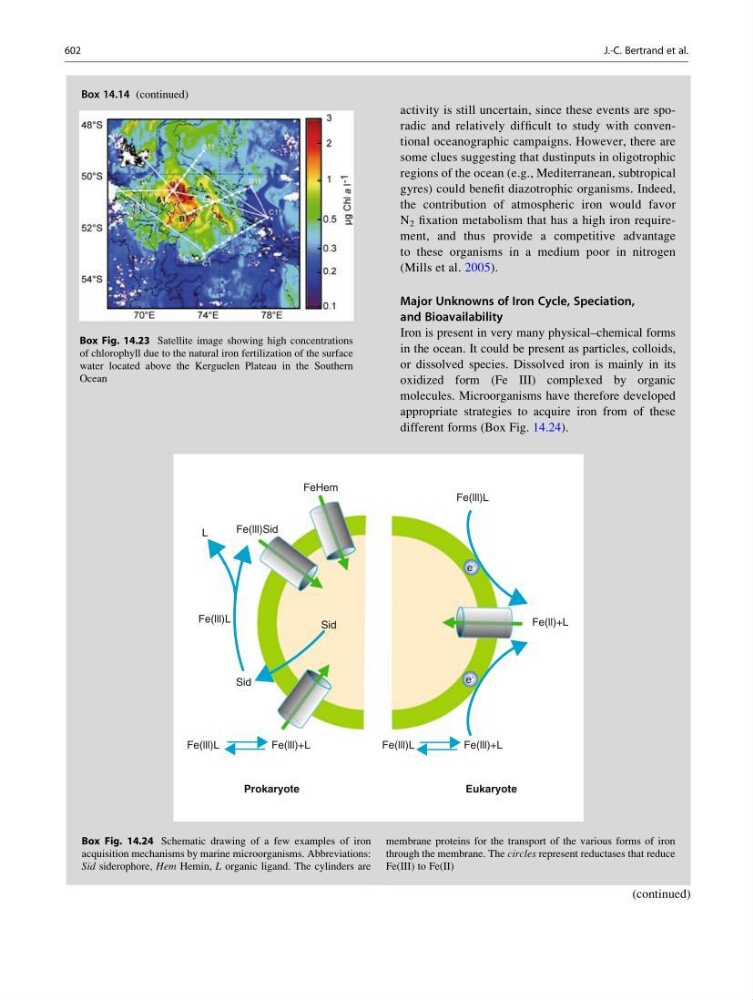
Iron is present in very many physical–chemical forms
in the ocean. It could be present as particles, colloids,
or dissolved species. Dissolved iron is mainly in its
oxidized form (Fe III) complexed by organic
molecules. Microorganisms have therefore developed
appropriate strategies to acquire iron from of these
different forms (Box Fig. 14.24).
(continued)
Box Fig. 14.23 Satellite image showing high concentrations
of chlorophyll due to the natural iron fertilization of the surface
water located above the Kerguelen Plateau in the Southern
Ocean
e
-
e
-
Fe(lll)L
Fe(lll)L
Fe(lll)+L
Fe(lll)L
Fe(lll)L
Fe(lll)Sid
FeHem
Sid
Sid
L
Fe(ll)+L
Fe(lll)+L
Prokaryote
Eukaryote
Box Fig. 14.24 Schematic drawing of a few examples of iron
acquisition mechanisms by marine microorganisms. Abbreviations:
Sid siderophore, Hem Hemin, L organic ligand. The cylinders are
membrane proteins for the transport of the various forms of iron
through the membrane. The circles represent reductases that reduce
Fe(III) to Fe(II)
602
J.-C. Bertrand et al.
(continued)
Box 14.14 (continued)
activity is still uncertain, since these events are sporadic and relatively difficult to study with conventional oceanographic campaigns. However, there are
some clues suggesting that dustinputs in oligotrophic
regions of the ocean (e.g., Mediterranean, subtropical
gyres) could benefit diazotrophic organisms. Indeed,
the contribution of atmospheric iron would favor
N 2 fixation metabolism that has a high iron requirement, and thus provide a competitive advantage
to these organisms in a medium poor in nitrogen
(Mills et al. 2005).
Major Unknowns of Iron Cycle, Speciation,
and Bioavailability
Iron is present in very many physical–chemical forms
in the ocean. It could be present as particles, colloids,
or dissolved species. Dissolved iron is mainly in its
oxidized form (Fe III) complexed by organic
molecules. Microorganisms have therefore developed
appropriate strategies to acquire iron from of these
different forms (Box Fig. 14.24).
(continued)
Box Fig. 14.23 Satellite image showing high concentrations
of chlorophyll due to the natural iron fertilization of the surface
water located above the Kerguelen Plateau in the Southern
Ocean
e
-
e
-
Fe(lll)L
Fe(lll)L
Fe(lll)+L
Fe(lll)L
Fe(lll)L
Fe(lll)Sid
FeHem
Sid
Sid
L
Fe(ll)+L
Fe(lll)+L
Prokaryote
Eukaryote
Box Fig. 14.24 Schematic drawing of a few examples of iron
acquisition mechanisms by marine microorganisms. Abbreviations:
Sid siderophore, Hem Hemin, L organic ligand. The cylinders are
membrane proteins for the transport of the various forms of iron
through the membrane. The circles represent reductases that reduce
Fe(III) to Fe(II)
602
J.-C. Bertrand et al.