

thermocline*, i.e. the water layer where the temperature
decreases rapidly. This thermocline separates a surface oxic
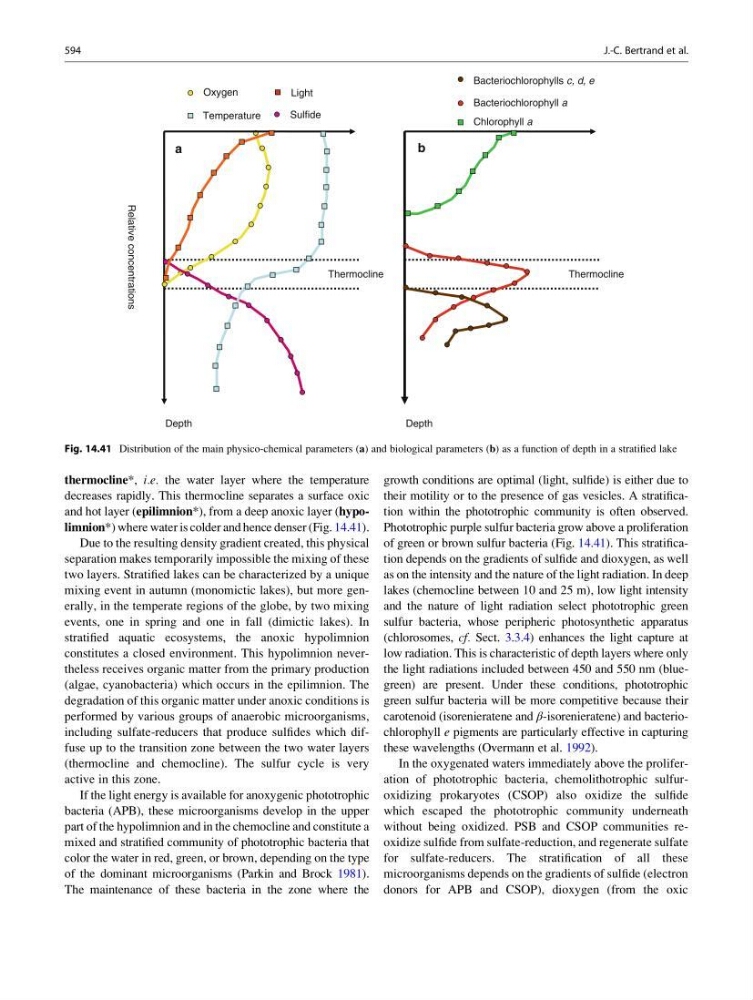
and hot layer (epilimnion*), from a deep anoxic layer (hypolimnion*) where water is colder and hence denser (Fig. 14.41).
Due to the resulting density gradient created, this physical
separation makes temporarily impossible the mixing of these
two layers. Stratified lakes can be characterized by a unique
mixing event in autumn (monomictic lakes), but more generally, in the temperate regions of the globe, by two mixing
events, one in spring and one in fall (dimictic lakes). In
stratified aquatic ecosystems, the anoxic hypolimnion
constitutes a closed environment. This hypolimnion nevertheless receives organic matter from the primary production
(algae, cyanobacteria) which occurs in the epilimnion. The
degradation of this organic matter under anoxic conditions is
performed by various groups of anaerobic microorganisms,
including sulfate-reducers that produce sulfides which diffuse up to the transition zone between the two water layers
(thermocline and chemocline). The sulfur cycle is very
active in this zone.
If the light energy is available for anoxygenic phototrophic
bacteria (APB), these microorganisms develop in the upper
part of the hypolimnion and in the chemocline and constitute a
mixed and stratified community of phototrophic bacteria that
color the water in red, green, or brown, depending on the type
of the dominant microorganisms (Parkin and Brock 1981).
The maintenance of these bacteria in the zone where the
growth conditions are optimal (light, sulfide) is either due to
their motility or to the presence of gas vesicles. A stratification within the phototrophic community is often observed.
Phototrophic purple sulfur bacteria grow above a proliferation
of green or brown sulfur bacteria (Fig. 14.41). This stratification depends on the gradients of sulfide and dioxygen, as well
as on the intensity and the nature of the light radiation. In deep
lakes (chemocline between 10 and 25 m), low light intensity
and the nature of light radiation select phototrophic green
sulfur bacteria, whose peripheric photosynthetic apparatus
(chlorosomes, cf. Sect. 3.3.4) enhances the light capture at
low radiation. This is characteristic of depth layers where only
the light radiations included between 450 and 550 nm (bluegreen) are present. Under these conditions, phototrophic
green sulfur bacteria will be more competitive because their
carotenoid (isorenieratene and β-isorenieratene) and bacteriochlorophyll e pigments are particularly effective in capturing
these wavelengths (Overmann et al. 1992).
In the oxygenated waters immediately above the proliferation of phototrophic bacteria, chemolithotrophic sulfuroxidizing prokaryotes (CSOP) also oxidize the sulfide
which escaped the phototrophic community underneath
without being oxidized. PSB and CSOP communities reoxidize sulfide from sulfate-reduction, and regenerate sulfate
for sulfate-reducers. The stratification of all these
microorganisms depends on the gradients of sulfide (electron
donors for APB and CSOP), dioxygen (from the oxic
Depth
Temperature
Oxygen
Sulfide
Thermocline
Light
Depth
Thermocline
Chlorophyll a
Bacteriochlorophyll a
Bacteriochlorophylls c, d, e
a
b
Relative concentrations
Fig. 14.41 Distribution of the main physico-chemical parameters (a) and biological parameters (b) as a function of depth in a stratified lake
594
J.-C. Bertrand et al.