

Sulfate-reducing bacteria have many other metabolic
alternatives. Electron acceptors are not only limited to sulfur
compounds: nitrate, fumarate, and certain metals can play this
role. Finally, some studies have challenged the question of
dioxygen toxicity for sulfate-reducers, some of the strains of
which are not only able to tolerate low dioxygen tensions, but
are also capable of reducing dioxygen to H 2 O (cf. Sect. 3.3.2).
The ecological significance of this process and its possible
contribution in terms of energy production remain to be
elucidated (Cypionka 2000).
Finally, sulfate-reducing bacteria are involved in the
dismutation of thiosulfate, sulfite, or elemental sulfur, as
discovered in Desulfovibrio sulfodismutans (Bak and
Cypionka 1987). Dismutation is an inorganic fermentation
during which sulfite and thiosulfate are used both as electron
donors and acceptors, thus contributing to the formation of
Box 14.12 (continued)
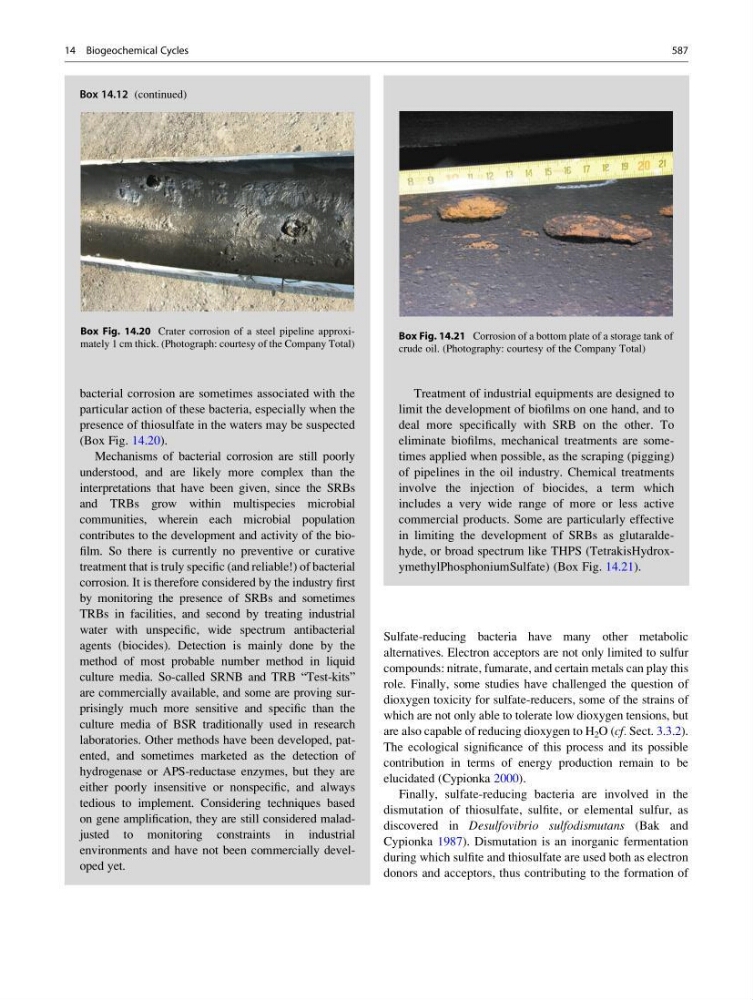
bacterial corrosion are sometimes associated with the
particular action of these bacteria, especially when the
presence of thiosulfate in the waters may be suspected
(Box Fig. 14.20).
Mechanisms of bacterial corrosion are still poorly
understood, and are likely more complex than the
interpretations that have been given, since the SRBs
and TRBs grow within multispecies microbial
communities, wherein each microbial population
contributes to the development and activity of the biofilm. So there is currently no preventive or curative
treatment that is truly specific (and reliable!) of bacterial
corrosion. It is therefore considered by the industry first
by monitoring the presence of SRBs and sometimes
TRBs in facilities, and second by treating industrial
water with unspecific, wide spectrum antibacterial
agents (biocides). Detection is mainly done by the
method of most probable number method in liquid
culture media. So-called SRNB and TRB “Test-kits”
are commercially available, and some are proving surprisingly much more sensitive and specific than the
culture media of BSR traditionally used in research
laboratories. Other methods have been developed, patented, and sometimes marketed as the detection of
hydrogenase or APS-reductase enzymes, but they are
either poorly insensitive or nonspecific, and always
tedious to implement. Considering techniques based
on gene amplification, they are still considered maladjusted to monitoring constraints in industrial
environments and have not been commercially developed yet.
(continued)
Box 14.12 (continued)
Treatment of industrial equipments are designed to
limit the development of biofilms on one hand, and to
deal more specifically with SRB on the other. To
eliminate biofilms, mechanical treatments are sometimes applied when possible, as the scraping (pigging)
of pipelines in the oil industry. Chemical treatments
involve the injection of biocides, a term which
includes a very wide range of more or less active
commercial products. Some are particularly effective
in limiting the development of SRBs as glutaraldehyde, or broad spectrum like THPS (TetrakisHydroxymethylPhosphoniumSulfate) (Box Fig. 14.21).
Box Fig. 14.20 Crater corrosion of a steel pipeline approximately 1 cm thick. (Photograph: courtesy of the Company Total)
Box Fig. 14.21 Corrosion of a bottom plate of a storage tank of
crude oil. (Photography: courtesy of the Company Total)
14 Biogeochemical Cycles
587