

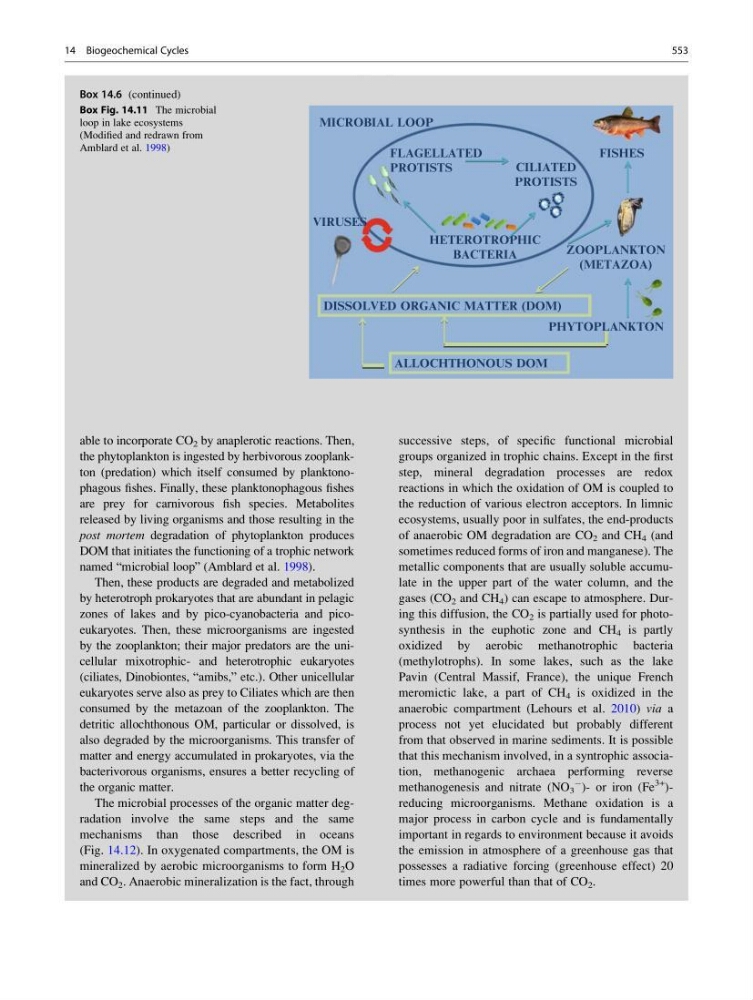
Box 14.6 (continued)
able to incorporate CO 2 by anaplerotic reactions. Then,
the phytoplankton is ingested by herbivorous zooplankton (predation) which itself consumed by planktonophagous fishes. Finally, these planktonophagous fishes
are prey for carnivorous fish species. Metabolites
released by living organisms and those resulting in the
post mortem degradation of phytoplankton produces
DOM that initiates the functioning of a trophic network
named “microbial loop” (Amblard et al. 1998).
Then, these products are degraded and metabolized
by heterotroph prokaryotes that are abundant in pelagic
zones of lakes and by pico-cyanobacteria and picoeukaryotes. Then, these microorganisms are ingested
by the zooplankton; their major predators are the unicellular mixotrophic- and heterotrophic eukaryotes
(ciliates, Dinobiontes, “amibs,” etc.). Other unicellular
eukaryotes serve also as prey to Ciliates which are then
consumed by the metazoan of the zooplankton. The
detritic allochthonous OM, particular or dissolved, is
also degraded by the microorganisms. This transfer of
matter and energy accumulated in prokaryotes, via the
bacterivorous organisms, ensures a better recycling of
the organic matter.
The microbial processes of the organic matter degradation involve the same steps and the same
mechanisms than those described in oceans
(Fig. 14.12). In oxygenated compartments, the OM is
mineralized by aerobic microorganisms to form H 2 O
and CO 2 . Anaerobic mineralization is the fact, through
(continued)
Box 14.6 (continued)
successive steps, of specific functional microbial
groups organized in trophic chains. Except in the first
step, mineral degradation processes are redox
reactions in which the oxidation of OM is coupled to
the reduction of various electron acceptors. In limnic
ecosystems, usually poor in sulfates, the end-products
of anaerobic OM degradation are CO 2 and CH 4 (and
sometimes reduced forms of iron and manganese). The
metallic components that are usually soluble accumulate in the upper part of the water column, and the
gases (CO 2 and CH 4 ) can escape to atmosphere. During this diffusion, the CO 2 is partially used for photosynthesis in the euphotic zone and CH 4 is partly
oxidized by aerobic methanotrophic bacteria
(methylotrophs). In some lakes, such as the lake
Pavin (Central Massif, France), the unique French
meromictic lake, a part of CH 4 is oxidized in the
anaerobic compartment (Lehours et al. 2010) via a
process not yet elucidated but probably different
from that observed in marine sediments. It is possible
that this mechanism involved, in a syntrophic association, methanogenic archaea performing reverse
methanogenesis and nitrate (NO 3
À
)- or iron (Fe
3+ )reducing microorganisms. Methane oxidation is a
major process in carbon cycle and is fundamentally
important in regards to environment because it avoids
the emission in atmosphere of a greenhouse gas that
possesses a radiative forcing (greenhouse effect) 20
times more powerful than that of CO 2 .
FISHES
ZOOPLANKTON
(METAZOA)
PHYTOPLANKTON
FLAGELLATED
PROTISTS
CILIATED
PROTISTS
HETEROTROPHIC
BACTERIA
DISSOLVED ORGANIC MATTER (DOM)
ALLOCHTHONOUS DOM
OP
MICROBIAL LOOP
VIRUSES
Box Fig. 14.11 The microbial
loop in lake ecosystems
(Modified and redrawn from
Amblard et al. 1998)
14 Biogeochemical Cycles
553
able to incorporate CO 2 by anaplerotic reactions. Then,
the phytoplankton is ingested by herbivorous zooplankton (predation) which itself consumed by planktonophagous fishes. Finally, these planktonophagous fishes
are prey for carnivorous fish species. Metabolites
released by living organisms and those resulting in the
post mortem degradation of phytoplankton produces
DOM that initiates the functioning of a trophic network
named “microbial loop” (Amblard et al. 1998).
Then, these products are degraded and metabolized
by heterotroph prokaryotes that are abundant in pelagic
zones of lakes and by pico-cyanobacteria and picoeukaryotes. Then, these microorganisms are ingested
by the zooplankton; their major predators are the unicellular mixotrophic- and heterotrophic eukaryotes
(ciliates, Dinobiontes, “amibs,” etc.). Other unicellular
eukaryotes serve also as prey to Ciliates which are then
consumed by the metazoan of the zooplankton. The
detritic allochthonous OM, particular or dissolved, is
also degraded by the microorganisms. This transfer of
matter and energy accumulated in prokaryotes, via the
bacterivorous organisms, ensures a better recycling of
the organic matter.
The microbial processes of the organic matter degradation involve the same steps and the same
mechanisms than those described in oceans
(Fig. 14.12). In oxygenated compartments, the OM is
mineralized by aerobic microorganisms to form H 2 O
and CO 2 . Anaerobic mineralization is the fact, through
(continued)
Box 14.6 (continued)
successive steps, of specific functional microbial
groups organized in trophic chains. Except in the first
step, mineral degradation processes are redox
reactions in which the oxidation of OM is coupled to
the reduction of various electron acceptors. In limnic
ecosystems, usually poor in sulfates, the end-products
of anaerobic OM degradation are CO 2 and CH 4 (and
sometimes reduced forms of iron and manganese). The
metallic components that are usually soluble accumulate in the upper part of the water column, and the
gases (CO 2 and CH 4 ) can escape to atmosphere. During this diffusion, the CO 2 is partially used for photosynthesis in the euphotic zone and CH 4 is partly
oxidized by aerobic methanotrophic bacteria
(methylotrophs). In some lakes, such as the lake
Pavin (Central Massif, France), the unique French
meromictic lake, a part of CH 4 is oxidized in the
anaerobic compartment (Lehours et al. 2010) via a
process not yet elucidated but probably different
from that observed in marine sediments. It is possible
that this mechanism involved, in a syntrophic association, methanogenic archaea performing reverse
methanogenesis and nitrate (NO 3
À
)- or iron (Fe
3+ )reducing microorganisms. Methane oxidation is a
major process in carbon cycle and is fundamentally
important in regards to environment because it avoids
the emission in atmosphere of a greenhouse gas that
possesses a radiative forcing (greenhouse effect) 20
times more powerful than that of CO 2 .
FISHES
ZOOPLANKTON
(METAZOA)
PHYTOPLANKTON
FLAGELLATED
PROTISTS
CILIATED
PROTISTS
HETEROTROPHIC
BACTERIA
DISSOLVED ORGANIC MATTER (DOM)
ALLOCHTHONOUS DOM
OP
MICROBIAL LOOP
VIRUSES
Box Fig. 14.11 The microbial
loop in lake ecosystems
(Modified and redrawn from
Amblard et al. 1998)
14 Biogeochemical Cycles
553