

Lytic infections are by far the best studied of the virus-host
interactions. Lysogenic activity has been less studied in
aquatic environments where the temperate phage can alternatively integrate into the host genome as prophage which is
replicated for several generations. The lysogenic conversion
of competent prokaryotes allows the dissemination and
maintenance of viral populations primarily in harsh
conditions while promoting horizontal transfers of viral
and host genes between microorganisms through the process
of transduction. This conversion can thus influence microbial speciation, providing novel phenotypic, genotypic, and
metabolic traits to the host cell, such as resistance to superinfection or the capacity to produce toxins. A spectacular
case for such a phage conversion is the finding that cholera
infection is due to a lysogenic strain of the Vibrio cholerae
bacterium.
Large-scale metagenomics has shown that viruses contain
diverse genes of interest, including virulence genes such as
the cholera toxin, respiration, nucleic acid, carbohydrate,
and protein metabolism genes, as well as genes involved in
vitamin and cofactor synthesis, in stress response, and in
motility and chemotaxis, which are more common in
viromes (metagenomics of viruses) than in their
corresponding microbiomes (metagenomics of microbes)
(Edwards and Rohwer 2005). Microbes that take up these
genes increase their competitive ability and extend their
ecological niches. More interestingly, virally encoded host
genes also include crucial photosynthetic genetic elements
present in cyanophage genomes, which can be used to maintain the targeted function in dead hosts and accomplish the
lytic cycle and can be transferred between hosts as well.
About 10 % of total global photosynthesis could be carried
out as a result of phage genes originally from phages
(Lindell et al. 2005). Given the prevalence of phage-encoded
biological functions and the occurrence of recombination
between phage and host genes, phage populations are thus
expected to serve as gene reservoirs that contribute to niche
partitioning of microbial species in aquatic ecosystems.
Overall, our conceptual understanding of the function and
regulation of aquatic ecosystems, from microbial to global
biogeochemical processes, has changed with the study of
viruses. Aquatic viral ecology, although is a relatively recent
discipline, is a source of novel knowledge related to the
biodiversity of living things, the functioning of ecosystems,
and the evolution of the cellular world (Forterre 2007). For
example, it is becoming clear that most of the environmental
viruses are not microbial pathogens but mutualistic cell
partners that provide helper functions (Rohwer and Thurber
2009; Roossinck 2011). The discovery of giant viruses
which encode trademark cellular functions (La Scola et al.
2003) is weakening the gap between inert and living things.
13.4.2 Main Factors Controlling Benthic Marine
and Lake Microbial Food Webs
Grazing effects of microbial communities by benthic
macrofauna (“top down”) are well known for biofilms.
These effects are mainly direct and negative reducing both
diversity and biomass of microalgae (e.g., Liess and
Hillebrand 2004). In contrast, for meiofauna, bioturbation
effects are stronger than grazing effects, enhancing the photosynthetic activity of photoautotrophic microorganisms in
biofilms (Mathieu et al. 2007; Majdi et al. 2012b).
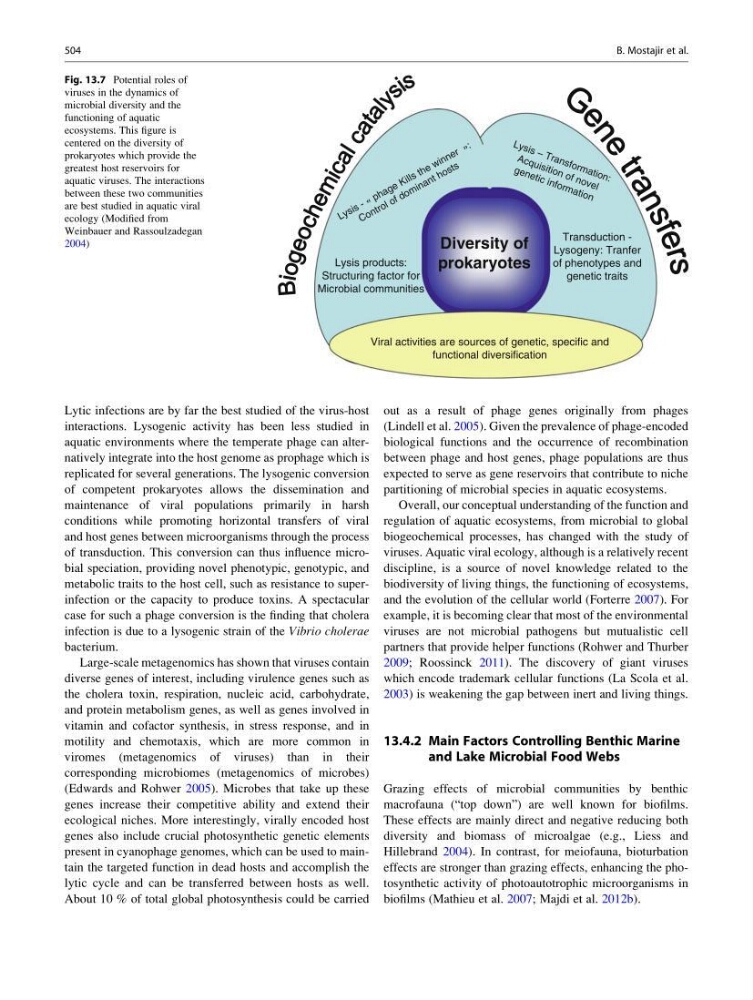
Diversity of
prokaryotes
L y s is - « p h a g e K il ls t h e w in n e r » :
C o n t r o l o f d o m in a n t h o s t s
L y s is – T ra n s fo rm a ti o n :
A c q u is it io n o f n o v e l
g e n e ti c in fo rm a ti o n
Lysis products:
Structuring factor for
Microbial communities
Transduction -
Lysogeny: Tranfer
of phenotypes and
genetic traits
Viral activities are sources of genetic, specific and
functional diversification
Fig. 13.7 Potential roles of
viruses in the dynamics of
microbial diversity and the
functioning of aquatic
ecosystems. This figure is
centered on the diversity of
prokaryotes which provide the
greatest host reservoirs for
aquatic viruses. The interactions
between these two communities
are best studied in aquatic viral
ecology (Modified from
Weinbauer and Rassoulzadegan
2004)
504
B. Mostajir et al.
interactions. Lysogenic activity has been less studied in
aquatic environments where the temperate phage can alternatively integrate into the host genome as prophage which is
replicated for several generations. The lysogenic conversion
of competent prokaryotes allows the dissemination and
maintenance of viral populations primarily in harsh
conditions while promoting horizontal transfers of viral
and host genes between microorganisms through the process
of transduction. This conversion can thus influence microbial speciation, providing novel phenotypic, genotypic, and
metabolic traits to the host cell, such as resistance to superinfection or the capacity to produce toxins. A spectacular
case for such a phage conversion is the finding that cholera
infection is due to a lysogenic strain of the Vibrio cholerae
bacterium.
Large-scale metagenomics has shown that viruses contain
diverse genes of interest, including virulence genes such as
the cholera toxin, respiration, nucleic acid, carbohydrate,
and protein metabolism genes, as well as genes involved in
vitamin and cofactor synthesis, in stress response, and in
motility and chemotaxis, which are more common in
viromes (metagenomics of viruses) than in their
corresponding microbiomes (metagenomics of microbes)
(Edwards and Rohwer 2005). Microbes that take up these
genes increase their competitive ability and extend their
ecological niches. More interestingly, virally encoded host
genes also include crucial photosynthetic genetic elements
present in cyanophage genomes, which can be used to maintain the targeted function in dead hosts and accomplish the
lytic cycle and can be transferred between hosts as well.
About 10 % of total global photosynthesis could be carried
out as a result of phage genes originally from phages
(Lindell et al. 2005). Given the prevalence of phage-encoded
biological functions and the occurrence of recombination
between phage and host genes, phage populations are thus
expected to serve as gene reservoirs that contribute to niche
partitioning of microbial species in aquatic ecosystems.
Overall, our conceptual understanding of the function and
regulation of aquatic ecosystems, from microbial to global
biogeochemical processes, has changed with the study of
viruses. Aquatic viral ecology, although is a relatively recent
discipline, is a source of novel knowledge related to the
biodiversity of living things, the functioning of ecosystems,
and the evolution of the cellular world (Forterre 2007). For
example, it is becoming clear that most of the environmental
viruses are not microbial pathogens but mutualistic cell
partners that provide helper functions (Rohwer and Thurber
2009; Roossinck 2011). The discovery of giant viruses
which encode trademark cellular functions (La Scola et al.
2003) is weakening the gap between inert and living things.
13.4.2 Main Factors Controlling Benthic Marine
and Lake Microbial Food Webs
Grazing effects of microbial communities by benthic
macrofauna (“top down”) are well known for biofilms.
These effects are mainly direct and negative reducing both
diversity and biomass of microalgae (e.g., Liess and
Hillebrand 2004). In contrast, for meiofauna, bioturbation
effects are stronger than grazing effects, enhancing the photosynthetic activity of photoautotrophic microorganisms in
biofilms (Mathieu et al. 2007; Majdi et al. 2012b).
Diversity of
prokaryotes
L y s is - « p h a g e K il ls t h e w in n e r » :
C o n t r o l o f d o m in a n t h o s t s
L y s is – T ra n s fo rm a ti o n :
A c q u is it io n o f n o v e l
g e n e ti c in fo rm a ti o n
Lysis products:
Structuring factor for
Microbial communities
Transduction -
Lysogeny: Tranfer
of phenotypes and
genetic traits
Viral activities are sources of genetic, specific and
functional diversification
Fig. 13.7 Potential roles of
viruses in the dynamics of
microbial diversity and the
functioning of aquatic
ecosystems. This figure is
centered on the diversity of
prokaryotes which provide the
greatest host reservoirs for
aquatic viruses. The interactions
between these two communities
are best studied in aquatic viral
ecology (Modified from
Weinbauer and Rassoulzadegan
2004)
504
B. Mostajir et al.