

The main predators of picoplankton in marine and lake
ecosystems are the heterotrophic pico- and nanoflagellates
which their abundance is about 1,000 cells mL
À1 .
13.2.1.3 Nanoplankton
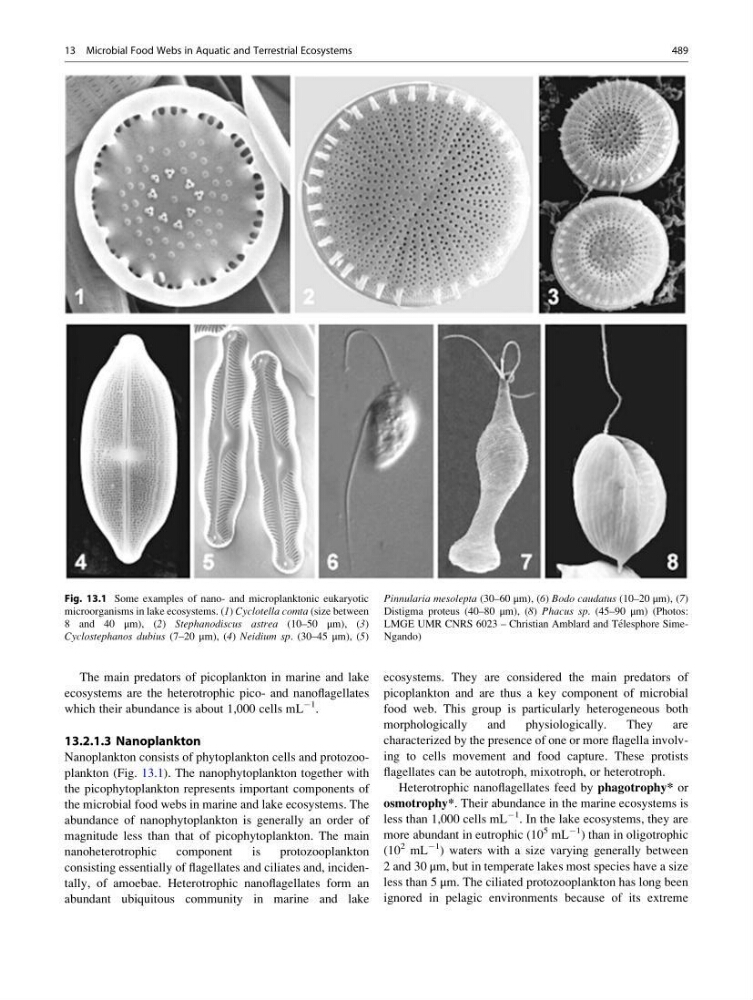
Nanoplankton consists of phytoplankton cells and protozooplankton (Fig. 13.1). The nanophytoplankton together with
the picophytoplankton represents important components of
the microbial food webs in marine and lake ecosystems. The
abundance of nanophytoplankton is generally an order of
magnitude less than that of picophytoplankton. The main
nanoheterotrophic
component
is
protozooplankton
consisting essentially of flagellates and ciliates and, incidentally, of amoebae. Heterotrophic nanoflagellates form an
abundant ubiquitous community in marine and lake
ecosystems. They are considered the main predators of
picoplankton and are thus a key component of microbial
food web. This group is particularly heterogeneous both
morphologically
and
physiologically.
They
are
characterized by the presence of one or more flagella involving to cells movement and food capture. These protists
flagellates can be autotroph, mixotroph, or heterotroph.
Heterotrophic nanoflagellates feed by phagotrophy* or
osmotrophy*. Their abundance in the marine ecosystems is
less than 1,000 cells mL
À1 . In the lake ecosystems, they are
more abundant in eutrophic (10
5 mL
À1 ) than in oligotrophic
(10
2 mL
À1
) waters with a size varying generally between
2 and 30 μm, but in temperate lakes most species have a size
less than 5 μm. The ciliated protozooplankton has long been
ignored in pelagic environments because of its extreme
Fig. 13.1 Some examples of nano- and microplanktonic eukaryotic
microorganisms in lake ecosystems. (1) Cyclotella comta (size between
8 and 40 μm), (2) Stephanodiscus astrea (10–50 μm), (3)
Cyclostephanos dubius (7–20 μm), (4) Neidium sp. (30–45 μm), (5)
Pinnularia mesolepta (30–60 μm), (6) Bodo caudatus (10–20 μm), (7)
Distigma proteus (40–80 μm), (8) Phacus sp. (45–90 μm) (Photos:
LMGE UMR CNRS 6023 – Christian Amblard and Te ´lesphore SimeNgando)
13 Microbial Food Webs in Aquatic and Terrestrial Ecosystems
489
ecosystems are the heterotrophic pico- and nanoflagellates
which their abundance is about 1,000 cells mL
À1 .
13.2.1.3 Nanoplankton
Nanoplankton consists of phytoplankton cells and protozooplankton (Fig. 13.1). The nanophytoplankton together with
the picophytoplankton represents important components of
the microbial food webs in marine and lake ecosystems. The
abundance of nanophytoplankton is generally an order of
magnitude less than that of picophytoplankton. The main
nanoheterotrophic
component
is
protozooplankton
consisting essentially of flagellates and ciliates and, incidentally, of amoebae. Heterotrophic nanoflagellates form an
abundant ubiquitous community in marine and lake
ecosystems. They are considered the main predators of
picoplankton and are thus a key component of microbial
food web. This group is particularly heterogeneous both
morphologically
and
physiologically.
They
are
characterized by the presence of one or more flagella involving to cells movement and food capture. These protists
flagellates can be autotroph, mixotroph, or heterotroph.
Heterotrophic nanoflagellates feed by phagotrophy* or
osmotrophy*. Their abundance in the marine ecosystems is
less than 1,000 cells mL
À1 . In the lake ecosystems, they are
more abundant in eutrophic (10
5 mL
À1 ) than in oligotrophic
(10
2 mL
À1
) waters with a size varying generally between
2 and 30 μm, but in temperate lakes most species have a size
less than 5 μm. The ciliated protozooplankton has long been
ignored in pelagic environments because of its extreme
Fig. 13.1 Some examples of nano- and microplanktonic eukaryotic
microorganisms in lake ecosystems. (1) Cyclotella comta (size between
8 and 40 μm), (2) Stephanodiscus astrea (10–50 μm), (3)
Cyclostephanos dubius (7–20 μm), (4) Neidium sp. (30–45 μm), (5)
Pinnularia mesolepta (30–60 μm), (6) Bodo caudatus (10–20 μm), (7)
Distigma proteus (40–80 μm), (8) Phacus sp. (45–90 μm) (Photos:
LMGE UMR CNRS 6023 – Christian Amblard and Te ´lesphore SimeNgando)
13 Microbial Food Webs in Aquatic and Terrestrial Ecosystems
489