

consumption (grazing) by the zooplankton (metazoan), and
the predation of this one by fishes. As, in this simple and
linear trophic chain, the grazing was mainly as a central role,
it had so been identified in the aquatic system, “grazer food
chain,” and the trophic chain based on the detritus “detritus
food chain” (Wetzel et al. 1972).
This simplified vision of the aquatic food web resulted
from methods of sampling, preservation, and especially
observation, which were adapted well to the large-sized
planktonic organisms but were not appropriate for the
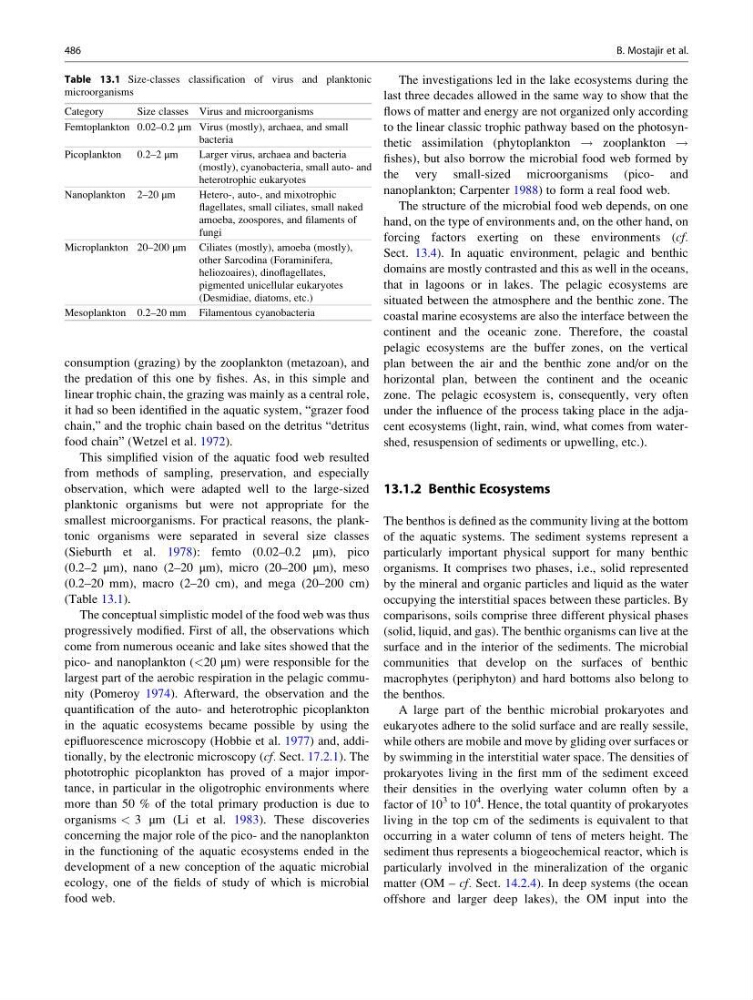
smallest microorganisms. For practical reasons, the planktonic organisms were separated in several size classes
(Sieburth et al. 1978): femto (0.02–0.2 μm), pico
(0.2–2 μm), nano (2–20 μm), micro (20–200 μm), meso
(0.2–20 mm), macro (2–20 cm), and mega (20–200 cm)
(Table 13.1).
The conceptual simplistic model of the food web was thus
progressively modified. First of all, the observations which
come from numerous oceanic and lake sites showed that the
pico- and nanoplankton (<20 μm) were responsible for the
largest part of the aerobic respiration in the pelagic community (Pomeroy 1974). Afterward, the observation and the
quantification of the auto- and heterotrophic picoplankton
in the aquatic ecosystems became possible by using the
epifluorescence microscopy (Hobbie et al. 1977) and, additionally, by the electronic microscopy (cf. Sect. 17.2.1). The
phototrophic picoplankton has proved of a major importance, in particular in the oligotrophic environments where
more than 50 % of the total primary production is due to
organisms < 3 μm (Li et al. 1983). These discoveries
concerning the major role of the pico- and the nanoplankton
in the functioning of the aquatic ecosystems ended in the
development of a new conception of the aquatic microbial
ecology, one of the fields of study of which is microbial
food web.
The investigations led in the lake ecosystems during the
last three decades allowed in the same way to show that the
flows of matter and energy are not organized only according
to the linear classic trophic pathway based on the photosynthetic assimilation (phytoplankton ! zooplankton !
fishes), but also borrow the microbial food web formed by
the very small-sized microorganisms (pico- and
nanoplankton; Carpenter 1988) to form a real food web.
The structure of the microbial food web depends, on one
hand, on the type of environments and, on the other hand, on
forcing factors exerting on these environments (cf.
Sect. 13.4). In aquatic environment, pelagic and benthic
domains are mostly contrasted and this as well in the oceans,
that in lagoons or in lakes. The pelagic ecosystems are
situated between the atmosphere and the benthic zone. The
coastal marine ecosystems are also the interface between the
continent and the oceanic zone. Therefore, the coastal
pelagic ecosystems are the buffer zones, on the vertical
plan between the air and the benthic zone and/or on the
horizontal plan, between the continent and the oceanic
zone. The pelagic ecosystem is, consequently, very often
under the influence of the process taking place in the adjacent ecosystems (light, rain, wind, what comes from watershed, resuspension of sediments or upwelling, etc.).
13.1.2 Benthic Ecosystems
The benthos is defined as the community living at the bottom
of the aquatic systems. The sediment systems represent a
particularly important physical support for many benthic
organisms. It comprises two phases, i.e., solid represented
by the mineral and organic particles and liquid as the water
occupying the interstitial spaces between these particles. By
comparisons, soils comprise three different physical phases
(solid, liquid, and gas). The benthic organisms can live at the
surface and in the interior of the sediments. The microbial
communities that develop on the surfaces of benthic
macrophytes (periphyton) and hard bottoms also belong to
the benthos.
A large part of the benthic microbial prokaryotes and
eukaryotes adhere to the solid surface and are really sessile,
while others are mobile and move by gliding over surfaces or
by swimming in the interstitial water space. The densities of
prokaryotes living in the first mm of the sediment exceed
their densities in the overlying water column often by a
factor of 10
3 to 10
4 . Hence, the total quantity of prokaryotes
living in the top cm of the sediments is equivalent to that
occurring in a water column of tens of meters height. The
sediment thus represents a biogeochemical reactor, which is
particularly involved in the mineralization of the organic
matter (OM – cf. Sect. 14.2.4). In deep systems (the ocean
offshore and larger deep lakes), the OM input into the
Table 13.1 Size-classes classification of virus and planktonic
microorganisms
Category
Size classes Virus and microorganisms
Femtoplankton 0.02–0.2 μm Virus (mostly), archaea, and small
bacteria
Picoplankton 0.2–2 μm
Larger virus, archaea and bacteria
(mostly), cyanobacteria, small auto- and
heterotrophic eukaryotes
Nanoplankton 2–20 μm
Hetero-, auto-, and mixotrophic
flagellates, small ciliates, small naked
amoeba, zoospores, and filaments of
fungi
Microplankton 20–200 μm Ciliates (mostly), amoeba (mostly),
other Sarcodina (Foraminifera,
heliozoaires), dinoflagellates,
pigmented unicellular eukaryotes
(Desmidiae, diatoms, etc.)
Mesoplankton 0.2–20 mm Filamentous cyanobacteria
486
B. Mostajir et al.
the predation of this one by fishes. As, in this simple and
linear trophic chain, the grazing was mainly as a central role,
it had so been identified in the aquatic system, “grazer food
chain,” and the trophic chain based on the detritus “detritus
food chain” (Wetzel et al. 1972).
This simplified vision of the aquatic food web resulted
from methods of sampling, preservation, and especially
observation, which were adapted well to the large-sized
planktonic organisms but were not appropriate for the
smallest microorganisms. For practical reasons, the planktonic organisms were separated in several size classes
(Sieburth et al. 1978): femto (0.02–0.2 μm), pico
(0.2–2 μm), nano (2–20 μm), micro (20–200 μm), meso
(0.2–20 mm), macro (2–20 cm), and mega (20–200 cm)
(Table 13.1).
The conceptual simplistic model of the food web was thus
progressively modified. First of all, the observations which
come from numerous oceanic and lake sites showed that the
pico- and nanoplankton (<20 μm) were responsible for the
largest part of the aerobic respiration in the pelagic community (Pomeroy 1974). Afterward, the observation and the
quantification of the auto- and heterotrophic picoplankton
in the aquatic ecosystems became possible by using the
epifluorescence microscopy (Hobbie et al. 1977) and, additionally, by the electronic microscopy (cf. Sect. 17.2.1). The
phototrophic picoplankton has proved of a major importance, in particular in the oligotrophic environments where
more than 50 % of the total primary production is due to
organisms < 3 μm (Li et al. 1983). These discoveries
concerning the major role of the pico- and the nanoplankton
in the functioning of the aquatic ecosystems ended in the
development of a new conception of the aquatic microbial
ecology, one of the fields of study of which is microbial
food web.
The investigations led in the lake ecosystems during the
last three decades allowed in the same way to show that the
flows of matter and energy are not organized only according
to the linear classic trophic pathway based on the photosynthetic assimilation (phytoplankton ! zooplankton !
fishes), but also borrow the microbial food web formed by
the very small-sized microorganisms (pico- and
nanoplankton; Carpenter 1988) to form a real food web.
The structure of the microbial food web depends, on one
hand, on the type of environments and, on the other hand, on
forcing factors exerting on these environments (cf.
Sect. 13.4). In aquatic environment, pelagic and benthic
domains are mostly contrasted and this as well in the oceans,
that in lagoons or in lakes. The pelagic ecosystems are
situated between the atmosphere and the benthic zone. The
coastal marine ecosystems are also the interface between the
continent and the oceanic zone. Therefore, the coastal
pelagic ecosystems are the buffer zones, on the vertical
plan between the air and the benthic zone and/or on the
horizontal plan, between the continent and the oceanic
zone. The pelagic ecosystem is, consequently, very often
under the influence of the process taking place in the adjacent ecosystems (light, rain, wind, what comes from watershed, resuspension of sediments or upwelling, etc.).
13.1.2 Benthic Ecosystems
The benthos is defined as the community living at the bottom
of the aquatic systems. The sediment systems represent a
particularly important physical support for many benthic
organisms. It comprises two phases, i.e., solid represented
by the mineral and organic particles and liquid as the water
occupying the interstitial spaces between these particles. By
comparisons, soils comprise three different physical phases
(solid, liquid, and gas). The benthic organisms can live at the
surface and in the interior of the sediments. The microbial
communities that develop on the surfaces of benthic
macrophytes (periphyton) and hard bottoms also belong to
the benthos.
A large part of the benthic microbial prokaryotes and
eukaryotes adhere to the solid surface and are really sessile,
while others are mobile and move by gliding over surfaces or
by swimming in the interstitial water space. The densities of
prokaryotes living in the first mm of the sediment exceed
their densities in the overlying water column often by a
factor of 10
3 to 10
4 . Hence, the total quantity of prokaryotes
living in the top cm of the sediments is equivalent to that
occurring in a water column of tens of meters height. The
sediment thus represents a biogeochemical reactor, which is
particularly involved in the mineralization of the organic
matter (OM – cf. Sect. 14.2.4). In deep systems (the ocean
offshore and larger deep lakes), the OM input into the
Table 13.1 Size-classes classification of virus and planktonic
microorganisms
Category
Size classes Virus and microorganisms
Femtoplankton 0.02–0.2 μm Virus (mostly), archaea, and small
bacteria
Picoplankton 0.2–2 μm
Larger virus, archaea and bacteria
(mostly), cyanobacteria, small auto- and
heterotrophic eukaryotes
Nanoplankton 2–20 μm
Hetero-, auto-, and mixotrophic
flagellates, small ciliates, small naked
amoeba, zoospores, and filaments of
fungi
Microplankton 20–200 μm Ciliates (mostly), amoeba (mostly),
other Sarcodina (Foraminifera,
heliozoaires), dinoflagellates,
pigmented unicellular eukaryotes
(Desmidiae, diatoms, etc.)
Mesoplankton 0.2–20 mm Filamentous cyanobacteria
486
B. Mostajir et al.