

Box 11.4: Cycle of Plasmodium, the Etiologic Agent
of Malaria
Patrick Mavingui
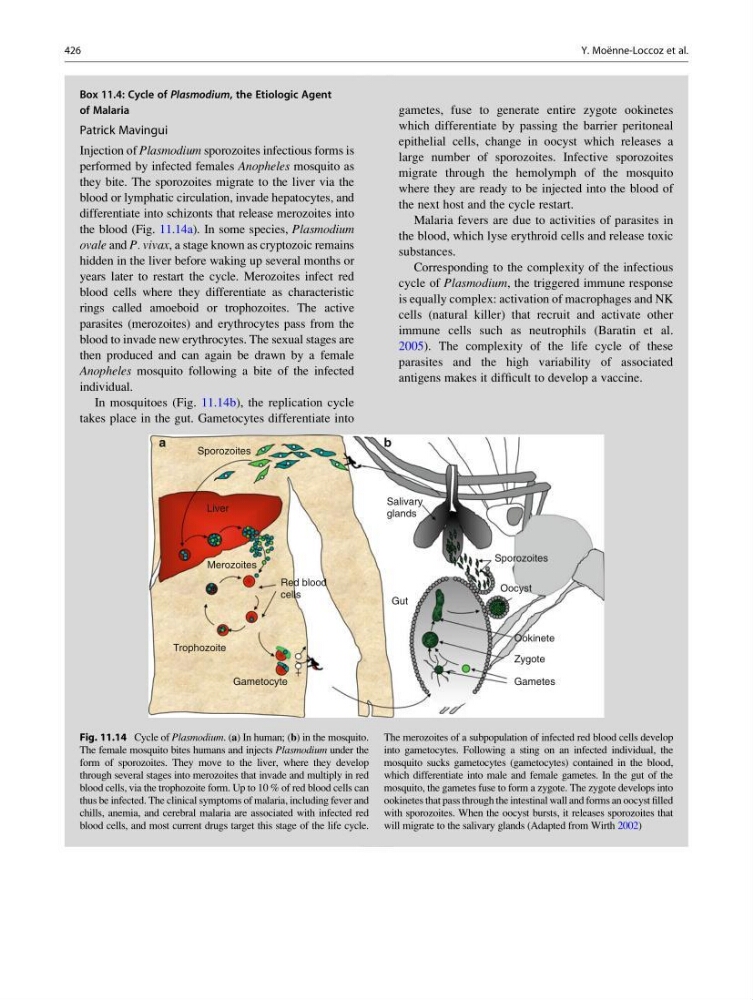
Injection of Plasmodium sporozoites infectious forms is
performed by infected females Anopheles mosquito as
they bite. The sporozoites migrate to the liver via the
blood or lymphatic circulation, invade hepatocytes, and
differentiate into schizonts that release merozoites into
the blood (Fig. 11.14a). In some species, Plasmodium
ovale and P. vivax, a stage known as cryptozoic remains
hidden in the liver before waking up several months or
years later to restart the cycle. Merozoites infect red
blood cells where they differentiate as characteristic
rings called amoeboid or trophozoites. The active
parasites (merozoites) and erythrocytes pass from the
blood to invade new erythrocytes. The sexual stages are
then produced and can again be drawn by a female
Anopheles mosquito following a bite of the infected
individual.
In mosquitoes (Fig. 11.14b), the replication cycle
takes place in the gut. Gametocytes differentiate into
(continued)
Box 11.4 (continued)
gametes, fuse to generate entire zygote ookinetes
which differentiate by passing the barrier peritoneal
epithelial cells, change in oocyst which releases a
large number of sporozoites. Infective sporozoites
migrate through the hemolymph of the mosquito
where they are ready to be injected into the blood of
the next host and the cycle restart.
Malaria fevers are due to activities of parasites in
the blood, which lyse erythroid cells and release toxic
substances.
Corresponding to the complexity of the infectious
cycle of Plasmodium, the triggered immune response
is equally complex: activation of macrophages and NK
cells (natural killer) that recruit and activate other
immune cells such as neutrophils (Baratin et al.
2005). The complexity of the life cycle of these
parasites and the high variability of associated
antigens makes it difficult to develop a vaccine.
Liver
Sporozoites
a
b
Gametocyte
Trophozoite
Gut
Merozoites
Red blood
cells
Salivary
glands
Sporozoites
Oocyst
Ookinete
Zygote
Gametes
Fig. 11.14 Cycle of Plasmodium. (a) In human; (b) in the mosquito.
The female mosquito bites humans and injects Plasmodium under the
form of sporozoites. They move to the liver, where they develop
through several stages into merozoites that invade and multiply in red
blood cells, via the trophozoite form. Up to 10 % of red blood cells can
thus be infected. The clinical symptoms of malaria, including fever and
chills, anemia, and cerebral malaria are associated with infected red
blood cells, and most current drugs target this stage of the life cycle.
The merozoites of a subpopulation of infected red blood cells develop
into gametocytes. Following a sting on an infected individual, the
mosquito sucks gametocytes (gametocytes) contained in the blood,
which differentiate into male and female gametes. In the gut of the
mosquito, the gametes fuse to form a zygote. The zygote develops into
ookinetes that pass through the intestinal wall and forms an oocyst filled
with sporozoites. When the oocyst bursts, it releases sporozoites that
will migrate to the salivary glands (Adapted from Wirth 2002)
426
Y. Moe ¨nne-Loccoz et al.
of Malaria
Patrick Mavingui
Injection of Plasmodium sporozoites infectious forms is
performed by infected females Anopheles mosquito as
they bite. The sporozoites migrate to the liver via the
blood or lymphatic circulation, invade hepatocytes, and
differentiate into schizonts that release merozoites into
the blood (Fig. 11.14a). In some species, Plasmodium
ovale and P. vivax, a stage known as cryptozoic remains
hidden in the liver before waking up several months or
years later to restart the cycle. Merozoites infect red
blood cells where they differentiate as characteristic
rings called amoeboid or trophozoites. The active
parasites (merozoites) and erythrocytes pass from the
blood to invade new erythrocytes. The sexual stages are
then produced and can again be drawn by a female
Anopheles mosquito following a bite of the infected
individual.
In mosquitoes (Fig. 11.14b), the replication cycle
takes place in the gut. Gametocytes differentiate into
(continued)
Box 11.4 (continued)
gametes, fuse to generate entire zygote ookinetes
which differentiate by passing the barrier peritoneal
epithelial cells, change in oocyst which releases a
large number of sporozoites. Infective sporozoites
migrate through the hemolymph of the mosquito
where they are ready to be injected into the blood of
the next host and the cycle restart.
Malaria fevers are due to activities of parasites in
the blood, which lyse erythroid cells and release toxic
substances.
Corresponding to the complexity of the infectious
cycle of Plasmodium, the triggered immune response
is equally complex: activation of macrophages and NK
cells (natural killer) that recruit and activate other
immune cells such as neutrophils (Baratin et al.
2005). The complexity of the life cycle of these
parasites and the high variability of associated
antigens makes it difficult to develop a vaccine.
Liver
Sporozoites
a
b
Gametocyte
Trophozoite
Gut
Merozoites
Red blood
cells
Salivary
glands
Sporozoites
Oocyst
Ookinete
Zygote
Gametes
Fig. 11.14 Cycle of Plasmodium. (a) In human; (b) in the mosquito.
The female mosquito bites humans and injects Plasmodium under the
form of sporozoites. They move to the liver, where they develop
through several stages into merozoites that invade and multiply in red
blood cells, via the trophozoite form. Up to 10 % of red blood cells can
thus be infected. The clinical symptoms of malaria, including fever and
chills, anemia, and cerebral malaria are associated with infected red
blood cells, and most current drugs target this stage of the life cycle.
The merozoites of a subpopulation of infected red blood cells develop
into gametocytes. Following a sting on an infected individual, the
mosquito sucks gametocytes (gametocytes) contained in the blood,
which differentiate into male and female gametes. In the gut of the
mosquito, the gametes fuse to form a zygote. The zygote develops into
ookinetes that pass through the intestinal wall and forms an oocyst filled
with sporozoites. When the oocyst bursts, it releases sporozoites that
will migrate to the salivary glands (Adapted from Wirth 2002)
426
Y. Moe ¨nne-Loccoz et al.