

The type and evolution of relationships between
microorganisms and animals, especially along the
parasitism-mutualism continuum, depend on the mode of
transmission of the microbe (Edwald 1987). Horizontal
transmission, by contact between infected and uninfected
individuals, tends to favor the evolution to parasitism with
intermediate levels of virulence resulting from a trade-off
between maximum exploitation of the host and the probability of transmission of the microbe. In contrast, vertical
transmission from parents to offspring promotes a reduction
in virulence and evolution toward mutualism, fitness
depending then on host reproduction. Examples of
interactions sustainable or not between microbes and
animals are presented hereafter, as well as the mechanisms
involved and consequences on the evolution and adaptation
of interacting entities.
11.4.3.1 Parasitic Interactions
Microorganisms are the cause of most diseases of man and
animals. From the 1,500 microbial pathogens identified in
man, over half would be zoonotic (i.e., of animal origin), and
many of them are transmitted by hematophagous arthropods
(Woolhouse et al. 2005). Nosological entities (microorganisms responsible for a disease) are involved in
zoonoses or anthropozoonoses (animal diseases transmissible to humans), in epizooties (animal epidemics), and in
human pathologies. These diseases include prion disease
(bovine spongiform encephalopathy or BSE), bacterioses
(tuberculosis, leprosy, pneumonia), fungal infections (ringworm, candida), parasitoses (malaria, filariasis, sleeping
sickness), and various virus diseases (influenza, acquired
immunodeficiency syndrome or AIDS, severe acute
respiratory syndrome, or SARS, Ebola). Apart from the
viruses, in terms of prevalence and incidence, bacteria represent the largest group involved in human and animal
diseases; fungal diseases are a minority (cf. Chap. 15).
Microbes and Infectious Diseases
Since their appearance on earth about 3 billion years ago (cf.
Chap. 4), microbes have caused major epidemics and
pandemics in humans and animals. Examples of infectious
diseases include cholera since antiquity, the plague in the
fourteenth century, or tuberculosis that decimated human
populations in the nineteenth century and that is unfortunately reemerging in recent years. The Spanish flu of the
early twentieth century caused many damages estimated at
more than 40 million people. Since its discovery in 1981,
AIDS has become pandemic and continues to cause victims.
Animals are not spared with outbreaks of diseases such as
BSE (or mad cow disease), which is a form that causes the
Creutzfeldt–Jakob disease to humans. Since the 1960s, the
foot and mouth disease and swine fever have killed and led
to the slaughter of millions of animals. Recently, the outbreak of avian influenza due to the highly pathogenic avian
influenza virus H5N1 has killed or led to the culling of
millions of poultry.
Many parasitoses are among the most devastating infectious diseases in humans and animals, of which vector-borne
diseases occupy an important part. One of them is the
Chagas disease caused by Trypanosoma cruzi transmitted
by blood-sucking bugs. Trypanosomiasis is endemic in tropical South and Central America, infecting 300,000 people
each year and causing 13,000 deaths. Schistosomiasis is
itself considered the second most important parasitic
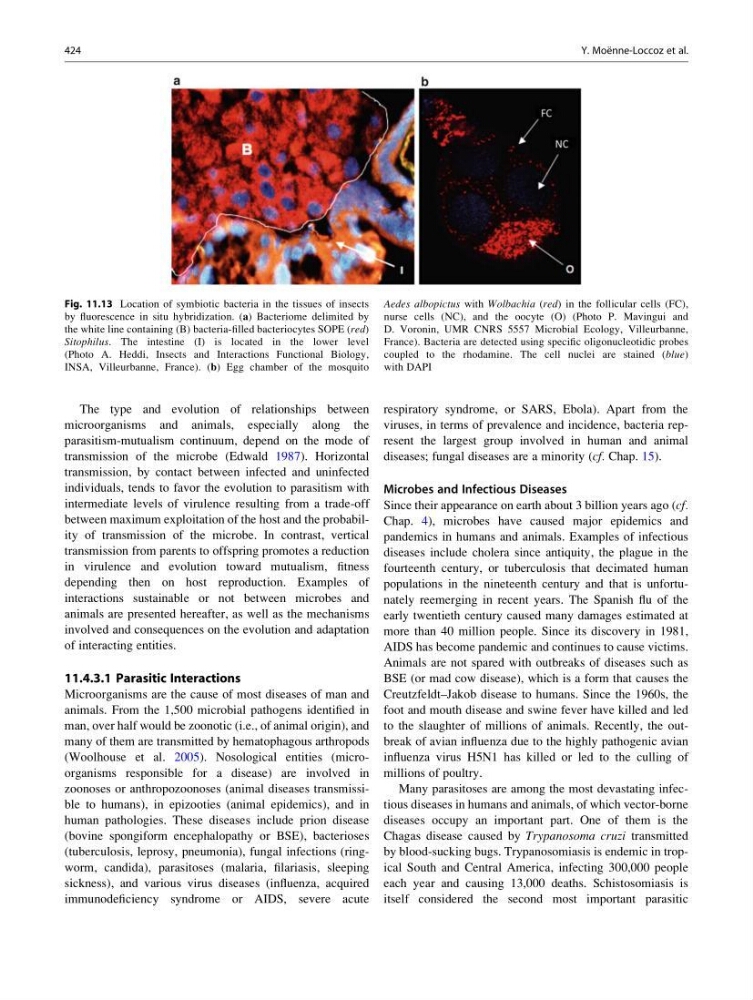
Fig. 11.13 Location of symbiotic bacteria in the tissues of insects
by fluorescence in situ hybridization. (a) Bacteriome delimited by
the white line containing (B) bacteria-filled bacteriocytes SOPE (red)
Sitophilus. The intestine (I) is located in the lower level
(Photo A. Heddi, Insects and Interactions Functional Biology,
INSA, Villeurbanne, France). (b) Egg chamber of the mosquito
Aedes albopictus with Wolbachia (red) in the follicular cells (FC),
nurse cells (NC), and the oocyte (O) (Photo P. Mavingui and
D. Voronin, UMR CNRS 5557 Microbial Ecology, Villeurbanne,
France). Bacteria are detected using specific oligonucleotidic probes
coupled to the rhodamine. The cell nuclei are stained (blue)
with DAPI
424
Y. Moe ¨nne-Loccoz et al.
microorganisms and animals, especially along the
parasitism-mutualism continuum, depend on the mode of
transmission of the microbe (Edwald 1987). Horizontal
transmission, by contact between infected and uninfected
individuals, tends to favor the evolution to parasitism with
intermediate levels of virulence resulting from a trade-off
between maximum exploitation of the host and the probability of transmission of the microbe. In contrast, vertical
transmission from parents to offspring promotes a reduction
in virulence and evolution toward mutualism, fitness
depending then on host reproduction. Examples of
interactions sustainable or not between microbes and
animals are presented hereafter, as well as the mechanisms
involved and consequences on the evolution and adaptation
of interacting entities.
11.4.3.1 Parasitic Interactions
Microorganisms are the cause of most diseases of man and
animals. From the 1,500 microbial pathogens identified in
man, over half would be zoonotic (i.e., of animal origin), and
many of them are transmitted by hematophagous arthropods
(Woolhouse et al. 2005). Nosological entities (microorganisms responsible for a disease) are involved in
zoonoses or anthropozoonoses (animal diseases transmissible to humans), in epizooties (animal epidemics), and in
human pathologies. These diseases include prion disease
(bovine spongiform encephalopathy or BSE), bacterioses
(tuberculosis, leprosy, pneumonia), fungal infections (ringworm, candida), parasitoses (malaria, filariasis, sleeping
sickness), and various virus diseases (influenza, acquired
immunodeficiency syndrome or AIDS, severe acute
respiratory syndrome, or SARS, Ebola). Apart from the
viruses, in terms of prevalence and incidence, bacteria represent the largest group involved in human and animal
diseases; fungal diseases are a minority (cf. Chap. 15).
Microbes and Infectious Diseases
Since their appearance on earth about 3 billion years ago (cf.
Chap. 4), microbes have caused major epidemics and
pandemics in humans and animals. Examples of infectious
diseases include cholera since antiquity, the plague in the
fourteenth century, or tuberculosis that decimated human
populations in the nineteenth century and that is unfortunately reemerging in recent years. The Spanish flu of the
early twentieth century caused many damages estimated at
more than 40 million people. Since its discovery in 1981,
AIDS has become pandemic and continues to cause victims.
Animals are not spared with outbreaks of diseases such as
BSE (or mad cow disease), which is a form that causes the
Creutzfeldt–Jakob disease to humans. Since the 1960s, the
foot and mouth disease and swine fever have killed and led
to the slaughter of millions of animals. Recently, the outbreak of avian influenza due to the highly pathogenic avian
influenza virus H5N1 has killed or led to the culling of
millions of poultry.
Many parasitoses are among the most devastating infectious diseases in humans and animals, of which vector-borne
diseases occupy an important part. One of them is the
Chagas disease caused by Trypanosoma cruzi transmitted
by blood-sucking bugs. Trypanosomiasis is endemic in tropical South and Central America, infecting 300,000 people
each year and causing 13,000 deaths. Schistosomiasis is
itself considered the second most important parasitic
Fig. 11.13 Location of symbiotic bacteria in the tissues of insects
by fluorescence in situ hybridization. (a) Bacteriome delimited by
the white line containing (B) bacteria-filled bacteriocytes SOPE (red)
Sitophilus. The intestine (I) is located in the lower level
(Photo A. Heddi, Insects and Interactions Functional Biology,
INSA, Villeurbanne, France). (b) Egg chamber of the mosquito
Aedes albopictus with Wolbachia (red) in the follicular cells (FC),
nurse cells (NC), and the oocyte (O) (Photo P. Mavingui and
D. Voronin, UMR CNRS 5557 Microbial Ecology, Villeurbanne,
France). Bacteria are detected using specific oligonucleotidic probes
coupled to the rhodamine. The cell nuclei are stained (blue)
with DAPI
424
Y. Moe ¨nne-Loccoz et al.