

parts or internal organs (Nardon and Charles 2001;
Dethlefsen et al. 2007). Extraction of DNA from human
tissues and large-scale sequencing of the gene encoding
16S ribosomal RNA have revealed bacterial phyla of the
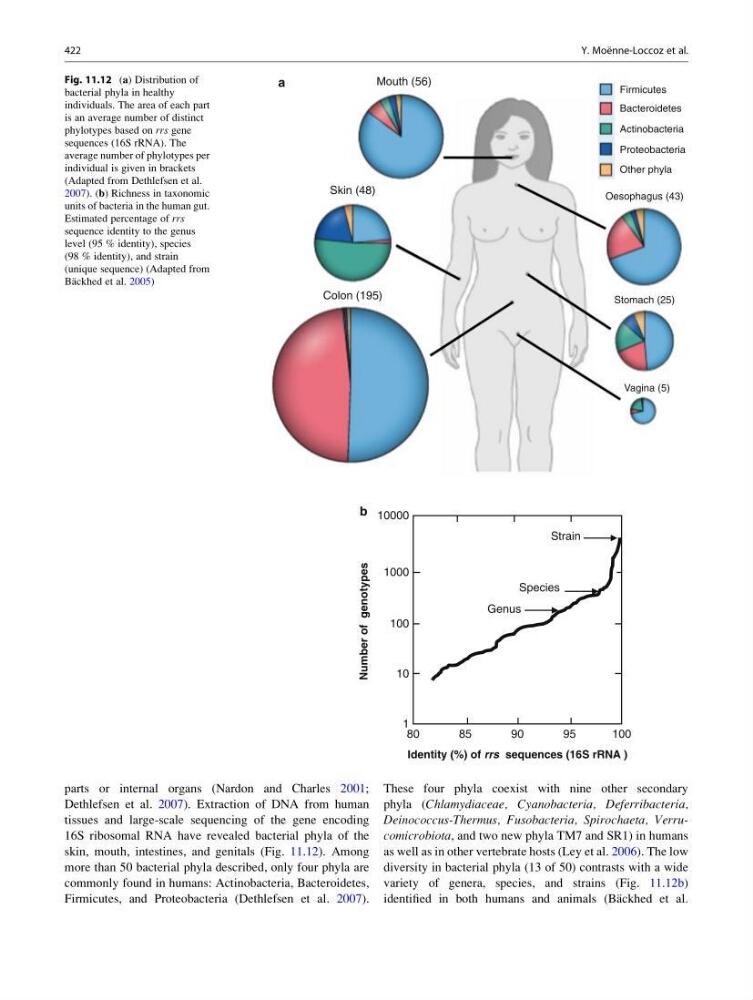
skin, mouth, intestines, and genitals (Fig. 11.12). Among
more than 50 bacterial phyla described, only four phyla are
commonly found in humans: Actinobacteria, Bacteroidetes,
Firmicutes, and Proteobacteria (Dethlefsen et al. 2007).
These four phyla coexist with nine other secondary
phyla (Chlamydiaceae, Cyanobacteria, Deferribacteria,
Deinococcus-Thermus, Fusobacteria, Spirochaeta, Verrucomicrobiota, and two new phyla TM7 and SR1) in humans
as well as in other vertebrate hosts (Ley et al. 2006). The low
diversity in bacterial phyla (13 of 50) contrasts with a wide
variety of genera, species, and strains (Fig. 11.12b)
identified in both humans and animals (Ba ¨ckhed et al.
Mouth (56)
Skin (48)
Colon (195)
Firmicutes
Bacteroidetes
Actinobacteria
Proteobacteria
Other phyla
Oesophagus (43)
Stomach (25)
Vagina (5)
Strain
Species
Genus
1
80
85
90
95
100
10
100
1000
10000
Identity (%) of rrs sequences (16S rRNA )
Number of genotypes
a
b
Fig. 11.12 (a) Distribution of
bacterial phyla in healthy
individuals. The area of each part
is an average number of distinct
phylotypes based on rrs gene
sequences (16S rRNA). The
average number of phylotypes per
individual is given in brackets
(Adapted from Dethlefsen et al.
2007). (b) Richness in taxonomic
units of bacteria in the human gut.
Estimated percentage of rrs
sequence identity to the genus
level (95 % identity), species
(98 % identity), and strain
(unique sequence) (Adapted from
Ba ¨ckhed et al. 2005)
422
Y. Moe ¨nne-Loccoz et al.
Dethlefsen et al. 2007). Extraction of DNA from human
tissues and large-scale sequencing of the gene encoding
16S ribosomal RNA have revealed bacterial phyla of the
skin, mouth, intestines, and genitals (Fig. 11.12). Among
more than 50 bacterial phyla described, only four phyla are
commonly found in humans: Actinobacteria, Bacteroidetes,
Firmicutes, and Proteobacteria (Dethlefsen et al. 2007).
These four phyla coexist with nine other secondary
phyla (Chlamydiaceae, Cyanobacteria, Deferribacteria,
Deinococcus-Thermus, Fusobacteria, Spirochaeta, Verrucomicrobiota, and two new phyla TM7 and SR1) in humans
as well as in other vertebrate hosts (Ley et al. 2006). The low
diversity in bacterial phyla (13 of 50) contrasts with a wide
variety of genera, species, and strains (Fig. 11.12b)
identified in both humans and animals (Ba ¨ckhed et al.
Mouth (56)
Skin (48)
Colon (195)
Firmicutes
Bacteroidetes
Actinobacteria
Proteobacteria
Other phyla
Oesophagus (43)
Stomach (25)
Vagina (5)
Strain
Species
Genus
1
80
85
90
95
100
10
100
1000
10000
Identity (%) of rrs sequences (16S rRNA )
Number of genotypes
a
b
Fig. 11.12 (a) Distribution of
bacterial phyla in healthy
individuals. The area of each part
is an average number of distinct
phylotypes based on rrs gene
sequences (16S rRNA). The
average number of phylotypes per
individual is given in brackets
(Adapted from Dethlefsen et al.
2007). (b) Richness in taxonomic
units of bacteria in the human gut.
Estimated percentage of rrs
sequence identity to the genus
level (95 % identity), species
(98 % identity), and strain
(unique sequence) (Adapted from
Ba ¨ckhed et al. 2005)
422
Y. Moe ¨nne-Loccoz et al.