

the nodule. The oxygen supply to the bacteroid is provided by
leghemoglobin, a carrier of both bacterial (heme) and plant
origin (globin). The leghemoglobin allows a high flux of
oxygen without the latter reaching a concentration deleterious
for the nitrogenase. The nitrogen fixed by the bacteroid is
transferred to the plant in the form of ammonia and more
rarely alanine. It will be transported in the phloem sap as
amides (for temperate Fabaceae, with indeterminate nodules)
or ureides (for tropical Fabaceae, with determinate nodules).
In the bacterial partner, key genes (over fifty) involved in
symbiosis are generally clustered as islands of genes, often
plasmid-borne. They may be transferred horizontally, which
probably explains their presence in both alphaproteobacteria
and betaproteobacteria (Moulin et al. 2001).
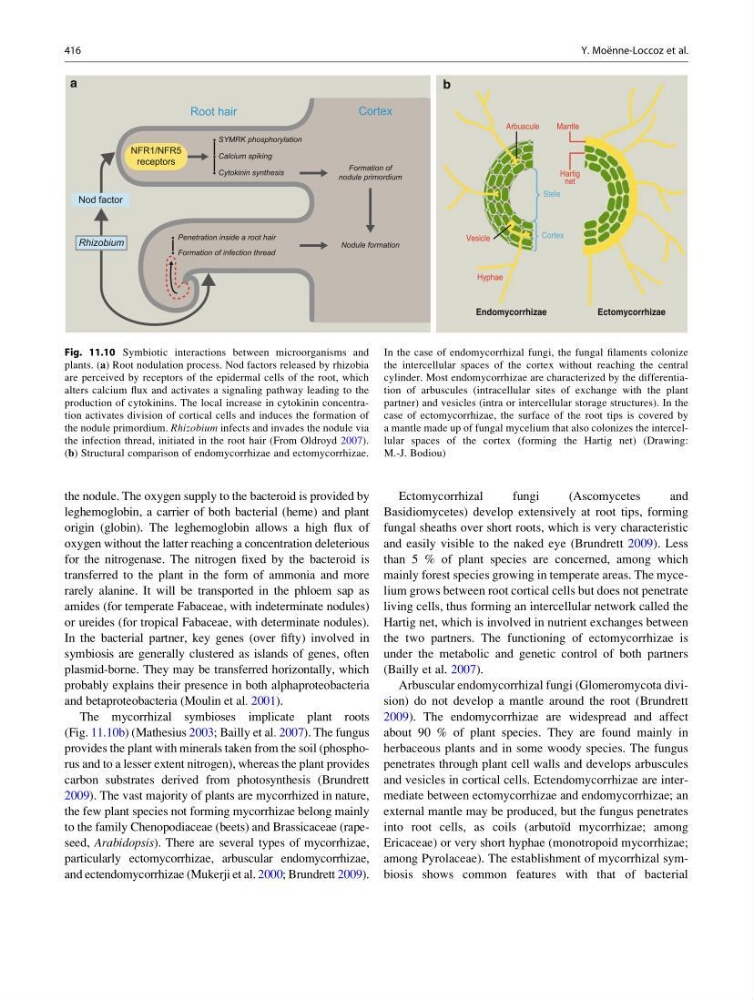
The mycorrhizal symbioses implicate plant roots
(Fig. 11.10b) (Mathesius 2003; Bailly et al. 2007). The fungus
provides the plant with minerals taken from the soil (phosphorus and to a lesser extent nitrogen), whereas the plant provides
carbon substrates derived from photosynthesis (Brundrett
2009). The vast majority of plants are mycorrhized in nature,
the few plant species not forming mycorrhizae belong mainly
to the family Chenopodiaceae (beets) and Brassicaceae (rapeseed, Arabidopsis). There are several types of mycorrhizae,
particularly ectomycorrhizae, arbuscular endomycorrhizae,
and ectendomycorrhizae (Mukerji et al. 2000; Brundrett 2009).
Ectomycorrhizal
fungi
(Ascomycetes
and
Basidiomycetes) develop extensively at root tips, forming
fungal sheaths over short roots, which is very characteristic
and easily visible to the naked eye (Brundrett 2009). Less
than 5 % of plant species are concerned, among which
mainly forest species growing in temperate areas. The mycelium grows between root cortical cells but does not penetrate
living cells, thus forming an intercellular network called the
Hartig net, which is involved in nutrient exchanges between
the two partners. The functioning of ectomycorrhizae is
under the metabolic and genetic control of both partners
(Bailly et al. 2007).
Arbuscular endomycorrhizal fungi (Glomeromycota division) do not develop a mantle around the root (Brundrett
2009). The endomycorrhizae are widespread and affect
about 90 % of plant species. They are found mainly in
herbaceous plants and in some woody species. The fungus
penetrates through plant cell walls and develops arbuscules
and vesicles in cortical cells. Ectendomycorrhizae are intermediate between ectomycorrhizae and endomycorrhizae; an
external mantle may be produced, but the fungus penetrates
into root cells, as coils (arbutoı ¨d mycorrhizae; among
Ericaceae) or very short hyphae (monotropoid mycorrhizae;
among Pyrolaceae). The establishment of mycorrhizal symbiosis shows common features with that of bacterial
Arbuscule
Vesicle
Hyphae
Mantle
Hartig
net
Stele
Cortex
Endomycorrhizae
Ectomycorrhizae
b
Rhizobium
NFR1/NFR5
Récepteurs
Poil absorbant
Facteur Nod
Cortex
Phosphorylation
de SYMRK
Oscillations calciques
Synthèse cytokinines
Pénétration dans le poil absorbant
Formation du cordon d'infection
Formation du
primordium nodulaire
Formation de la nodosité
a
Fig. 11.10 Symbiotic interactions between microorganisms and
plants. (a) Root nodulation process. Nod factors released by rhizobia
are perceived by receptors of the epidermal cells of the root, which
alters calcium flux and activates a signaling pathway leading to the
production of cytokinins. The local increase in cytokinin concentration activates division of cortical cells and induces the formation of
the nodule primordium. Rhizobium infects and invades the nodule via
the infection thread, initiated in the root hair (From Oldroyd 2007).
(b) Structural comparison of endomycorrhizae and ectomycorrhizae.
In the case of endomycorrhizal fungi, the fungal filaments colonize
the intercellular spaces of the cortex without reaching the central
cylinder. Most endomycorrhizae are characterized by the differentiation of arbuscules (intracellular sites of exchange with the plant
partner) and vesicles (intra or intercellular storage structures). In the
case of ectomycorrhizae, the surface of the root tips is covered by
a mantle made up of fungal mycelium that also colonizes the intercellular spaces of the cortex (forming the Hartig net) (Drawing:
M.-J. Bodiou)
416
Y. Moe ¨nne-Loccoz et al.
leghemoglobin, a carrier of both bacterial (heme) and plant
origin (globin). The leghemoglobin allows a high flux of
oxygen without the latter reaching a concentration deleterious
for the nitrogenase. The nitrogen fixed by the bacteroid is
transferred to the plant in the form of ammonia and more
rarely alanine. It will be transported in the phloem sap as
amides (for temperate Fabaceae, with indeterminate nodules)
or ureides (for tropical Fabaceae, with determinate nodules).
In the bacterial partner, key genes (over fifty) involved in
symbiosis are generally clustered as islands of genes, often
plasmid-borne. They may be transferred horizontally, which
probably explains their presence in both alphaproteobacteria
and betaproteobacteria (Moulin et al. 2001).
The mycorrhizal symbioses implicate plant roots
(Fig. 11.10b) (Mathesius 2003; Bailly et al. 2007). The fungus
provides the plant with minerals taken from the soil (phosphorus and to a lesser extent nitrogen), whereas the plant provides
carbon substrates derived from photosynthesis (Brundrett
2009). The vast majority of plants are mycorrhized in nature,
the few plant species not forming mycorrhizae belong mainly
to the family Chenopodiaceae (beets) and Brassicaceae (rapeseed, Arabidopsis). There are several types of mycorrhizae,
particularly ectomycorrhizae, arbuscular endomycorrhizae,
and ectendomycorrhizae (Mukerji et al. 2000; Brundrett 2009).
Ectomycorrhizal
fungi
(Ascomycetes
and
Basidiomycetes) develop extensively at root tips, forming
fungal sheaths over short roots, which is very characteristic
and easily visible to the naked eye (Brundrett 2009). Less
than 5 % of plant species are concerned, among which
mainly forest species growing in temperate areas. The mycelium grows between root cortical cells but does not penetrate
living cells, thus forming an intercellular network called the
Hartig net, which is involved in nutrient exchanges between
the two partners. The functioning of ectomycorrhizae is
under the metabolic and genetic control of both partners
(Bailly et al. 2007).
Arbuscular endomycorrhizal fungi (Glomeromycota division) do not develop a mantle around the root (Brundrett
2009). The endomycorrhizae are widespread and affect
about 90 % of plant species. They are found mainly in
herbaceous plants and in some woody species. The fungus
penetrates through plant cell walls and develops arbuscules
and vesicles in cortical cells. Ectendomycorrhizae are intermediate between ectomycorrhizae and endomycorrhizae; an
external mantle may be produced, but the fungus penetrates
into root cells, as coils (arbutoı ¨d mycorrhizae; among
Ericaceae) or very short hyphae (monotropoid mycorrhizae;
among Pyrolaceae). The establishment of mycorrhizal symbiosis shows common features with that of bacterial
Arbuscule
Vesicle
Hyphae
Mantle
Hartig
net
Stele
Cortex
Endomycorrhizae
Ectomycorrhizae
b
Rhizobium
NFR1/NFR5
Récepteurs
Poil absorbant
Facteur Nod
Cortex
Phosphorylation
de SYMRK
Oscillations calciques
Synthèse cytokinines
Pénétration dans le poil absorbant
Formation du cordon d'infection
Formation du
primordium nodulaire
Formation de la nodosité
a
Fig. 11.10 Symbiotic interactions between microorganisms and
plants. (a) Root nodulation process. Nod factors released by rhizobia
are perceived by receptors of the epidermal cells of the root, which
alters calcium flux and activates a signaling pathway leading to the
production of cytokinins. The local increase in cytokinin concentration activates division of cortical cells and induces the formation of
the nodule primordium. Rhizobium infects and invades the nodule via
the infection thread, initiated in the root hair (From Oldroyd 2007).
(b) Structural comparison of endomycorrhizae and ectomycorrhizae.
In the case of endomycorrhizal fungi, the fungal filaments colonize
the intercellular spaces of the cortex without reaching the central
cylinder. Most endomycorrhizae are characterized by the differentiation of arbuscules (intracellular sites of exchange with the plant
partner) and vesicles (intra or intercellular storage structures). In the
case of ectomycorrhizae, the surface of the root tips is covered by
a mantle made up of fungal mycelium that also colonizes the intercellular spaces of the cortex (forming the Hartig net) (Drawing:
M.-J. Bodiou)
416
Y. Moe ¨nne-Loccoz et al.