

moisture (Liesack et al. 2000). Redox conditions also modulate aerobic transformations including nitrification
(Bohrerova et al. 2004).
Besides microbial transformations, most functions related
to biotic interactions are also stimulated in the presence of
plants. Most of them involve the plant directly, whether they
are favorable (cooperation and symbiosis), unfavorable
(competition, antagonism, and parasitism), or without effect
on the plant (commensalism). Interactions not directly
involving the plant can also be stimulated. These are positive
interactions such as gene transfer (Bjorklof et al. 2000) or
quorum sensing (a mechanism involving signals such as Nacyl homoserine lactones and used to perceive microenvironmental changes; Hense et al. 2007) and negative
interactions such as predation of bacteria by protozoa
(Bonkowski 2004). It also applies to interactions between
microorganisms and soil fauna, for instance, the antagonism
of certain bacteria toward plant-parasitic nematodes (Dabire ´
et al. 2005). Overall, the stimulation of biotic interactions by
the plant often has a positive impact on the latter, except
when phytoparasites are favored.
11.3.5 Biotic Interactions of Microorganisms
Associated with Plants
11.3.5.1 Overview
The plant is exposed to high numbers of microorganisms,
but most of them probably have little effects on the plant if
any. Phytobeneficial microorganisms are much less prevalent comparatively. Cooperating microorganisms predominate over symbiotic ones on plant surfaces or in the
rhizosphere, but this is less significant or even the opposite
within the plant. Plant-parasitic microorganisms are a minority, except sometimes in infected plants, but their impact on
the latter can be high. It is important to note that there is a
continuum of plant–microbe interactions, ranging from
mutualism to parasitism, and that the implementation of
many plant–microbe interactions is highly dependent on
plant genotype, interactions with other members of the
microbial community, and environmental conditions.
11.3.5.2 Parasitism
Plant Parasites
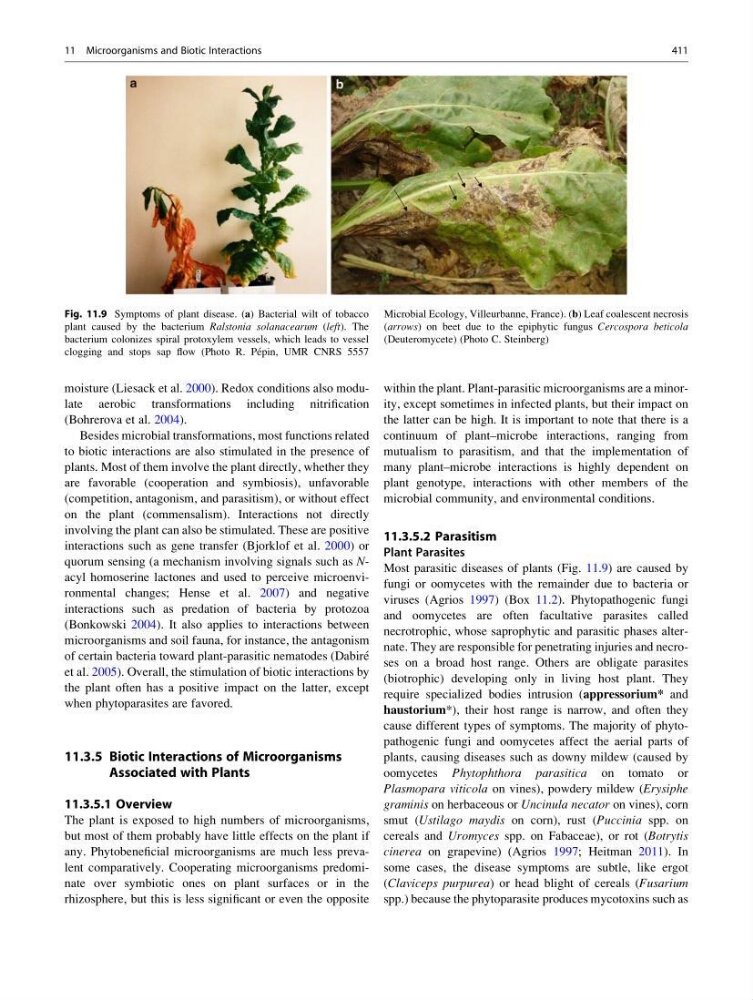
Most parasitic diseases of plants (Fig. 11.9) are caused by
fungi or oomycetes with the remainder due to bacteria or
viruses (Agrios 1997) (Box 11.2). Phytopathogenic fungi
and oomycetes are often facultative parasites called
necrotrophic, whose saprophytic and parasitic phases alternate. They are responsible for penetrating injuries and necroses on a broad host range. Others are obligate parasites
(biotrophic) developing only in living host plant. They
require specialized bodies intrusion (appressorium* and
haustorium*), their host range is narrow, and often they
cause different types of symptoms. The majority of phytopathogenic fungi and oomycetes affect the aerial parts of
plants, causing diseases such as downy mildew (caused by
oomycetes Phytophthora parasitica on tomato or
Plasmopara viticola on vines), powdery mildew (Erysiphe
graminis on herbaceous or Uncinula necator on vines), corn
smut (Ustilago maydis on corn), rust (Puccinia spp. on
cereals and Uromyces spp. on Fabaceae), or rot (Botrytis
cinerea on grapevine) (Agrios 1997; Heitman 2011). In
some cases, the disease symptoms are subtle, like ergot
(Claviceps purpurea) or head blight of cereals (Fusarium
spp.) because the phytoparasite produces mycotoxins such as
Fig. 11.9 Symptoms of plant disease. (a) Bacterial wilt of tobacco
plant caused by the bacterium Ralstonia solanacearum (left). The
bacterium colonizes spiral protoxylem vessels, which leads to vessel
clogging and stops sap flow (Photo R. Pe ´pin, UMR CNRS 5557
Microbial Ecology, Villeurbanne, France). (b) Leaf coalescent necrosis
(arrows) on beet due to the epiphytic fungus Cercospora beticola
(Deuteromycete) (Photo C. Steinberg)
11 Microorganisms and Biotic Interactions
411
(Bohrerova et al. 2004).
Besides microbial transformations, most functions related
to biotic interactions are also stimulated in the presence of
plants. Most of them involve the plant directly, whether they
are favorable (cooperation and symbiosis), unfavorable
(competition, antagonism, and parasitism), or without effect
on the plant (commensalism). Interactions not directly
involving the plant can also be stimulated. These are positive
interactions such as gene transfer (Bjorklof et al. 2000) or
quorum sensing (a mechanism involving signals such as Nacyl homoserine lactones and used to perceive microenvironmental changes; Hense et al. 2007) and negative
interactions such as predation of bacteria by protozoa
(Bonkowski 2004). It also applies to interactions between
microorganisms and soil fauna, for instance, the antagonism
of certain bacteria toward plant-parasitic nematodes (Dabire ´
et al. 2005). Overall, the stimulation of biotic interactions by
the plant often has a positive impact on the latter, except
when phytoparasites are favored.
11.3.5 Biotic Interactions of Microorganisms
Associated with Plants
11.3.5.1 Overview
The plant is exposed to high numbers of microorganisms,
but most of them probably have little effects on the plant if
any. Phytobeneficial microorganisms are much less prevalent comparatively. Cooperating microorganisms predominate over symbiotic ones on plant surfaces or in the
rhizosphere, but this is less significant or even the opposite
within the plant. Plant-parasitic microorganisms are a minority, except sometimes in infected plants, but their impact on
the latter can be high. It is important to note that there is a
continuum of plant–microbe interactions, ranging from
mutualism to parasitism, and that the implementation of
many plant–microbe interactions is highly dependent on
plant genotype, interactions with other members of the
microbial community, and environmental conditions.
11.3.5.2 Parasitism
Plant Parasites
Most parasitic diseases of plants (Fig. 11.9) are caused by
fungi or oomycetes with the remainder due to bacteria or
viruses (Agrios 1997) (Box 11.2). Phytopathogenic fungi
and oomycetes are often facultative parasites called
necrotrophic, whose saprophytic and parasitic phases alternate. They are responsible for penetrating injuries and necroses on a broad host range. Others are obligate parasites
(biotrophic) developing only in living host plant. They
require specialized bodies intrusion (appressorium* and
haustorium*), their host range is narrow, and often they
cause different types of symptoms. The majority of phytopathogenic fungi and oomycetes affect the aerial parts of
plants, causing diseases such as downy mildew (caused by
oomycetes Phytophthora parasitica on tomato or
Plasmopara viticola on vines), powdery mildew (Erysiphe
graminis on herbaceous or Uncinula necator on vines), corn
smut (Ustilago maydis on corn), rust (Puccinia spp. on
cereals and Uromyces spp. on Fabaceae), or rot (Botrytis
cinerea on grapevine) (Agrios 1997; Heitman 2011). In
some cases, the disease symptoms are subtle, like ergot
(Claviceps purpurea) or head blight of cereals (Fusarium
spp.) because the phytoparasite produces mycotoxins such as
Fig. 11.9 Symptoms of plant disease. (a) Bacterial wilt of tobacco
plant caused by the bacterium Ralstonia solanacearum (left). The
bacterium colonizes spiral protoxylem vessels, which leads to vessel
clogging and stops sap flow (Photo R. Pe ´pin, UMR CNRS 5557
Microbial Ecology, Villeurbanne, France). (b) Leaf coalescent necrosis
(arrows) on beet due to the epiphytic fungus Cercospora beticola
(Deuteromycete) (Photo C. Steinberg)
11 Microorganisms and Biotic Interactions
411