

A striking feature of the biosphere, repeatedly stressed
among others by Stephen Jay Gould (Gould 1989), is the
appearance of new body plans, which has not consistently
resulted in the elimination of body plans that had formed
previously. Thus, even though individuals have constantly
disappeared and the species succeeded each other, the
main types of living beings continue to exist to this day,
whether they appeared 3 billion years ago or recently. The
most striking example is provided by prokaryotes, which
have remained ubiquitous and diversified in all areas of
the world, despite the emergence of all kinds of unicellular
or multicellular organisms. The evolution of life has led
to the emergence of multiple interactions between all
levels of organization, the first species to appear also
taking advantage of the emergence of new ones, as
shown, for example, by the colonization of eukaryotes
by prokaryotes.
Interactions are so much the rule that we may even
wonder if, in a given ecosystem – inasmuch as there is
unity of place and time – there are living species not
interacting directly or indirectly with other species. Interaction thus appears as one of the fundamental features
of life, alongside metabolism and reproduction. We
should not be surprised that interactions take many forms
and those involving microorganisms are both diverse and
particularly important for the exchange of matter and
energy.
A fundamental character of interactions of living beings
is that any individual can interact with any other individual.
For example, viruses interact with prokaryotes, unicellular
eukaryotes, or humans; prokaryotes interact with multicellular eukaryotes; individuals of a given species interact with
others of the same species; etc. Even individual cells of the
same multicellular organism interact with other cells of the
same organism, through continuous exchange of electrical
(nerve impulses) or chemical (hormones) signals between
cells that are genetically identical but express different
genes.
Curiously, this universality of interactions is a strong
argument in favor of the unity of life. This concept of
unity, of which Geoffroy Saint-Hilaire was the defender in
the middle of the nineteenth century, is evidenced, for
example, by the construction of proteins from a list determined once and for all of 20 amino acids, by the
similarities of metabolic pathways and biophysical processes, and of course by the universal genetic code. The
ability of a transposon to insert foreign DNA, the ability
for bacteria to invade animal tissues, the ability of Toxoplasma (protozoan) to manipulate the behavior of a rodent,
and the possibility of limitless pairwise interactions are all
further evidence that life probably arose only once, or at
least only the descendants of a particular life form survived (cf. Sect. 2.1). For example, any pathogen and its
host share a common ancestor. The result is that signals
can be exchanged between organisms whose common
ancestor existed billions of years ago, and this might
explain why a pathogen can use and manipulate to his
advantage the biochemical processes of its host. What
has changed throughout evolution is the complexity of
organisms, but not the basis for their functioning or the
nature of the molecular signaling pathways: this could
only facilitate the establishment of multiple interactions
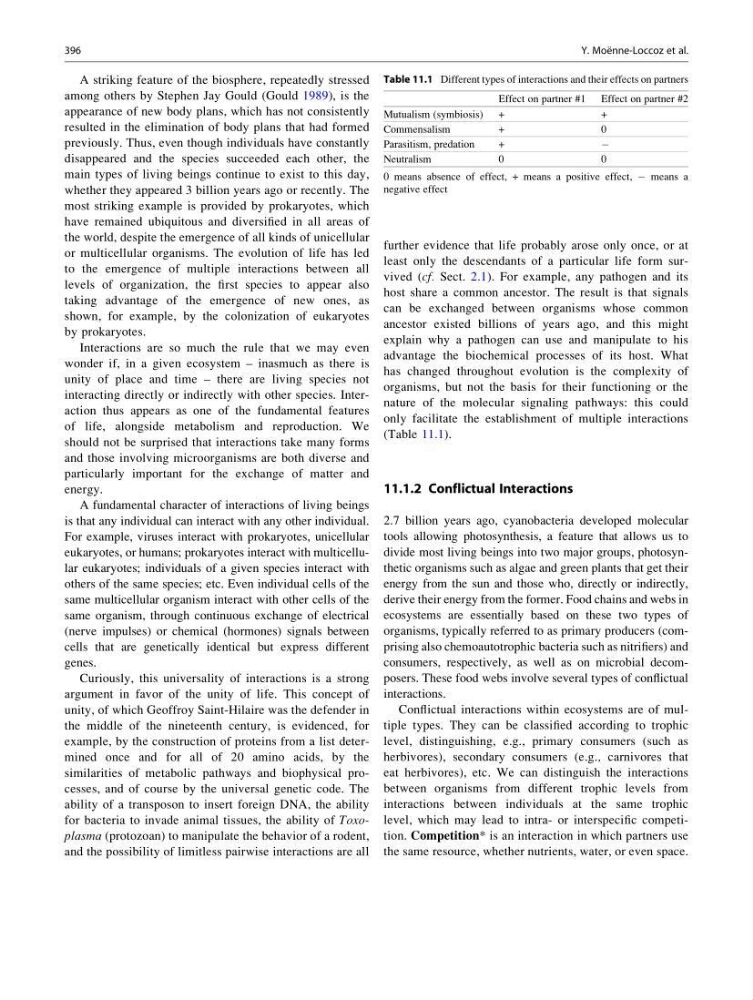
(Table 11.1).
11.1.2 Conflictual Interactions
2.7 billion years ago, cyanobacteria developed molecular
tools allowing photosynthesis, a feature that allows us to
divide most living beings into two major groups, photosynthetic organisms such as algae and green plants that get their
energy from the sun and those who, directly or indirectly,
derive their energy from the former. Food chains and webs in
ecosystems are essentially based on these two types of
organisms, typically referred to as primary producers (comprising also chemoautotrophic bacteria such as nitrifiers) and
consumers, respectively, as well as on microbial decomposers. These food webs involve several types of conflictual
interactions.
Conflictual interactions within ecosystems are of multiple types. They can be classified according to trophic
level, distinguishing, e.g., primary consumers (such as
herbivores), secondary consumers (e.g., carnivores that
eat herbivores), etc. We can distinguish the interactions
between organisms from different trophic levels from
interactions between individuals at the same trophic
level, which may lead to intra- or interspecific competition. Competition* is an interaction in which partners use
the same resource, whether nutrients, water, or even space.
Table 11.1 Different types of interactions and their effects on partners
Effect on partner #1 Effect on partner #2
Mutualism (symbiosis) +
+
Commensalism
+
0
Parasitism, predation
+
À
Neutralism
0
0
0 means absence of effect, + means a positive effect, À means a
negative effect
396
Y. Moe ¨nne-Loccoz et al.
among others by Stephen Jay Gould (Gould 1989), is the
appearance of new body plans, which has not consistently
resulted in the elimination of body plans that had formed
previously. Thus, even though individuals have constantly
disappeared and the species succeeded each other, the
main types of living beings continue to exist to this day,
whether they appeared 3 billion years ago or recently. The
most striking example is provided by prokaryotes, which
have remained ubiquitous and diversified in all areas of
the world, despite the emergence of all kinds of unicellular
or multicellular organisms. The evolution of life has led
to the emergence of multiple interactions between all
levels of organization, the first species to appear also
taking advantage of the emergence of new ones, as
shown, for example, by the colonization of eukaryotes
by prokaryotes.
Interactions are so much the rule that we may even
wonder if, in a given ecosystem – inasmuch as there is
unity of place and time – there are living species not
interacting directly or indirectly with other species. Interaction thus appears as one of the fundamental features
of life, alongside metabolism and reproduction. We
should not be surprised that interactions take many forms
and those involving microorganisms are both diverse and
particularly important for the exchange of matter and
energy.
A fundamental character of interactions of living beings
is that any individual can interact with any other individual.
For example, viruses interact with prokaryotes, unicellular
eukaryotes, or humans; prokaryotes interact with multicellular eukaryotes; individuals of a given species interact with
others of the same species; etc. Even individual cells of the
same multicellular organism interact with other cells of the
same organism, through continuous exchange of electrical
(nerve impulses) or chemical (hormones) signals between
cells that are genetically identical but express different
genes.
Curiously, this universality of interactions is a strong
argument in favor of the unity of life. This concept of
unity, of which Geoffroy Saint-Hilaire was the defender in
the middle of the nineteenth century, is evidenced, for
example, by the construction of proteins from a list determined once and for all of 20 amino acids, by the
similarities of metabolic pathways and biophysical processes, and of course by the universal genetic code. The
ability of a transposon to insert foreign DNA, the ability
for bacteria to invade animal tissues, the ability of Toxoplasma (protozoan) to manipulate the behavior of a rodent,
and the possibility of limitless pairwise interactions are all
further evidence that life probably arose only once, or at
least only the descendants of a particular life form survived (cf. Sect. 2.1). For example, any pathogen and its
host share a common ancestor. The result is that signals
can be exchanged between organisms whose common
ancestor existed billions of years ago, and this might
explain why a pathogen can use and manipulate to his
advantage the biochemical processes of its host. What
has changed throughout evolution is the complexity of
organisms, but not the basis for their functioning or the
nature of the molecular signaling pathways: this could
only facilitate the establishment of multiple interactions
(Table 11.1).
11.1.2 Conflictual Interactions
2.7 billion years ago, cyanobacteria developed molecular
tools allowing photosynthesis, a feature that allows us to
divide most living beings into two major groups, photosynthetic organisms such as algae and green plants that get their
energy from the sun and those who, directly or indirectly,
derive their energy from the former. Food chains and webs in
ecosystems are essentially based on these two types of
organisms, typically referred to as primary producers (comprising also chemoautotrophic bacteria such as nitrifiers) and
consumers, respectively, as well as on microbial decomposers. These food webs involve several types of conflictual
interactions.
Conflictual interactions within ecosystems are of multiple types. They can be classified according to trophic
level, distinguishing, e.g., primary consumers (such as
herbivores), secondary consumers (e.g., carnivores that
eat herbivores), etc. We can distinguish the interactions
between organisms from different trophic levels from
interactions between individuals at the same trophic
level, which may lead to intra- or interspecific competition. Competition* is an interaction in which partners use
the same resource, whether nutrients, water, or even space.
Table 11.1 Different types of interactions and their effects on partners
Effect on partner #1 Effect on partner #2
Mutualism (symbiosis) +
+
Commensalism
+
0
Parasitism, predation
+
À
Neutralism
0
0
0 means absence of effect, + means a positive effect, À means a
negative effect
396
Y. Moe ¨nne-Loccoz et al.