

result in the release of OH
À , and subsequent generation of
alkaline conditions. OH
À together with Mg
+ ions precipitates
to serpentine and lime (Ca(OH) 2 ). The pH of such waters can
reach values higher than 11. Some preliminary studies of
these sources report low bacterial populations whose composition is similar to that of soils and less alkaline waters (Grant
and Sorokin 2011).
Termites harbor a variety of microorganisms in different
compartments of their gut. The first compartment of the
termite gut has an elevated pH, between 10 and 12, and is
very rich in K
+ ions. However, most of alkaliphilic bacteria
isolated from the gut of termites are alkalitolerant.
Microorganisms developing in alkaline pH are also frequently
isolated from soils. Soil microbial processes, especially
ammonification, can cause localized soil alkalinization. It is
recognized that the metabolism of some alkaliphilic bacteria
can locally modify the pH, thus creating alkaline microniches.
In other cases, it is the metabolic activity of other
microorganisms which raises the pH sufficiently high to
allow the development of alkaliphiles. Most of isolated
alkaliphilic bacteria from such non-alkaline environments
are Gram-positive, spore-forming bacteria belonging to the
genus Bacillus. Nonspore-forming alkalitolerant bacteria
belong to genera Aeromonas, Corynebacterium, Micrococcus, Paracoccus, Pseudomonas, and Streptomyces.
Finally, there are anthropogenic alkaline environments.
They are associated with the use of alkaline products (e.g.,
sodium hydroxyde) in various industrial processes
(electroplating, food and paper industries) or derived from
the production of lime or from calcium hydroxide (cement,
blast furnace). The few studies conducted in microbiology
indicate that these environments are inhabited by
alkalitolerant and alkaliphilic bacteria similar to those
isolated from non-alkaline environments.
10.7.3 Microbial Diversity of Soda Lakes
Despite the extreme conditions existing in such environments,
the different trophic groups composing the microflora are
similar to those composing the microbial communities
already reported in traditional environments, except that all
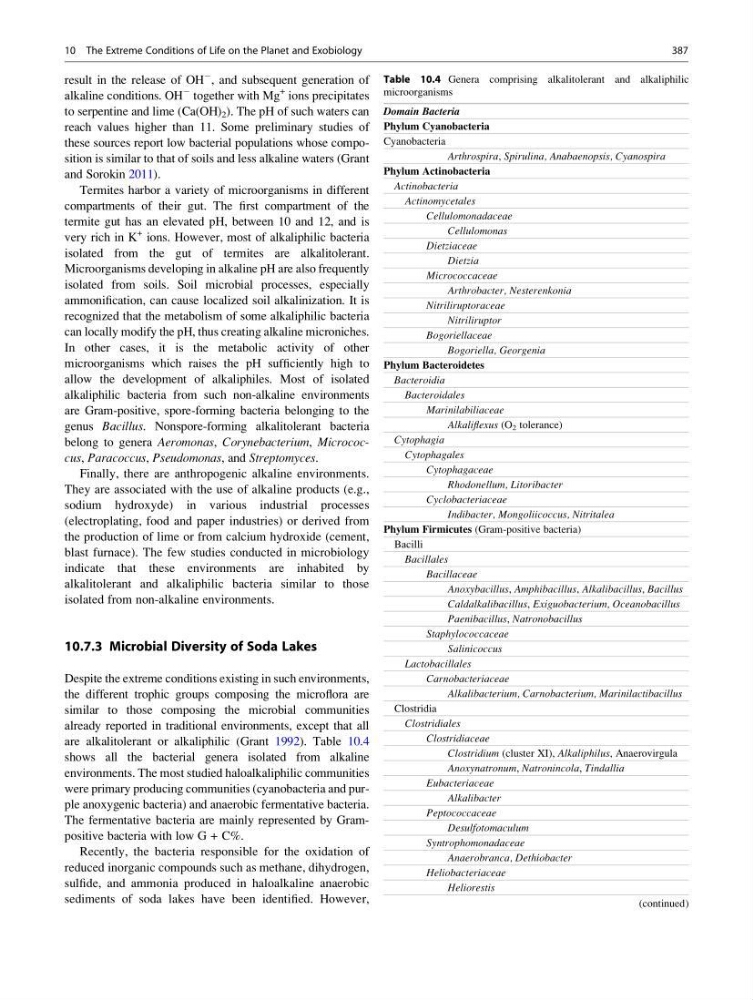
are alkalitolerant or alkaliphilic (Grant 1992). Table 10.4
shows all the bacterial genera isolated from alkaline
environments. The most studied haloalkaliphilic communities
were primary producing communities (cyanobacteria and purple anoxygenic bacteria) and anaerobic fermentative bacteria.
The fermentative bacteria are mainly represented by Grampositive bacteria with low G + C%.
Recently, the bacteria responsible for the oxidation of
reduced inorganic compounds such as methane, dihydrogen,
sulfide, and ammonia produced in haloalkaline anaerobic
sediments of soda lakes have been identified. However,
Table 10.4 Genera comprising alkalitolerant and alkaliphilic
microorganisms
Domain Bacteria
Phylum Cyanobacteria
Cyanobacteria
Arthrospira, Spirulina, Anabaenopsis, Cyanospira
Phylum Actinobacteria
Actinobacteria
Actinomycetales
Cellulomonadaceae
Cellulomonas
Dietziaceae
Dietzia
Micrococcaceae
Arthrobacter, Nesterenkonia
Nitriliruptoraceae
Nitriliruptor
Bogoriellaceae
Bogoriella, Georgenia
Phylum Bacteroidetes
Bacteroidia
Bacteroidales
Marinilabiliaceae
Alkaliflexus (O 2 tolerance)
Cytophagia
Cytophagales
Cytophagaceae
Rhodonellum, Litoribacter
Cyclobacteriaceae
Indibacter, Mongoliicoccus, Nitritalea
Phylum Firmicutes (Gram-positive bacteria)
Bacilli
Bacillales
Bacillaceae
Anoxybacillus, Amphibacillus, Alkalibacillus, Bacillus
Caldalkalibacillus, Exiguobacterium, Oceanobacillus
Paenibacillus, Natronobacillus
Staphylococcaceae
Salinicoccus
Lactobacillales
Carnobacteriaceae
Alkalibacterium, Carnobacterium, Marinilactibacillus
Clostridia
Clostridiales
Clostridiaceae
Clostridium (cluster XI), Alkaliphilus, Anaerovirgula
Anoxynatronum, Natronincola, Tindallia
Eubacteriaceae
Alkalibacter
Peptococcaceae
Desulfotomaculum
Syntrophomonadaceae
Anaerobranca, Dethiobacter
Heliobacteriaceae
Heliorestis
(continued)
10 The Extreme Conditions of Life on the Planet and Exobiology
387
À , and subsequent generation of
alkaline conditions. OH
À together with Mg
+ ions precipitates
to serpentine and lime (Ca(OH) 2 ). The pH of such waters can
reach values higher than 11. Some preliminary studies of
these sources report low bacterial populations whose composition is similar to that of soils and less alkaline waters (Grant
and Sorokin 2011).
Termites harbor a variety of microorganisms in different
compartments of their gut. The first compartment of the
termite gut has an elevated pH, between 10 and 12, and is
very rich in K
+ ions. However, most of alkaliphilic bacteria
isolated from the gut of termites are alkalitolerant.
Microorganisms developing in alkaline pH are also frequently
isolated from soils. Soil microbial processes, especially
ammonification, can cause localized soil alkalinization. It is
recognized that the metabolism of some alkaliphilic bacteria
can locally modify the pH, thus creating alkaline microniches.
In other cases, it is the metabolic activity of other
microorganisms which raises the pH sufficiently high to
allow the development of alkaliphiles. Most of isolated
alkaliphilic bacteria from such non-alkaline environments
are Gram-positive, spore-forming bacteria belonging to the
genus Bacillus. Nonspore-forming alkalitolerant bacteria
belong to genera Aeromonas, Corynebacterium, Micrococcus, Paracoccus, Pseudomonas, and Streptomyces.
Finally, there are anthropogenic alkaline environments.
They are associated with the use of alkaline products (e.g.,
sodium hydroxyde) in various industrial processes
(electroplating, food and paper industries) or derived from
the production of lime or from calcium hydroxide (cement,
blast furnace). The few studies conducted in microbiology
indicate that these environments are inhabited by
alkalitolerant and alkaliphilic bacteria similar to those
isolated from non-alkaline environments.
10.7.3 Microbial Diversity of Soda Lakes
Despite the extreme conditions existing in such environments,
the different trophic groups composing the microflora are
similar to those composing the microbial communities
already reported in traditional environments, except that all
are alkalitolerant or alkaliphilic (Grant 1992). Table 10.4
shows all the bacterial genera isolated from alkaline
environments. The most studied haloalkaliphilic communities
were primary producing communities (cyanobacteria and purple anoxygenic bacteria) and anaerobic fermentative bacteria.
The fermentative bacteria are mainly represented by Grampositive bacteria with low G + C%.
Recently, the bacteria responsible for the oxidation of
reduced inorganic compounds such as methane, dihydrogen,
sulfide, and ammonia produced in haloalkaline anaerobic
sediments of soda lakes have been identified. However,
Table 10.4 Genera comprising alkalitolerant and alkaliphilic
microorganisms
Domain Bacteria
Phylum Cyanobacteria
Cyanobacteria
Arthrospira, Spirulina, Anabaenopsis, Cyanospira
Phylum Actinobacteria
Actinobacteria
Actinomycetales
Cellulomonadaceae
Cellulomonas
Dietziaceae
Dietzia
Micrococcaceae
Arthrobacter, Nesterenkonia
Nitriliruptoraceae
Nitriliruptor
Bogoriellaceae
Bogoriella, Georgenia
Phylum Bacteroidetes
Bacteroidia
Bacteroidales
Marinilabiliaceae
Alkaliflexus (O 2 tolerance)
Cytophagia
Cytophagales
Cytophagaceae
Rhodonellum, Litoribacter
Cyclobacteriaceae
Indibacter, Mongoliicoccus, Nitritalea
Phylum Firmicutes (Gram-positive bacteria)
Bacilli
Bacillales
Bacillaceae
Anoxybacillus, Amphibacillus, Alkalibacillus, Bacillus
Caldalkalibacillus, Exiguobacterium, Oceanobacillus
Paenibacillus, Natronobacillus
Staphylococcaceae
Salinicoccus
Lactobacillales
Carnobacteriaceae
Alkalibacterium, Carnobacterium, Marinilactibacillus
Clostridia
Clostridiales
Clostridiaceae
Clostridium (cluster XI), Alkaliphilus, Anaerovirgula
Anoxynatronum, Natronincola, Tindallia
Eubacteriaceae
Alkalibacter
Peptococcaceae
Desulfotomaculum
Syntrophomonadaceae
Anaerobranca, Dethiobacter
Heliobacteriaceae
Heliorestis
(continued)
10 The Extreme Conditions of Life on the Planet and Exobiology
387