

Some sulfate-reducing activity has been detected associated
to sediments in certain parts of the river.
Considering the geomicrobiological characteristics of the
Tinto ecosystem, we postulate that the river is predominantly under the control of iron (Gonza ´lez-Toril et al.
2003). Iron is the main product of bioleaching of pyrite
and other iron-bearing sulfidic mineral, like chalcopyrite,
both of which are present in high concentrations in the
Iberian Pyritic Belt. The activity of iron-oxidizing
prokaryotes is responsible for both the solubilization of
sulfidic minerals and the correspondent high concentration
of ferric iron, sulfate, and protons in the water column.
Ferric iron is a strong oxidant able to oxidize exposed
sulfidic minerals.
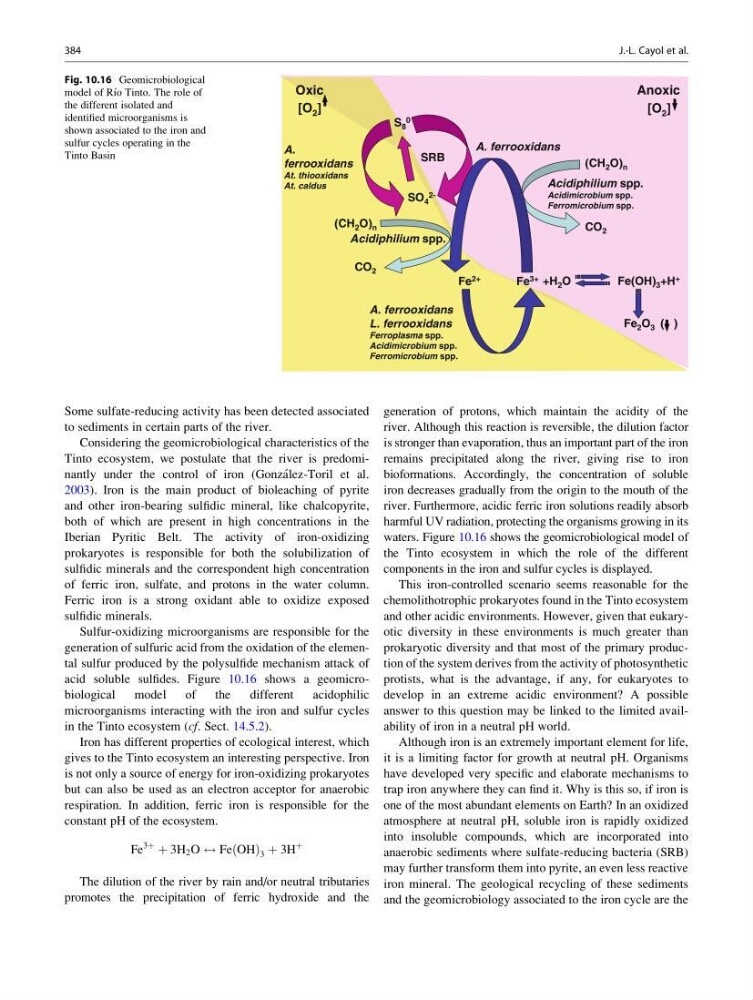
Sulfur-oxidizing microorganisms are responsible for the
generation of sulfuric acid from the oxidation of the elemental sulfur produced by the polysulfide mechanism attack of
acid soluble sulfides. Figure 10.16 shows a geomicrobiological
model
of
the
different
acidophilic
microorganisms interacting with the iron and sulfur cycles
in the Tinto ecosystem (cf. Sect. 14.5.2).
Iron has different properties of ecological interest, which
gives to the Tinto ecosystem an interesting perspective. Iron
is not only a source of energy for iron-oxidizing prokaryotes
but can also be used as an electron acceptor for anaerobic
respiration. In addition, ferric iron is responsible for the
constant pH of the ecosystem.
Fe
3þ
þ 3H 2 O $ Fe OH
ð Þ 3 þ 3H
þ
The dilution of the river by rain and/or neutral tributaries
promotes the precipitation of ferric hydroxide and the
generation of protons, which maintain the acidity of the
river. Although this reaction is reversible, the dilution factor
is stronger than evaporation, thus an important part of the iron
remains precipitated along the river, giving rise to iron
bioformations. Accordingly, the concentration of soluble
iron decreases gradually from the origin to the mouth of the
river. Furthermore, acidic ferric iron solutions readily absorb
harmful UV radiation, protecting the organisms growing in its
waters. Figure 10.16 shows the geomicrobiological model of
the Tinto ecosystem in which the role of the different
components in the iron and sulfur cycles is displayed.
This iron-controlled scenario seems reasonable for the
chemolithotrophic prokaryotes found in the Tinto ecosystem
and other acidic environments. However, given that eukaryotic diversity in these environments is much greater than
prokaryotic diversity and that most of the primary production of the system derives from the activity of photosynthetic
protists, what is the advantage, if any, for eukaryotes to
develop in an extreme acidic environment? A possible
answer to this question may be linked to the limited availability of iron in a neutral pH world.
Although iron is an extremely important element for life,
it is a limiting factor for growth at neutral pH. Organisms
have developed very specific and elaborate mechanisms to
trap iron anywhere they can find it. Why is this so, if iron is
one of the most abundant elements on Earth? In an oxidized
atmosphere at neutral pH, soluble iron is rapidly oxidized
into insoluble compounds, which are incorporated into
anaerobic sediments where sulfate-reducing bacteria (SRB)
may further transform them into pyrite, an even less reactive
iron mineral. The geological recycling of these sediments
and the geomicrobiology associated to the iron cycle are the
+H 2 O
Fe(OH) 3 +H +
Fe 2 O 3 ( )
SRB
A.
ferrooxidans
At. thiooxidans
At. caldus
CO 2
(CH 2 O) n
Acidiphilium spp.
Acidimicrobium spp.
Ferromicrobium spp.
S 8
0
SO 4
2A. ferrooxidans
Acidiphilium spp.
(CH 2 O) n
CO 2
Anoxic
[O 2 ]
[O 2 ]
Oxic
Fe 2+
A. ferrooxidans
L. ferrooxidans
Ferroplasma spp.
Acidimicrobium spp.
Ferromicrobium spp.
Fe 3+
Fig. 10.16 Geomicrobiological
model of Rı ´o Tinto. The role of
the different isolated and
identified microorganisms is
shown associated to the iron and
sulfur cycles operating in the
Tinto Basin
384
J.-L. Cayol et al.
to sediments in certain parts of the river.
Considering the geomicrobiological characteristics of the
Tinto ecosystem, we postulate that the river is predominantly under the control of iron (Gonza ´lez-Toril et al.
2003). Iron is the main product of bioleaching of pyrite
and other iron-bearing sulfidic mineral, like chalcopyrite,
both of which are present in high concentrations in the
Iberian Pyritic Belt. The activity of iron-oxidizing
prokaryotes is responsible for both the solubilization of
sulfidic minerals and the correspondent high concentration
of ferric iron, sulfate, and protons in the water column.
Ferric iron is a strong oxidant able to oxidize exposed
sulfidic minerals.
Sulfur-oxidizing microorganisms are responsible for the
generation of sulfuric acid from the oxidation of the elemental sulfur produced by the polysulfide mechanism attack of
acid soluble sulfides. Figure 10.16 shows a geomicrobiological
model
of
the
different
acidophilic
microorganisms interacting with the iron and sulfur cycles
in the Tinto ecosystem (cf. Sect. 14.5.2).
Iron has different properties of ecological interest, which
gives to the Tinto ecosystem an interesting perspective. Iron
is not only a source of energy for iron-oxidizing prokaryotes
but can also be used as an electron acceptor for anaerobic
respiration. In addition, ferric iron is responsible for the
constant pH of the ecosystem.
Fe
3þ
þ 3H 2 O $ Fe OH
ð Þ 3 þ 3H
þ
The dilution of the river by rain and/or neutral tributaries
promotes the precipitation of ferric hydroxide and the
generation of protons, which maintain the acidity of the
river. Although this reaction is reversible, the dilution factor
is stronger than evaporation, thus an important part of the iron
remains precipitated along the river, giving rise to iron
bioformations. Accordingly, the concentration of soluble
iron decreases gradually from the origin to the mouth of the
river. Furthermore, acidic ferric iron solutions readily absorb
harmful UV radiation, protecting the organisms growing in its
waters. Figure 10.16 shows the geomicrobiological model of
the Tinto ecosystem in which the role of the different
components in the iron and sulfur cycles is displayed.
This iron-controlled scenario seems reasonable for the
chemolithotrophic prokaryotes found in the Tinto ecosystem
and other acidic environments. However, given that eukaryotic diversity in these environments is much greater than
prokaryotic diversity and that most of the primary production of the system derives from the activity of photosynthetic
protists, what is the advantage, if any, for eukaryotes to
develop in an extreme acidic environment? A possible
answer to this question may be linked to the limited availability of iron in a neutral pH world.
Although iron is an extremely important element for life,
it is a limiting factor for growth at neutral pH. Organisms
have developed very specific and elaborate mechanisms to
trap iron anywhere they can find it. Why is this so, if iron is
one of the most abundant elements on Earth? In an oxidized
atmosphere at neutral pH, soluble iron is rapidly oxidized
into insoluble compounds, which are incorporated into
anaerobic sediments where sulfate-reducing bacteria (SRB)
may further transform them into pyrite, an even less reactive
iron mineral. The geological recycling of these sediments
and the geomicrobiology associated to the iron cycle are the
+H 2 O
Fe(OH) 3 +H +
Fe 2 O 3 ( )
SRB
A.
ferrooxidans
At. thiooxidans
At. caldus
CO 2
(CH 2 O) n
Acidiphilium spp.
Acidimicrobium spp.
Ferromicrobium spp.
S 8
0
SO 4
2A. ferrooxidans
Acidiphilium spp.
(CH 2 O) n
CO 2
Anoxic
[O 2 ]
[O 2 ]
Oxic
Fe 2+
A. ferrooxidans
L. ferrooxidans
Ferroplasma spp.
Acidimicrobium spp.
Ferromicrobium spp.
Fe 3+
Fig. 10.16 Geomicrobiological
model of Rı ´o Tinto. The role of
the different isolated and
identified microorganisms is
shown associated to the iron and
sulfur cycles operating in the
Tinto Basin
384
J.-L. Cayol et al.